
Trademark Warning Letters (Part 2): How to Limit the Damage When Infringement Is Likely
Junhyek Lee, Patent Attorney, Unic Patent Firm · 2025.07.04
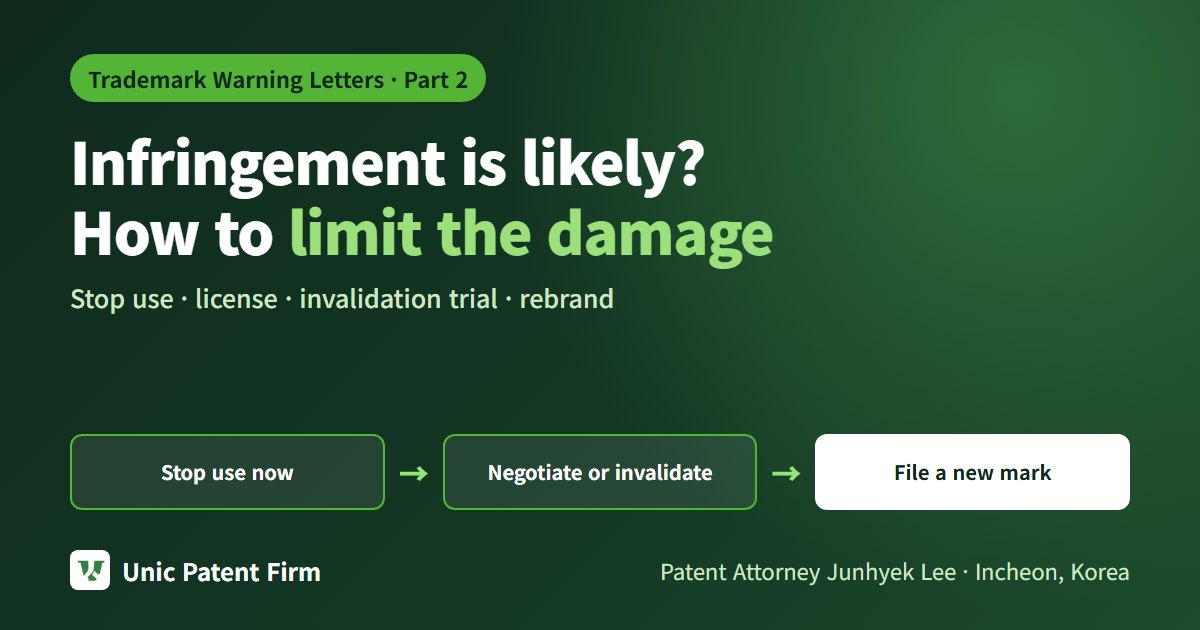
People often come to us after receiving a trademark infringement warning letter from a legal representative or trademark owner. These letters usually include the registered mark, records of your use (screenshots of your website or product photos), and a demand to stop using the mark, reply and pay damages within 7 to 14 days.
In Part 1 we covered cases where infringement is not established, such as dissimilar marks or goods, prior use rights and legitimate use of one's own name. In this Part 2, Unic Patent Firm in Cheongna, Incheon, explains how to respond when infringement is actually likely. In that case you need a strategic and prompt response that avoids legal disputes, minimizes losses and keeps your business stable.
1. When Is Infringement Likely?
Infringement is likely if all three of the following apply:
- The marks are similar,
- The mark is used on goods identical or similar to the designated goods, and
- It is trademark use (use to indicate source) — even a trade name counts if it is displayed prominently on the website or product front so that it is perceived as a trademark.
2. Basic Response When Infringement Is Likely
2.1. Acknowledge it and stop using the mark immediately
- If infringement is clear, stopping immediately helps minimize losses.
- Remove the identical or similar mark from websites, packaging, signage and marketing materials.
- Also consider how to handle remaining inventory.
2.2. Prepare and file a new mark
Rebrand, and be sure to file and register the new mark so the same problem does not recur.
3. If You Need to Keep Using the Current Mark
3.1. Settlement or license agreement
- You can negotiate with the owner for permission to use the mark for a period or a license fee.
- Draft an agreement covering conditions of use, term and territorial limits.
- Always make it a written contract; verbal promises are hard to prove later.
3.2. Trademark invalidation trial
Check whether the owner's registered mark has grounds for invalidation and, if so, request an invalidation trial. Assess the likelihood of success before filing.
| Ground for invalidation | Main content |
|---|---|
| The applicant had no intention to use the mark | Clearly filed only to register |
| Identical or similar to another's prior-used mark | May amount to unfair competition |
| Contrary to public order or morals | Obscene, discriminatory or otherwise against social norms |
| Consists only of generic or descriptive terms | No distinctiveness (e.g., "smartphone," "strawberry milk") |
| Imitates another's famous mark | Free-riding or risk of consumer confusion |
3.3. Non-use cancellation trial
If the owner has not used the mark on the designated goods for three years or more before the filing date, a cancellation trial can be requested. However, an owner who sends warning letters is likely using the mark, so cancellation is unlikely. How the three years are counted is explained in How to Count the Three Years in a Non-Use Cancellation Trial.
3.4. Negotiating damages for past use
Damages may be claimed for products already sold and the period of use. Negotiate a settlement based on the degree and duration of infringement, with expert help to keep it from becoming excessive.
4. Summary
| Item | Response |
|---|---|
| If infringement is likely | Stop use, negotiate, rebrand |
| Key points | No emotional reactions; written agreements and expert advice are essential |
| Ultimate goal | Minimize losses without legal disputes + secure brand stability |
Conclusion: A Warning Letter Is Not the End
Even when infringement is likely, responding correctly at the outset lets you continue your business safely without unnecessary litigation. For the first step — deciding whether you used the sign as a trademark — see also a case where there was no trademark use and therefore no infringement.
If you have received a trademark infringement warning letter, Patent Attorney Junhyek Lee of Unic Patent Firm in Cheongna, Incheon, will directly review whether there is infringement and how to respond.
Does this apply to your business?
The answer depends on your product, filing schedule and contracts. Talk to a patent attorney directly.
This article is for general information only. Specific cases may be assessed differently depending on the facts. It is based on Korean law as of the publication date.