
Can You Copy an Old Product With No Patent or Design Right? Korea's Unfair Competition Rules on Product Shapes
Junhyek Lee, Patent Attorney, Unic Patent Firm · 2026.09.04
Unic Patent Firm in Cheongna, Incheon, often receives questions like this: "Company A has been selling a product for about ten years. It is not currently protected by a patent or design right. Can we make and sell a product with the same or a similar shape?"
The person asking planned to differentiate their product from Company A's as follows:
- Use a different company name and trade name
- Choose a different product name
- Use completely different packaging
In this situation, can you conclude that there is no legal problem simply because there is no patent or design right?
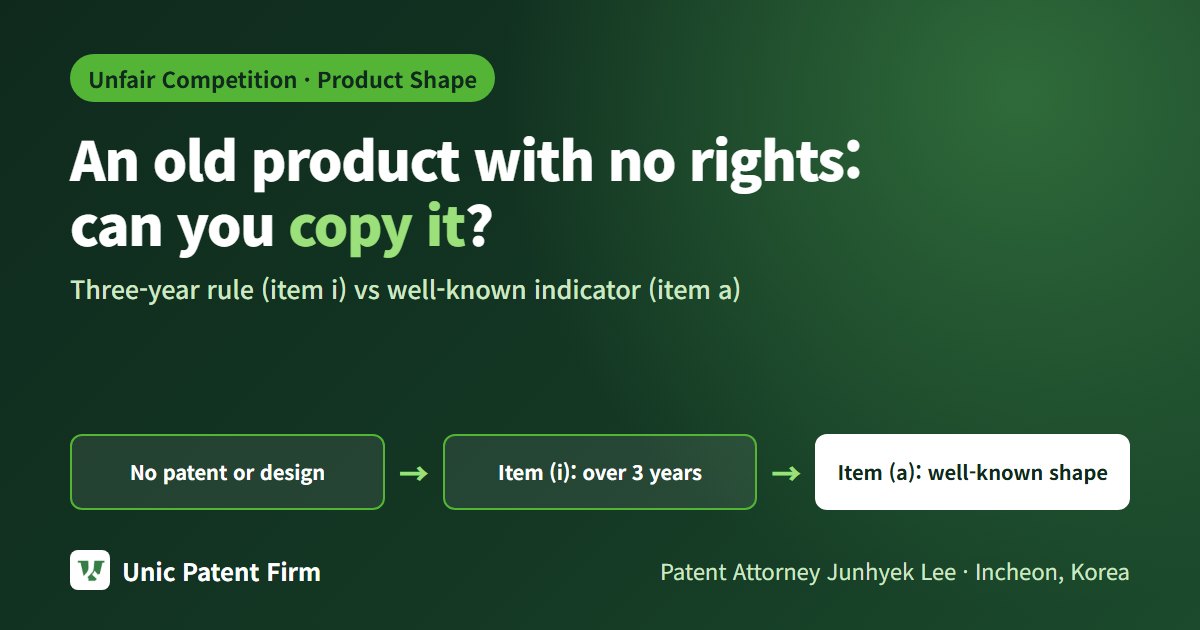
In short, the shape of a product that is not protected by a patent or design right can in principle be copied. However, Korea's Unfair Competition Prevention and Trade Secret Protection Act (the "Unfair Competition Prevention Act") protects the shape of products itself in certain cases, so two provisions must be reviewed separately before you start selling.
| Provision | What it protects |
|---|---|
| Article 2(1)(i) of the Act | The act of directly copying a product's shape |
| Article 2(1)(a) of the Act | A product shape that, after long sales, has become an indication that the product comes from a particular company |
1. Without a Patent or Design Right, Copying Is Allowed in Principle
The Korean Supreme Court takes the following basic position on product shapes (Supreme Court Decision 2010Do8383, February 9, 2012).
Unless the shape of a product is protected by a design right, patent right or the like, it is in principle permissible to copy and manufacture it.
Industrial property rights such as patents and design rights grant exclusivity for a set period, and in return, where no such right exists or the protection period has ended, free competition is allowed in principle.
So even if Company A has sold the product for ten years, without a currently valid patent or design right it cannot monopolize the product shape forever just because it made it first. There are, however, important exceptions under the Unfair Competition Prevention Act.
2. Exception 1, Item (i): Copying a Product Shape Is Protected for Three Years
Article 2(1)(i) of the Unfair Competition Prevention Act treats the following as an act of unfair competition:
Transferring, lending, displaying for those purposes, importing or exporting goods that copy the shape (form, pattern, color, gloss or a combination of these) of goods made by another person. However, this excludes copying the shape of goods more than three years after the date the shape was established, such as by making a prototype, and copying a shape that goods of the same kind ordinarily have.
In other words, even without a design registration, a business that develops a new product is protected against direct copying of its shape for a certain period from when the shape was established. That protection is limited to three years, and shapes ordinarily found in goods of the same kind are not protected at all.
If, as in the question, Company A's product shape was established and sales began about ten years ago, the protection period under item (i) can be regarded as having already expired, absent special circumstances.
3. Exception 2, Item (a): When the Product Shape Itself Becomes a "Source Indicator"
3.1. Item (a) normally protects names, trademarks and packaging
Article 2(1)(a) of the Act treats the following as an act of unfair competition:
Without justifiable reason, using a mark identical or similar to another person's name, trade name, trademark, container or packaging of goods, or any other indication of another person's goods that is widely known in Korea, or selling, distributing, importing or exporting goods bearing such a mark, thereby causing confusion with another person's goods.
On the wording alone, the ordinary shape or structure of a product is not automatically protected. For example, a general shape that serves a product's function, such as the shape of a straw or the structure of a degassing module, is in principle hard to regard as a "source indicator" in itself.
3.2. Exceptionally, a product shape can become a source indicator
However, if a product shape has been used for a long time and has gone beyond mere appearance to acquire a function of indicating that the goods come from a particular company, and has further become widely known in Korea, the shape itself can be protected under item (a) as "any other indication of another person's goods." The Supreme Court requires the product shape to:
- Have distinctive design features compared with similar products;
- Allow ordinary consumers to recognize a particular company's goods from the shape alone;
- Have been used continuously, exclusively and for a long time, or backed by strong advertising and promotion; and
- As a result, have become markedly individualized enough to call to mind goods from a particular source.
So item (a) does not apply just because the structure or shape is the same or similar. For functional products and industrial parts in particular, if the shape is merely an ordinary structure for a technical function and consumers do not see the shape as indicating the source, item (a) is relatively unlikely to apply.
4. Applying This to the Question
| Situation | Likely assessment |
|---|---|
| No patent or design right, and more than ten years since the shape was established | Hard in principle to regulate as copying a product shape under item (i) |
| Sold continuously and exclusively for a long time with active advertising, so the shape itself signals Company A's product | Separate protection under item (a) may be possible |
| A shape common in the industry, not used exclusively by Company A, and consumers do not recognize Company A from the shape | Protection under item (a) becomes less likely |
Conclusion: Don't Stop at "No Rights" — Review Items (i) and (a) Separately
An old product with no patent or design right can in principle be copied. But the Unfair Competition Prevention Act separately protects copying within three years (item (i)) and shapes that have become widely known source indicators (item (a)), so both must be checked before you sell.
The key questions are how distinctive Company A's product shape is, how long and how exclusively it has been sold, and whether consumers recognize Company A from the shape alone. If you are about to launch a similar product, Patent Attorney Junhyek Lee of Unic Patent Firm in Cheongna, Incheon, will review your product and market situation directly.
Does this apply to your business?
The answer depends on your product, filing schedule and contracts. Talk to a patent attorney directly.
This article is for general information only. Specific cases may be assessed differently depending on the facts. It is based on Korean law as of the publication date.