
Non-Entitled Applications (Part 2): When Is a Slightly Different Claim Still the Same Invention?
Junhyek Lee, Patent Attorney, Unic Patent Firm · 2026.08.27
In Part 1 we looked at who the rightful owner is when a former employee or a third party files an invention developed at a company. But even if the company is the rightful owner, the former employee's patent cannot be called a non-entitled application if it is a completely different invention.
So before a non-entitled application can be established, one must first decide whether the rightful owner's invention and the patented invention in question share the same or substantially the same technical idea. In this Part 2, we focus on Korean Supreme Court case law to explain how "identity of invention" is judged, the most important issue in non-entitled application cases.
1. A Non-Entitled Application Presupposes "the Same Invention"
Suppose the company developed technology A, and a former employee later filed a patent for B. The fact that A and B are in the same technical field or address similar problems does not by itself make it a non-entitled application.
A company claiming a non-entitled application must go through two steps:
- "What invention did the rightful owner complete first?" — it must show that it had created and completed a concrete technical idea before the filing.
- "Is the patent in question substantially the same invention?"
The Korean Supreme Court also holds that "a person who makes an invention" under Article 33(1) of the Patent Act means a person who carried out the act of creating a technical idea.
2. It Can Be Non-Entitled Even If Some Elements Differ
The key precedent here is Supreme Court Decision 2009Hu2463, September 29, 2011. The Court held that even if a non-inventor changed some elements of the original invention before filing, the application can be non-entitled if:
- The change is merely an addition, deletion or modification of elements of a kind a person skilled in the art would ordinarily adopt;
- The change creates no particular difference in the working effect of the invention; and
- Ultimately, it made no substantial contribution to creating a new technical idea.
In other words, the claims of the original invention and the registered patent need not be literally identical. Even if some elements were added or deleted or the wording changed, substantial identity can be recognized if the difference is merely at the level of a design change.
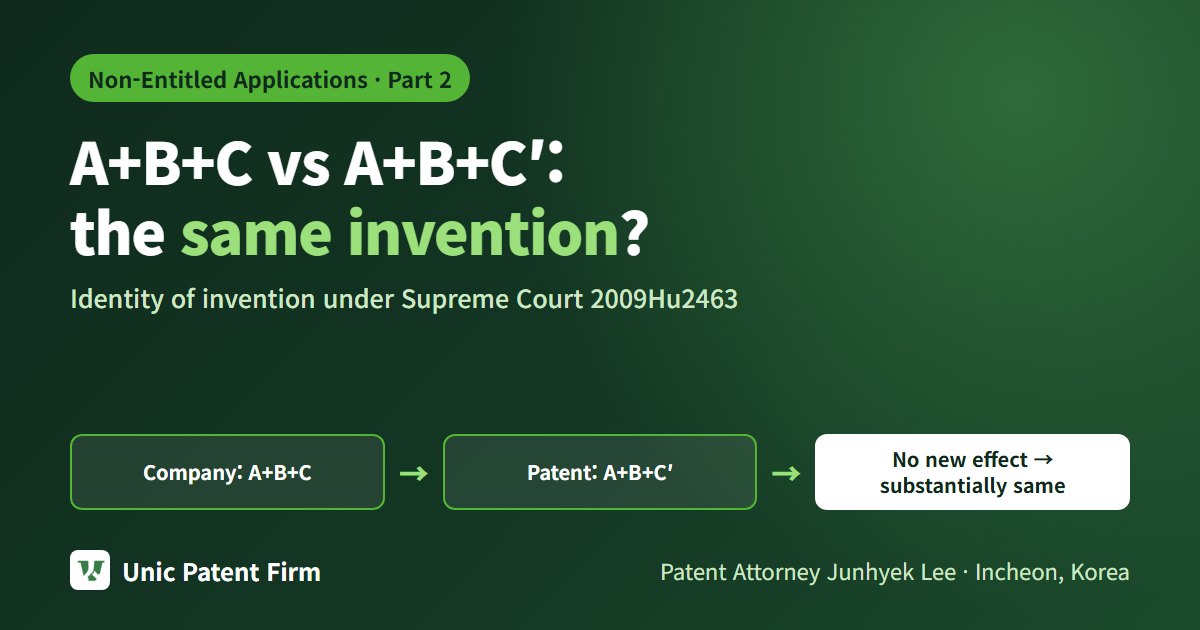
3. What If A+B+C Was Changed to A+B+C'?
Suppose the company's invention and the former employee's patent are as follows.
| Company invention | Former employee's patent |
|---|---|
| A + B + C | A + B + C' |
The fact that C and C' differ does not immediately make them different inventions. If changing C to C' was at a level such as the following, and caused no particular difference in working effect, the two may well be judged to share substantially the same technical idea:
- An ordinary change of material
- A slight change in a part's shape or size
- A change of arrangement a skilled person could easily adopt
- Substitution with a known means performing the same function
In such cases, even if the applicant partly amended the claims or used new wording, it may be difficult to avoid the non-entitled application problem.
4. Adding an Element Does Not Always Make a Separate Invention
Decision 2009Hu2463 is significant on this point too. The patent at issue contained several elements that were not in the original invention. Yet the Court held that if the characteristic part of the patent did not substantially differ from the original invention, and the added elements were ones a skilled person would ordinarily adopt with no special working effect, the applicant did not substantially contribute to creating the technical idea.
So it is hard to conclude that it is a separate invention merely because "at least one element not found in the original invention was added." What matters is how technically meaningful the added element is.
5. What If a New Technical Idea Was Added?
If the patent in question includes a core technical element not found in the company's invention, and that element produces a new working effect, the conclusion may differ.
| Company invention | Former employee's patent |
|---|---|
| A + B + C | A + B + C + D |
If D is not merely an incidental addition but a core element such as the following, it may be hard to regard the patent as a whole as substantially the same as the company's invention:
- An element that solves a problem the original invention could not
- An element that implements a new control method
- An element that produces a new working effect distinguishing it from the original
Ultimately, the key question is whether adding D substantially contributed to creating the technical idea.
Note: if the A+B+C invention is registered in the company's name, practicing the former employee's A+B+C+D patent is likely to infringe the company's patent. This article does not address infringement and deals only with whether a non-entitled patent can stand or be invalidated.
6. In Practice, Claims Are Compared Element by Element
When asserting or rebutting a non-entitled application, comparing only the titles or abstracts is not enough. In practice, the independent claim of the patent is broken down into its elements and compared one by one with the invention the rightful owner says it had.
For example, if claim 1 of the patent consists of the following elements, you need to check whether each element actually existed in the company's lab notes, design drawings, development reports, source code and so on.
| Element | Content |
|---|---|
| a | Collecting data |
| b | Analyzing the collected data |
| c | Determining a specific condition |
| d | Changing operation according to the result |
| e | Automatically recovering in a specific situation |
But looking only at whether each element is present is not sufficient. You should also examine:
- Whether each element performs the same function
- Whether the relationships between elements are the same
- Whether the processing order or control relationships are the same
- Where the core technical feature lies
- Whether the working effect of the combination is the same
In the end, what is compared is not individual phrases but the technical idea of the claim as a whole.
7. Look at Both "Differences in Elements" and "Differences in Effect"
In non-entitled application disputes, the arguments usually clash like this:
| The company | The patentee (former employee) |
|---|---|
| "They just reworded the claims from our technology." | "The company's technology did not have the core elements of this patent." |
Rather than deciding based on a single differing element, it is important to also look at whether the difference produces a new working effect.
For example, if the company's materials only describe a function for detecting a state, while the patent newly includes a sequence of state detection → judging abnormality → automatically selecting optimal conditions → propagating information to other devices → automatic recovery on failure, producing an autonomous failure response and recovery effect absent from the existing technology, it may be hard to see this as a mere addition of elements.
Conversely, if the added elements are only ordinary known means with no particular difference in effect, substantial identity is more likely to be recognized.
8. The Party Asserting a Non-Entitled Application Must Prove It
The Korean Supreme Court has held that when a patent is challenged as a non-entitled application, the burden of proving that ground lies with the party asserting it. So it is not enough for a company to say, "A former employee took our invention and patented it."
The company needs to support the following with objective evidence:
- When and in what form the company's invention was completed
- Who created the invention
- Whether the applicant knew or could have obtained the content of the invention
- Whether the company's invention and the patent are the same or substantially the same
Conclusion: Start by Comparing the Claims Element by Element
For a non-entitled application to be recognized, there must be identity or substantial identity between the rightful owner's invention and the patented invention. In real cases, the rightful owner's research materials and the patent's claims must be compared element by element to decide whether the technical ideas are the same.
In Part 3, we look at the remedies available to the rightful owner when a non-entitled person has already registered a patent, including invalidation trials and claims for transfer of the patent. If you need a claim comparison for a former-employee patent or joint invention dispute, Patent Attorney Junhyek Lee of Unic Patent Firm in Cheongna, Incheon, will review it directly.
Does this apply to your business?
The answer depends on your product, filing schedule and contracts. Talk to a patent attorney directly.
This article is for general information only. Specific cases may be assessed differently depending on the facts. It is based on Korean law as of the publication date.