
When a Former Employee Files a Patent on a Company Invention: Non-Entitled Applications and the Rightful Owner (Part 1)
Junhyek Lee, Patent Attorney, Unic Patent Firm · 2026.08.21
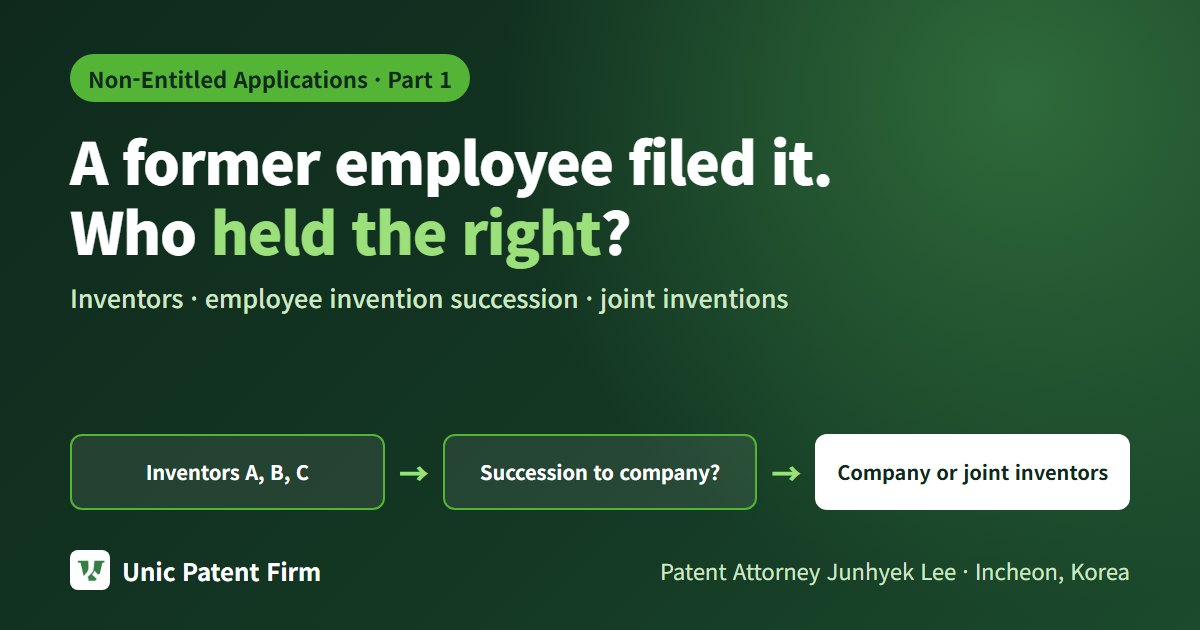
In patent consultations we often hear questions like these: "Our company developed this invention, but a former employee filed a patent in their own name. Can we invalidate it?" or "Someone else filed or registered a patent on an invention made by our CEO or our company first. What should we do?"
Under the Korean Patent Act, as a rule only the inventor or a person who has lawfully acquired the rights to the invention may obtain a patent. When someone who is neither files another person's invention, it becomes a so-called non-entitled application.
This is the first article in a series on non-entitled applications by Unic Patent Firm in Cheongna, Incheon. Here we cover three points:
- What a non-entitled application is
- Who the rightful owner is when several people jointly develop an invention at a company
- What to check when a former employee has filed the application
1. What Is a Non-Entitled Application?
Article 33(1) of the Korean Patent Act sets out who may obtain a patent.
A person who makes an invention, or his/her successor, shall have the right to obtain a patent in accordance with this Act.
In other words, there are basically two kinds of people who can obtain a patent:
- The inventor who actually made the invention
- A successor who lawfully acquired the right to obtain a patent from the inventor
If someone who is neither the inventor nor a successor files another person's invention in their own name and obtains a patent, it is a non-entitled application. Article 133(1)(ii) of the Patent Act makes this a ground for invalidation, so even if the non-entitled person has already registered the patent, the rightful owner can challenge its validity.
Here, the rightful owner means, in principle, the inventor or a person or corporation that has succeeded to the right to obtain a patent for the invention.
2. Who Owns an Invention Developed Jointly at a Company?
Suppose three employees, A, B and C, jointly developed one invention at a company. Under Article 33(2) of the Patent Act, when two or more people jointly make an invention, the right to obtain a patent is shared by the joint inventors.
For an employee invention made at a company, however, the actual inventors and the person holding the right may differ. Depending on whether the right passed to the company, the situation looks like this:
| Situation | Inventors | Rightful owner (applicant) |
|---|---|---|
| The company succeeded to the right | A, B, C | The company |
| The right did not pass to the company | A, B, C | A, B and C jointly |
2.1. When the company succeeded to the right
If the company has an employee invention agreement or employment rules, and the rights of A, B and C lawfully passed to the company under them, the company is the rightful owner. The current Invention Promotion Act also provides that where an employer has set out in advance, by contract or employment rules, that it will succeed to the right for employee inventions, the right passes to the employer under certain conditions.
In that case the inventors are A, B and C, but the rightful applicant is the company that succeeded to the right.
2.2. When the right did not pass to the company
If there are no succession rules, or the right did not pass to the company for some other reason, in principle the joint inventors A, B and C hold the right together. They must then file jointly. However, if some of them assigned their shares to another joint inventor, the inventor who acquired those shares can file as the rightful owner.
2.3. Three situations that often cause disputes
- The CEO, who is not an inventor, files in their own name: being the CEO does not make someone an inventor. If the CEO did not substantially contribute to creating the technical idea and did not acquire the right, filing in the CEO's personal name may be a non-entitled application. The same applies to a major shareholder or R&D manager.
- A files alone: if the right did not pass to the company and B's and C's rights were not transferred to A, A filing alone is not allowed in principle, because co-owners of the right must all file together.
- A, B and C file together: if the right did not go anywhere else, this is the normal form. But if the invention had already passed to the company, an application by the three inventors is a non-entitled application.
3. Is Every Application by a Former Employee Non-Entitled?
No. Leaving the company does not decide the question by itself. What matters is who held the right to the invention before the employee left.
3.1. If the company had already succeeded to the right
If the right had already passed to the company under succession rules or a separate agreement, it does not return to the employee when they leave. So if a former employee files the same invention in their own name, it can be a non-entitled application.
3.2. If the company had not succeeded to the right
Without succession rules or an agreement, the right does not automatically belong to the company just because the invention was developed during company work. In principle, the right may belong to the employee who actually made the invention.
The Korean Supreme Court has likewise held, in substance, that the right to an employee invention does not automatically belong to the company, and that without advance succession rules or a separate agreement one must examine whether there are clear circumstances showing that the employee transferred the right to the company. An implied succession may be recognized depending on the facts even without a written document, but it is not easily recognized merely because the company paid for development or the invention was developed as part of company work.
3.3. What to check in a dispute between a company and a former employee
- Whether the company had employee invention succession rules
- Whether there was a separate assignment or succession agreement
- Whether there are clear circumstances supporting an implied succession
- Whether the employee acted on the premise of company succession when submitting an invention disclosure
- Whether the employee cooperated in preparing the application or assignment documents
- Whether the company bore all application and patent costs
- Whether there was a practice of transferring multiple employee inventions to the company in the same way
- Whether the inventor knew of the company's application and raised no objection for a long time
- Whether the inventor received employee invention compensation
However, the presence of some of these factors does not by itself prove that the right passed to the company. Who actually held the right must be judged comprehensively, considering the contracts, internal rules and the parties' conduct.
Conclusion: Before Asking Whether Someone Left, Ask Who Held the Right
A dispute over a non-entitled application starts with who the inventor is and to whom the right to obtain a patent passed. For a company, keeping employee invention succession rules and the related documents in order is the surest preparation.
Also, even if the company is the rightful owner, it is hard to establish a non-entitled application if the former employee's patent is a separate, different invention. That is why the other key issue is "identity of invention." We cover it in Part 2: How Identity of Invention Is Judged, followed by Part 3: Remedies Against a Non-Entitled Patent.
If you are dealing with a patent filed by a former employee, employee invention succession or a joint invention dispute, Patent Attorney Junhyek Lee of Unic Patent Firm in Cheongna, Incheon, will review your materials directly.
Does this apply to your business?
The answer depends on your product, filing schedule and contracts. Talk to a patent attorney directly.
This article is for general information only. Specific cases may be assessed differently depending on the facts. It is based on Korean law as of the publication date.