
Non-Entitled Applications (Part 3): Invalidation, Transfer or Re-Filing Against a Patent Granted to the Wrong Person
Junhyek Lee, Patent Attorney, Unic Patent Firm · 2026.09.17
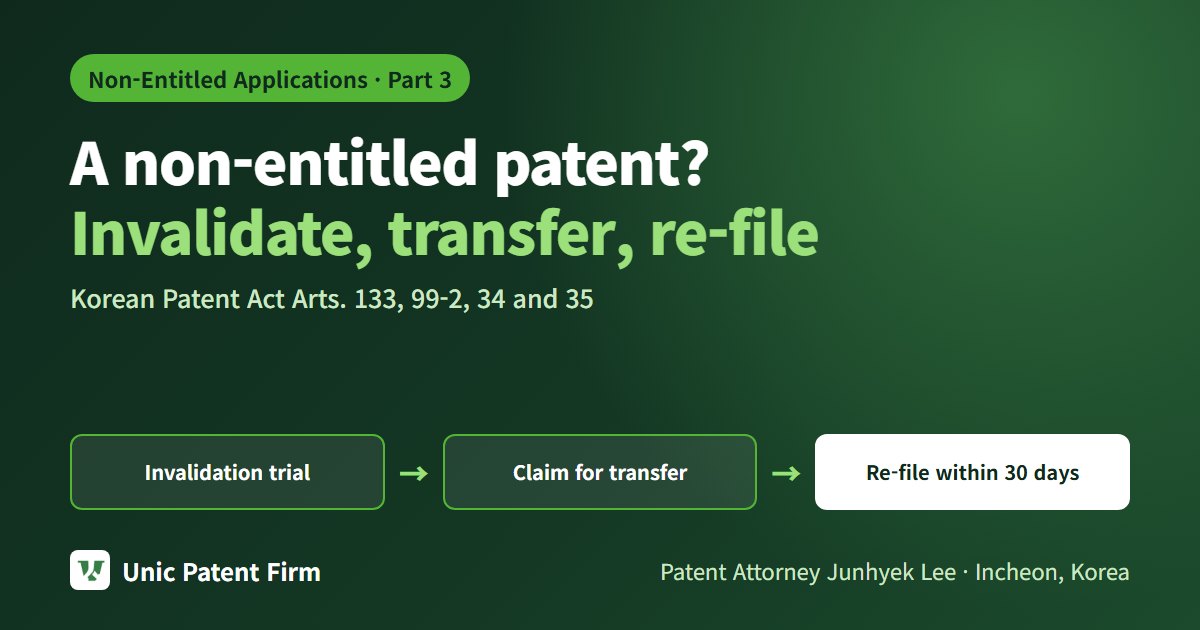
This is the final article in our series on non-entitled applications. Part 1 covered who the rightful owner is, and Part 2 covered whether the rightful owner's invention and the patent in question are the same invention (identity of invention).
So what can the rightful owner do if someone who is neither the actual inventor nor a lawful successor has already registered a patent? Under the current Korean Patent Act, there are four main options to consider:
- An invalidation trial against the non-entitled patent
- A claim for transfer of the patent held by the non-entitled person
- A patent application by the rightful owner after the non-entitled patent is invalidated
- Protection of the rightful owner's application if the patent has not yet been registered
1. Invalidation Trial Against a Non-Entitled Patent
Article 133(1)(ii) of the Patent Act makes it a ground for invalidation that a patent was granted to a person without the right to obtain it.
An interested person (in the case of the main text of subparagraph 2, only a person with the right to obtain a patent) or an examiner may request an invalidation trial if a patent falls under any of the following: … 2. Where the patent was granted to a person without the right to obtain a patent under the main text of Article 33(1), or in violation of Article 44. (Patent Act, Article 133(1))
So if someone who is neither the inventor nor a successor filed and registered another person's invention, an invalidation trial can be requested on the ground of a non-entitled application.
1.1. You must first prove that you are the rightful owner
For non-entitled applications (subparagraph 2), the provision allows only "a person with the right to obtain a patent" to request invalidation. A company seeking to invalidate a patent registered by a former employee must therefore first prove that the company itself is the rightful owner. The following materials should be reviewed:
- Employee invention succession rules
- Agreements assigning the right to obtain a patent
- Invention disclosures and succession notices
- Employee invention compensation records
- Documents prepared on the premise of filing in the company's name
- Any other materials showing the right passed to the company
The Korean Supreme Court has recently held that whether the petitioner is the rightful owner in such a trial is a question of standing. If the petitioner is not recognized as the rightful owner at the time of the decision, the request may be dismissed as improper before the ground for invalidation is even examined.
2. Taking the Patent Over Instead of Invalidating It
A patent registered by a non-entitled person does not necessarily have to be destroyed. If it is important to the business, bringing the patent right itself to the rightful owner may be more advantageous than eliminating it. Article 99-2 of the Patent Act provides a claim for transfer of a patent for this purpose.
Where a patent falls under the main text of Article 133(1)(ii), a person with the right to obtain a patent may file a claim with a court for transfer of the patent right. Where the right to obtain a patent is jointly owned, the person may claim transfer of the relevant share. (Patent Act, Article 99-2(1))
Where a patent right is registered as transferred on the basis of a claim under paragraph (1), the patent right and certain claims for compensation shall be deemed to have belonged to the transferee from the date the patent right was established and registered. (Patent Act, Article 99-2(2))
If the company lawfully succeeded to the right but a former employee obtained the patent in their own name, the company can ask a court to transfer the patent to the company. In a joint invention where the rightful owner holds only a share, it can claim transfer of that share.
Importantly, the transferee does not become the patentee only from the date of the transfer registration. For example, if a former employee registered the patent in 2025 and the company registered the transfer in 2027, the patent is legally treated, to a certain extent, as having belonged to the company since its original registration in 2025.
| Question | Option to consider |
|---|---|
| "Should we eliminate the patent?" | Invalidation trial |
| "Should we keep the patent and bring it to the company?" | Claim for transfer (consider first if the patent has business value) |
3. After Invalidation, the Rightful Owner Can File Again
Invalidating the non-entitled patent does not mean the rightful owner automatically acquires it. However, the Patent Act protects the rightful owner by allowing the non-entitled person's filing date to be recognized retroactively as the rightful owner's filing date.
Where a trial decision invalidating a patent under Article 133(1)(ii) on the ground of lack of the right to obtain a patent under the main text of Article 33(1) becomes final, a patent application filed by the rightful owner after the non-entitled person's application shall be deemed to have been filed at the time of the invalidated patent's application. This shall not apply where the rightful owner files the application more than 30 days after the date the decision becomes final. (Patent Act, Article 35)
For example, in the following sequence, if the rightful owner files within the statutory period, the application can be treated as filed on January 1, 2024, earlier than the actual filing date:
- The non-entitled person files a patent application on January 1, 2024
- The patent is registered
- The rightful owner requests an invalidation trial
- The invalidation decision on the ground of a non-entitled application becomes final
Even if a third party's application or publicly known technology appeared in between, the rightful owner can claim the non-entitled person's original filing date. But the deadline of 30 days from the date the invalidation decision becomes final must be met. If you choose the invalidation route, it is important to prepare the follow-up application after the decision becomes final, not just the trial itself.
4. What If the Non-Entitled Patent Has Not Been Registered Yet?
If the non-entitled application is still under examination and not yet registered, Article 34 of the Patent Act may apply.
Where a patent application filed by a person who is neither the inventor nor a successor to the right to obtain a patent cannot be granted a patent because that person lacks the right, a patent application filed by the rightful owner after the non-entitled application shall be deemed to have been filed at the time the non-entitled person filed. This shall not apply where the rightful owner files more than 30 days after the date the non-entitled person became unable to obtain the patent. (Patent Act, Article 34)
So if the non-entitled application is rejected on that ground, the rightful owner can file within a set period and obtain the non-entitled person's original filing date.
| Status of the non-entitled application | Protective provision | Filing deadline |
|---|---|---|
| Before registration (patent cannot be granted) | Patent Act Article 34 | Within 30 days from the date the patent could not be obtained |
| Invalidated after registration | Patent Act Article 35 | Within 30 days from the date the invalidation decision becomes final |
Conclusion: Choose Invalidation, Transfer or Re-Filing to Fit Your Business
Over three articles we have covered the rightful owner, identity of invention and the remedies once a non-entitled application has been filed or registered. Deciding whether an application is non-entitled requires a comprehensive review of the inventors and succession of rights, the identity of the two inventions, and who actually holds the right.
In disputes between a company and a former employee in particular, the fact that "the company developed the technology" does not settle the matter. Employee invention succession, joint inventorship, R&D records and a concrete comparison of the claims decide the outcome.
Consider consulting Patent Attorney Junhyek Lee of Unic Patent Firm in Cheongna, Incheon, if:
- A former employee has filed or registered a patent on company technology
- You are unsure whether an invalidation trial or a transfer claim is more favorable
- There is a dispute over joint inventorship or succession to an employee invention
Does this apply to your business?
The answer depends on your product, filing schedule and contracts. Talk to a patent attorney directly.
This article is for general information only. Specific cases may be assessed differently depending on the facts. It is based on Korean law as of the publication date.