
Trademark Warning Letters (Part 1): Don't Panic — Check the Requirements and Exceptions First
Junhyek Lee, Patent Attorney, Unic Patent Firm · 2025.06.17
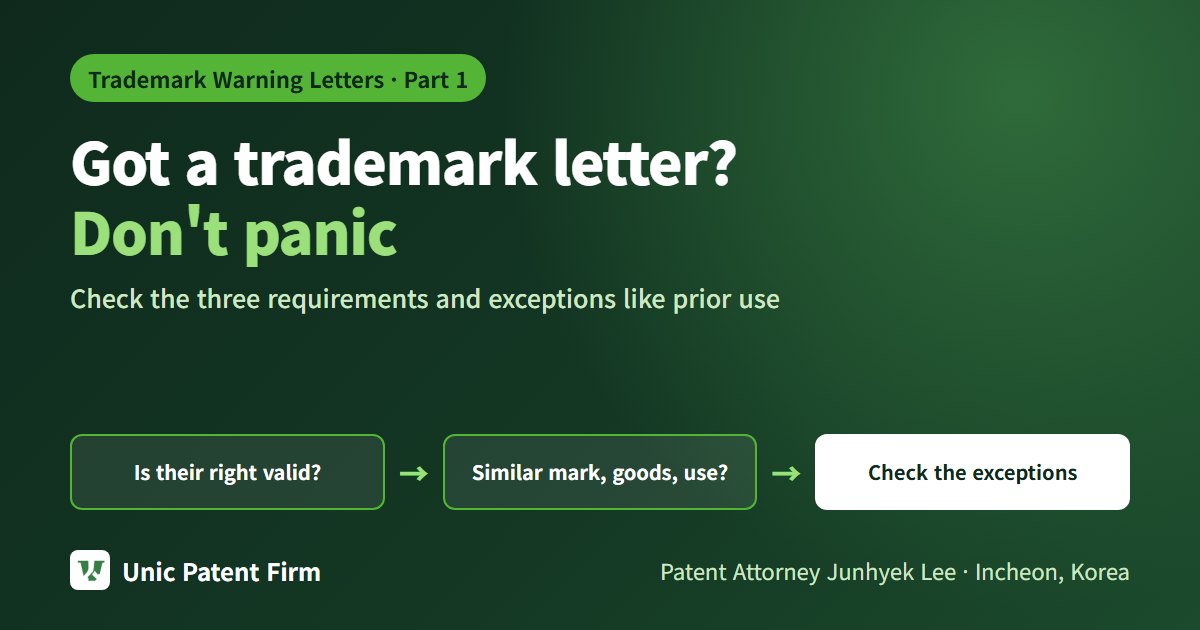
We often get calls from people who have received a trademark infringement warning letter from a legal representative or trademark owner and want to know what to do. These letters usually include the registered mark, records of your use (screenshots of your website or product photos), and a demand to stop using the mark, reply and pay damages within 7 to 14 days.
But don't panic. Not every warning letter means infringement, and in fact many cases are not infringement at all. In this article, Unic Patent Firm in Cheongna, Incheon, explains what to check after receiving a letter, how infringement is judged, and the exceptions where use is not infringement.
1. First, Check the Other Side's Trademark Right
- Whether the mark in the letter is actually registered
- Whether the sender is the legitimate owner of that right
- Whether the right is valid (for example, not expired)
2. Are You Infringing? Three Requirements
Under the Korean Trademark Act and case law, all three of the following must be met for infringement.
| Requirement | Description | Criteria |
|---|---|---|
| (1) A sign identical or similar to the registered mark | Using a sign identical to, or confusingly similar to, the registered mark | Overall appearance, sound and meaning |
| (2) Used on the designated (or similar) goods | Used on goods or services the right covers, or similar ones | Nature, use and trade circumstances of the goods |
| (3) Use as a trademark | Used so that it functions as a mark: indicating source, guaranteeing quality, advertising | Mere descriptions or modifiers do not count |
2.1. Similar goods — infringement is possible even across different similarity groups
For example, if Company A uses "NIKE" on its sneakers, there is a similar mark + similar goods + trademark use, so infringement is established. The Korean Supreme Court held "mobile phone chargers" and "mobile phone charging vending machines" to be similar goods (Supreme Court Decision 2003Hu144, July 22, 2004), because ordinary consumers strongly perceive phones and chargers as coming from the same source and the manufacturers, distribution channels, sellers and customers coincide, creating a sufficient risk of confusion about origin.
Whether designated goods are similar is judged by whether, if identical or similar marks were used on them, the goods would likely be mistaken as made or sold by the same business, considering comprehensively the goods' own attributes such as quality, shape and use, together with trade circumstances such as production, sales and the range of consumers, according to ordinary trade practice. (Supreme Court Decision 98Hu850, July 28, 2000)
In other words, even if a mark could be registered because the similarity groups differed, infringement can still be found across different similarity groups.
2.2. Use as a trademark — a company name can be a trademark too
Use as a trademark means use that indicates source. For example, if your website's main page prominently displays your company name together with your product mark, the company name is also regarded as used as a trademark, even though there is a separate product mark. So a company name that risks infringement should be shown small at the bottom of the website or as the manufacturer on the back of the packaging.
In practice, the mark in the letter is often the same, but the designated goods are not similar.
3. When It Is Not Infringement — Exceptions
Article 90 of the Trademark Act and related rules do not treat the following legitimate uses as infringement. However, even these can be infringement if there is an unfair competitive purpose or they cause confusion.
| Exception | Content | Example |
|---|---|---|
| Use of one's own name or trade name | Using one's own name, title etc. not for trademark purposes | A restaurant named after its owner |
| Descriptive use | Describing effects, ingredients or components of goods | Common expressions like "cola-flavored candy" |
| Parallel imports | Marks on genuine goods lawfully imported | Reselling genuine Nike products bought abroad (parallel import must be indicated) |
| Non-trademark use | For art, satire, parody or commentary | Parody T-shirts (depends on the case) |
| Keyword ads and search terms | Simply entering a keyword is not infringement, but inducing consumer confusion is a problem | Be careful using competitors' names in search ads |
| Prior use right | If you were using an identical or similar mark before the other party filed, you may continue using it | A shop name used for a long time without registration |
Conclusion: Stay Calm and Talk to a Patent Attorney First
Trademark infringement requires similar marks + similar goods + trademark use, and even when these are met there are exceptions such as use of one's own name, parallel imports and prior use rights. Many of the clients I have met who received warning letters were not infringing, because of legitimate parallel imports, prior use or dissimilar goods.
Of course, infringement does sometimes exist. In that case it is best to stop using the mark immediately; what to do next is covered in Part 2: Responding When Infringement Is Likely. If you have received a trademark infringement warning letter, Patent Attorney Junhyek Lee of Unic Patent Firm in Cheongna, Incheon, will review it directly.
Does this apply to your business?
The answer depends on your product, filing schedule and contracts. Talk to a patent attorney directly.
This article is for general information only. Specific cases may be assessed differently depending on the facts. It is based on Korean law as of the publication date.