
Trademark Non-Use Cancellation: When Does the "Three Years" Start and End?
Junhyek Lee, Patent Attorney, Unic Patent Firm · 2026.11.04
Unic Patent Firm, based in Cheongna, Incheon, was recently contacted by a trademark owner in the Incheon area who had just received a petition for a non-use cancellation trial. They had two questions: "Can my trademark really be cancelled?" and "What should I prepare now?"
Some owners file and register a trademark but then, for various reasons, never actually use it. However, if a registered trademark goes unused for three years or more, another party can file a non-use cancellation trial and have the registration cancelled. In other words, a trademark right you worked hard to obtain can disappear.
The most confusing part of this trial is the "three years." In this article, we walk through three things every owner should know when responding to a non-use cancellation action in Korea.
- The reference date: which period is examined
- Genuine use: what counts as use, and what evidence proves it
- Burden of proof: who must prove that the mark was used
1. What Is a Non-Use Cancellation Trial?
1.1. Legal basis
Article 119(1)(iii) of the Korean Trademark Act sets out the following as a ground for cancelling a trademark registration.
Where none of the trademark owner, an exclusive licensee or a non-exclusive licensee has used the registered trademark in Korea for the designated goods, without justifiable reason, for three or more consecutive years before the filing date of the cancellation trial
Put simply, if neither the owner nor anyone licensed to use the mark has used it on the designated goods in Korea for more than three consecutive years without a justifiable reason, the registration can be challenged in a cancellation trial.
1.2. Why does this system exist?
In Korea, a trademark can be registered before it is actually used, as long as the legal requirements are met. This lets businesses protect a brand while they are still preparing to launch. On the other hand, if unused marks stay monopolized, other businesses that want to use the same name are blocked.
The non-use cancellation trial addresses this problem. It encourages owners to actually use their registered marks and clears out marks that have been left idle, giving others a wider choice of trademarks.
2. When Do the "Three Years" Start and End?
2.1. The reference date is the filing date of the trial
The most important date in counting the three years is the date the cancellation trial was filed. The following dates are not the reference date:
- The date the owner received the petition
- The decision date or the date the proceedings closed
The Korean Supreme Court has also held that use must be assessed for the three years before the filing date, and that the period is not recalculated from the date the proceedings closed (Supreme Court Decision 95Hu651, December 26, 1995).
2.2. Count three years back from the filing date
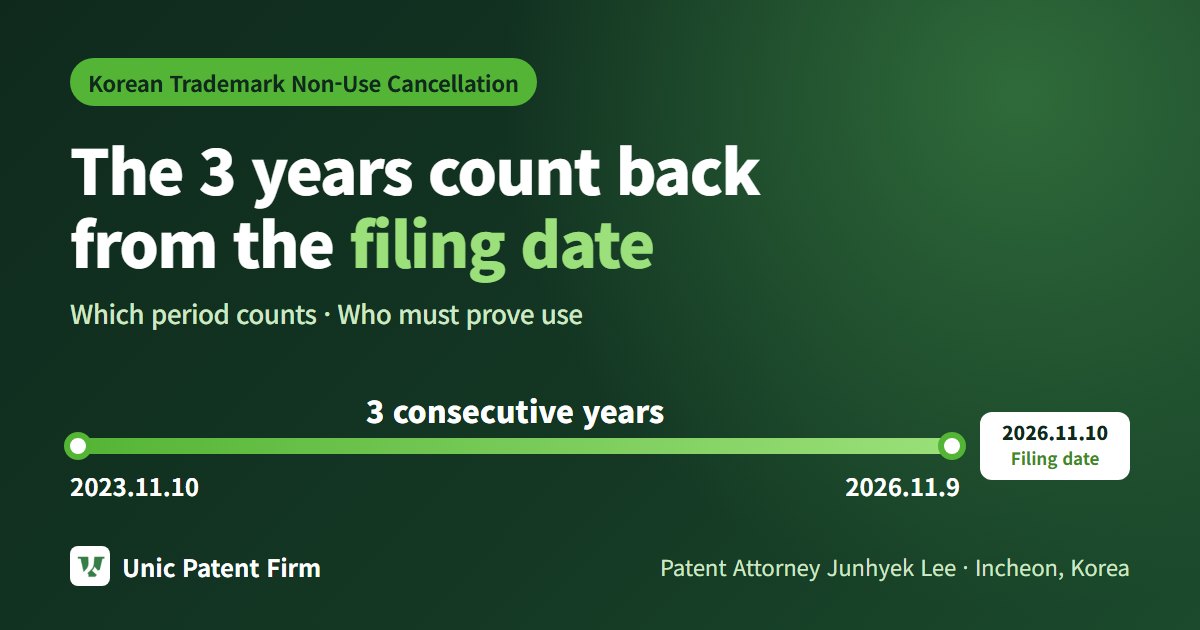
Suppose a non-use cancellation trial is filed on November 10, 2026 against a mark registered long ago. The period examined for use would be:
| Item | Date |
|---|---|
| Filing date of the cancellation trial | November 10, 2026 |
| Start of the period examined | November 10, 2023 |
| End of the period examined | November 9, 2026 (the day before filing) |
In short, the question is whether there was genuine use during the three years running up to the day before the filing date. In an actual case, the registration date and each individual date of use must also be checked.
For example, if a mark was registered in 2020 and used until 2022 but not afterwards, past use alone is not enough. If the mark then went unused for more than three years up to the filing date, cancellation can become an issue.
2.3. It does not mean "use throughout all three years"
This is a common misunderstanding. If there was even a single genuine use recognized by law within those three years, the owner can answer the ground that the mark was "not used for three or more consecutive years." There is no need to prove continuous use for the entire period.
However, the number of uses alone does not decide the matter. The question is also whether the mark was actually used to indicate the source of goods and whether the use related to normal trade. Token use made only to avoid cancellation may not be accepted as genuine use.
3. Evidence of Trademark Use: What to Prepare
3.1. "Use" is not limited to sales
Use of a trademark is not recognized only when goods are actually sold. The following acts can also count as use:
- Placing the mark on goods or packaging
- Selling, or displaying for sale, goods bearing the mark
- Displaying the mark in advertising or transaction documents for the goods
In every case, however, the mark must have been used as a trademark indicating the source of the goods.
3.2. Organize evidence so that it connects
When proving use, what matters is less each individual document and more whether the documents link together. It helps to organize your materials so that they answer the five questions below.
| What to show | Examples of evidence |
|---|---|
| When it was used | Transaction dates, order, payment and delivery records, advertising dates |
| Which mark was used | Photos of products, packaging and labels, advertisements, product pages |
| On which goods | Transaction documents listing the items, catalogs, product descriptions |
| Who used it | Business information, documents showing a license relationship |
| Whether actual use took place | Sales and delivery records, advertising records, catalog distribution and display records |
For example, if a tax invoice does not show the mark, you need to connect it with photos or delivery documents to explain which mark was on the goods in that transaction.
3.3. Evidence that may not be enough
- Product photos taken today: they do not show a date of use within the past three years.
- The current website: it shows only the present and does not directly prove past use.
- An explanation that a similar mark was used on similar goods: the mark actually used must be regarded as identical to the registered mark in ordinary trade, and the goods must fall within the designated goods subject to cancellation.
4. Who Bears the Burden of Proof?
It is natural to think that whoever asserts a fact must prove it. The non-use cancellation trial is different. The petitioner does not have to prove every instance of the other party's non-use.
Under Article 119(3) of the Korean Trademark Act, the respondent, that is, the trademark owner, must prove one of the following:
- That the registered mark was genuinely used in Korea during the period
- That there was a justifiable reason for not using it
If the owner proves neither, it will be hard to avoid cancellation of the registration for the designated goods at issue.
The petitioner cannot simply sit back either. Once the owner submits evidence, the petitioner can examine points such as:
- Whether the dates of use fall within the three-year period
- Whether it was a real transaction or token use
- Whether the mark and goods match the registration
- If a licensee used the mark, whether there was a valid license relationship
5. Can You Start Using the Mark After the Trial Is Filed?
Some owners rush to start using the mark only after receiving the petition. But if the three-year non-use ground already existed before the filing date, starting use afterwards does not remove it.
In the end, the decision turns on two things: the three-year period counted from the filing date, and evidence of genuine use within that period.
| Party | What to do now |
|---|---|
| Trademark owner | Keep product, advertising and transaction records linked to their dates as a routine |
| Party planning to file | Choose the filing date and the designated goods to challenge carefully |
6. If You Have Received a Petition, Start Here
When a petition arrives, it is easy to panic and start collecting documents at random. Checking things in order makes the right response much clearer.
- Check the date: find the filing date in the petition and fix the three-year period to be examined.
- Check the scope: see which designated goods are challenged and whether they overlap with the goods you actually sell.
- Collect evidence: gather sales, advertising and delivery records from that period in date order.
- Review how the mark was used: confirm that the mark used looks the same as the registered mark, and who used it (the owner directly or a licensee).
If you hold a registered trademark you are not currently using, it is wise, as part of trademark portfolio management, to review its use and the supporting evidence before any petition arrives.
Conclusion: Count Back From the Filing Date, Keep Dated Evidence
In a non-use cancellation trial, the "three years" are counted back from the day before the filing date. A single genuine use within that period is enough, but the owner must prove it with documents that show dates.
If you are using a registered trademark, start keeping dated sales and advertising records together with photos of products and packaging showing the mark. If you have already received a petition, the starting point is to check, one by one, which materials can be recognized as use within the three years.
If you need help responding to a non-use cancellation trial or organizing evidence of use, Patent Attorney Junhyek Lee of Unic Patent Firm in Cheongna, Incheon, will review your materials directly.
Does this apply to your business?
The answer depends on your product, filing schedule and contracts. Talk to a patent attorney directly.
This article is for general information only. Specific cases may be assessed differently depending on the facts. It is based on Korean law as of the publication date.