
Super-Accelerated Examination in Korea: Patents and Trademarks Registered in About Two Months?
Junhyek Lee, Patent Attorney, Unic Patent Firm · 2026.04.17
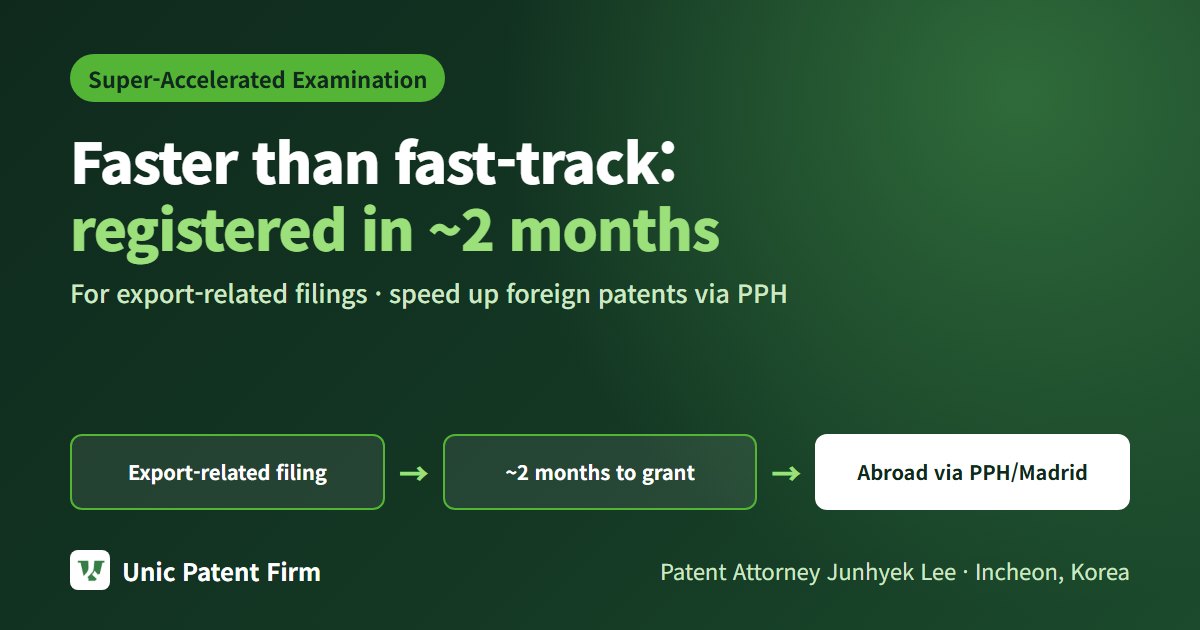
Patents and trademarks go through filing → examination (grounds for rejection and responses) → registration. Under regular examination, patents take about two years and trademarks about 18 months. Korea examines quickly by global standards, but for a business getting ready to launch it still feels long. (In Europe, registration often takes three to four years or more.)
Accelerated examination exists to shorten this, and recently an even faster super-accelerated examination has been introduced. In this article, Unic Patent Firm in Cheongna, Incheon, compares the three tracks and explains who can use super-accelerated examination and why it helps.
1. Regular vs Accelerated vs Super-Accelerated Examination
| Item | Regular | Accelerated | Super-accelerated |
|---|---|---|---|
| Time | Patents ~2 years / trademarks ~18 months | Patents 6 months+ / trademarks ~3 months | Patents ~2 months / trademarks ~2 months |
| Eligibility | – | Working or preparing to work the invention, venture companies, AI, autonomous driving and other eligible categories | Accelerated-examination conditions + export-related applications |
| Official fee | – | KRW 200,000 (trademarks KRW 160,000) | KRW 200,000 (trademarks KRW 160,000) |
Trademark examination takes longer than expected even on the regular track, so many applicants request acceleration. Super-accelerated examination saves the most time for patents: accelerated patents often exceed six months because of office action responses, while super-accelerated examination can reach registration in about two months.
2. Who Can Apply
2.1. Basic rule — export-related applications among those eligible for acceleration
| Right | Eligible applications |
|---|---|
| Patents and utility models | (1) Eligible for export-promotion acceleration, or (2) advanced technology that is also a basis for a Paris Convention priority claim |
| Trademarks | (1) Marks being exported or to be exported, (2) basis applications for Paris Convention priority, (3) basis applications for Madrid international registrations (no limit on number) |
- Advanced technology: fields designated and announced by the Commissioner, such as semiconductors, AI and secondary batteries
- Paris Convention priority: if you file the same content abroad within one year of a Korean filing, the Korean filing date is recognized as the filing date in that country
2.2. When export results are not required
- Patents and utility models that improve a product exported within the last three years can apply without direct export results.
- SMEs and mid-sized companies selected in the last three years for the IP office's export and overseas dispute programs (Global IP Star Company Program, IP Risk Response Program for Export Companies, Patent Dispute Response Strategy Support, and K-Brand Dispute Response Strategy Support (trademarks only)) are also eligible.
3. Benefits
- Fast protection.
- Faster foreign patents — once you have a Korean patent, you can use the Patent Prosecution Highway (PPH) to obtain patents quickly in the US, China, Japan and elsewhere. In the US, registration usually takes more than two years after filing, so the difference is substantial. (PPH: a program under which an application found patentable in the first country is examined with priority in the second; Korea runs PPH with 39 countries.)
- Trademarks gain an edge abroad — Madrid international filings can proceed more effectively, submission of a Statement of Use may be waived when filing in the US, and it helps with export contracts, preventing pre-emptive registrations abroad and handling disputes.
Conclusion: If You Are Preparing to Export, Consider Super-Accelerated Examination First
Super-accelerated examination registers export-related patents and trademarks even faster than accelerated examination. If you are exporting or preparing to, consider a strategy of securing Korean registration quickly and linking it to foreign filings and the PPH. Details from when the system launched are covered in Korea's Super-Accelerated Examination for Patents and Trademarks.
If you want to know whether you qualify, Patent Attorney Junhyek Lee of Unic Patent Firm in Cheongna, Incheon, will check directly.
Does this apply to your business?
The answer depends on your product, filing schedule and contracts. Talk to a patent attorney directly.
This article is for general information only. Specific cases may be assessed differently depending on the facts. It is based on Korean law as of the publication date.