
How to Register a Trademark in Korea: Checking Prior Similar Marks by Similarity Group
Junhyek Lee, Patent Attorney, Unic Patent Firm · 2025.12.03
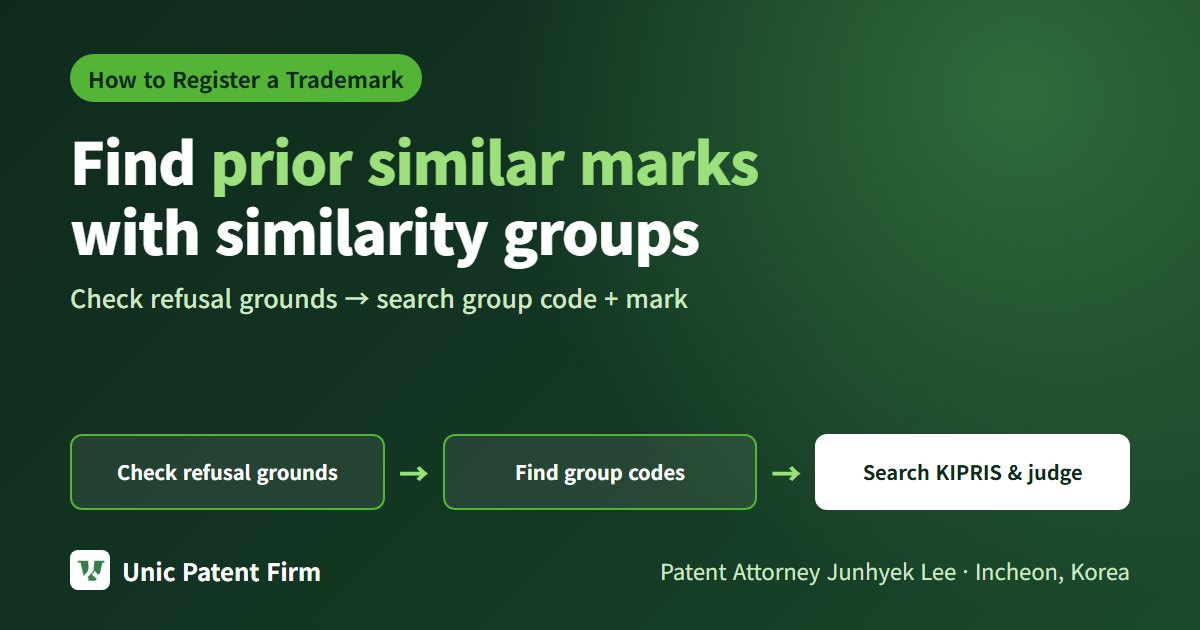
When you want to register a trademark, two questions come first: "Can this mark be registered?" and "Has someone already registered a similar mark?"
So in judging registrability, we check two things:
- Absolute grounds for refusal: whether the mark itself is one the Trademark Act prohibits
- Prior similar marks: whether an identical or similar mark is already registered in the same similarity group
In this article, Unic Patent Firm in Cheongna, Incheon, focuses on searching prior marks using similarity group codes, with a real example.
1. First, Check Whether the Mark Is Unregistrable Under the Trademark Act
Article 33 of the Korean Trademark Act sets out marks that cannot be registered for lack of distinctiveness. Typical examples:
- Generic names: the ordinary name of the goods
- Customary marks: marks used customarily by everyone in the trade
- Descriptive marks: indications of origin, quality, raw materials, effects or uses of the goods
- Well-known geographical names: famous place names or maps
- Common surnames or names
- Simple and common marks: marks so simple they lack distinctiveness
For example, if the designated goods are "apples" and the mark is "Sweet," "Delicious" or "Jeju," registration will be difficult, because it merely describes the taste, characteristics or origin of apples in an ordinary way.
2. Next, Search for Similar Marks by Similarity Group
If there are no absolute grounds for refusal, check whether similar marks were registered earlier. The key criterion is the similarity group code. Examiners at the Korean IP office judge as follows:
- Identify the designated goods and their similarity group codes.
- Search the same group for identical or similar registered marks.
- If a similar mark exists, lean toward refusal; if not, toward registration.
3. Example: Filing the Mark "Dallida" (달리다)
3.1. Similarity group codes by designated goods
| Designated goods | Class | Similarity group code |
|---|---|---|
| Coffee | Class 30 | G0502 |
| Downloadable game software | Class 9 | G390802 |
| Online shopping mall services | Class 35 | S2090 |
Now search KIPRIS with each code together with "달리다."
3.2. Results by similarity group
| Group | Prior marks found | Registrability |
|---|---|---|
| G0502 (coffee) | 71 results including "달리다방" and "달리는 커피" — given differences in composition and distinctiveness, arguably dissimilar | ⭕ Possible |
| G390802 (game software) | "달리다 Dalida" — identical or similar mark exists | ❌ Difficult |
| S2090 (online shopping mall) | An identical mark "달리다" exists | ❌ Very difficult |
Checking prior marks group by group lets you predict registrability quite accurately before filing and plan to adjust the designated goods or the mark.
4. Examination and Courts Use Slightly Different Standards
4.1. Examination: similarity group codes
Even different designated goods are treated as similar if they share a similarity group code. Examiners handle hundreds of thousands of cases a year and cannot investigate each product's use and sales channels, so they examine consistently and quickly by group. At the examination stage, the group code is effectively the decisive standard.
4.2. Courts and trials: overall trade circumstances
Whether goods (services) are similar is judged by considering their nature, use, manufacturing method, sales channels, supply channels and trade circumstances as a whole, to determine whether ordinary consumers are likely to be confused. (Supreme Court Decisions 2000Hu1340, 2003Hu3137, 2014Hu2454, among others)
So courts may treat goods as similar even across different groups, or dissimilar even within the same group.
| Stage | Approach |
|---|---|
| Examination | Formal judgment centered on group codes |
| Courts and trials | Substantive judgment including trade circumstances |
5. Practical Tip: Searching by Similarity Group on KIPRIS
- Go to KIPRIS (kipris.or.kr).
- Click Trademark search → Advanced search.
- Enter the similarity group code + the mark together.
- Review results for identical marks and also marks similar in appearance, pronunciation and meaning.
Variations like these all bear on similarity, so search carefully:
- Korean–English conversion: 달리다 ↔ Dalida
- Spacing and symbols: 달리다 / 달리 다 / 달리-다
- Added particles or suffixes: 달리다방, 달리는커피
How to use the KIPRIS trademark search screen is also covered in How to Search Trademarks on KIPRIS.
Conclusion: A Good Similarity Group Search Shows Your Odds
The first steps toward registration are checking absolute grounds for refusal and searching prior marks by similarity group. An accurate group search before filing reduces the risk of refusal and lets you plan a much more efficient trademark strategy, including adjusting the goods or the mark.
How to interpret the results and whether dissimilarity can be argued, however, require both case law and examination practice. If you want to know your mark's registrability before filing, Patent Attorney Junhyek Lee of Unic Patent Firm in Cheongna, Incheon, will review it directly.
Does this apply to your business?
The answer depends on your product, filing schedule and contracts. Talk to a patent attorney directly.
This article is for general information only. Specific cases may be assessed differently depending on the facts. It is based on Korean law as of the publication date.