
Analyzing KOMSCO's Mobile ID Patent: The DID, VC and Blockchain Authentication Structure
Junhyek Lee, Patent Attorney, Unic Patent Firm · 2025.12.23
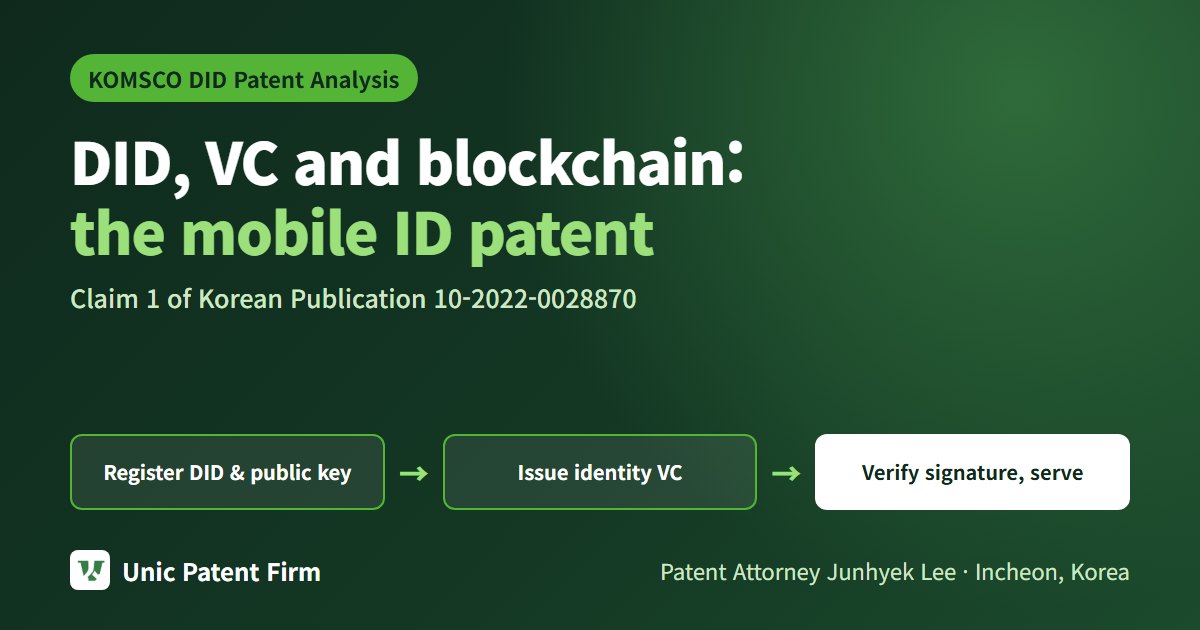
Korea's mobile ID, provided by the Ministry of the Interior and Safety, is actually issued by Korea Minting and Security Printing Corporation (KOMSCO). In this article, Unic Patent Firm in Cheongna, Incheon, looks claim by claim at KOMSCO's foundational mobile ID patent to see how its DID-based authentication structure is designed and how the issuance, storage and use stages are separated.
The overall structure and advantages of the mobile ID are covered first in Korea's Mobile ID and Digital Identity Authentication Patents.
1. Patent Overview
| Item | Content |
|---|---|
| Publication No. | 10-2022-0028870 |
| Application No. | 10-2020-0110469 |
| Applicant | Korea Minting and Security Printing Corporation (KOMSCO) |
| Title | Mobile ID authentication service method using blockchain network-based decentralized identifiers (DID), and user terminal performing the mobile ID authentication service |
The patent claims an overall structure that performs mobile ID authentication by combining DIDs (decentralized identifiers), VCs (verifiable credentials) and a blockchain.
2. Claim 1 — Long, but It Splits Into Two Stages
Claim 1 is very long and complex, but structurally it has two stages.
| Stage | Content (summary) |
|---|---|
| (a) Requesting issuance of a VC | With the user DID and public keys (a first public key for the ID app and a second for the service app) registered on the blockchain, and identity VCs issued by the issuing server after verification and stored in the device's first storage, the device sends a request to issue a user-information VC, signed with the second private key, through the service app to the service provider server; the server verifies the signature and then requests user authentication information |
| (b) Authentication using a specific identity VC | The device sends, through the ID app, the user DID, the required identity VC and a signature over it made with the first private key; the server obtains the first public key from the blockchain (or from the DID document via a resolver server), verifies the signature and the VC, and if valid creates a user-information VC and sends it to the device, which stores it in the service app's second storage |
In other words, the "ID issuance stage" and the "authentication stage when using a service" are clearly separated.
3. The Issuing Server — The Sole Trusted Issuer
- Nature: an administrative or public body (e.g., KOMSCO or a government agency), the only trusted entity able to verify a user's real identity directly.
- Identity verification: verifies real name, resident registration and license information against existing administrative databases, based on the DID the user created.
- VC issuance: issues a VC for each verified item of identity information, including the issuing server's DID and digital signature.
- Where VCs are stored: not on the blockchain, but in the ID app on the user's device (first storage).
3.1. What is a user DID?
A user DID is not issued by a central authority; it is a digital identifier that the user creates, owns and controls. Put simply, it is not a resident registration number or a login ID but "a digital ID number I created myself."
- The mobile ID app generates a private key and a public key.
- A DID is created from the public key, and the DID–public key relationship is registered on the blockchain (DID registry).
- As a result, the private key stays only on the device, while the DID and public key are public on the blockchain.
4. Storage Structure — The Blockchain Is Not a Store of Personal Data
| Stored on the blockchain | Not stored on the blockchain |
|---|---|
| User DID and its public key, DIDs of the issuing and service provider servers, public key information for each DID (DID Document) | Resident registration number, name, date of birth, the original identity VCs |
| Item | Storage location |
|---|---|
| User identity information | User device |
| Identity VC | User device |
| User-information VC | User device |
| DID and public key | Blockchain |
| Reference information for verification | Blockchain |
The blockchain's role is to provide "this is the correct public key for this DID" and "the reference for checking whether this signature is valid."
5. The Use Stage — Authentication Procedure
| Party | What it does |
|---|---|
| User device | Selects only the specific identity VCs needed and signs with the private key |
| Verifier | Looks up user DID → public key and issuing server DID → public key on the blockchain, verifies the signatures, and provides the service if successful |
6. Are Issuance and Authentication Separated?
| Function | Issuing server | Authentication stage |
|---|---|---|
| Confirming real identity | O | X |
| Issuing VCs | O | X |
| Real-time authentication | X | O |
| Blockchain lookup | X | O |
The issuing server belongs to an offline, administrative trust domain, while the authentication stage is an online, autonomous verification domain.
Conclusion: A Blueprint for National Digital Trust Infrastructure
KOMSCO's patent clearly shows a DID-based structure that fully separates issuance, storage and use of the mobile ID. Beyond ID technology, it can be seen as a core design for digital trust infrastructure usable across AI services, finance and fintech, unmanned services and smart cities.
If you are preparing patents on DID, VC or blockchain-based authentication technology, Patent Attorney Junhyek Lee of Unic Patent Firm in Cheongna, Incheon, can help directly with prior art analysis and claim design.
Does this apply to your business?
The answer depends on your product, filing schedule and contracts. Talk to a patent attorney directly.
This article is for general information only. Specific cases may be assessed differently depending on the facts. It is based on Korean law as of the publication date.