
Korea's Mobile ID and Digital Identity Patents: How Issuance, Storage and Verification Are Separated
Junhyek Lee, Patent Attorney, Unic Patent Firm · 2025.12.15
As artificial intelligence (AI) services spread rapidly, trustworthy digital identity authentication has become essential infrastructure. At its center is Korea's mobile ID, which the government is actively promoting.
A mobile ID is not simply "an ID card put on a smartphone." It is national digital identity infrastructure that combines security, privacy protection and blockchain technology. In this article, Unic Patent Firm in Cheongna, Incheon, summarizes the overall structure and features of Korea's mobile ID and the core of the identity authentication patents behind it.
1. What Is Korea's Mobile ID?
The mobile IDs currently provided by the Korean government are:
- Resident registration card
- Driver's license
- Alien registration card
- National veterans' registration card
As of 2024, cumulative issuance reached about 6.7 million people, and each ID has the same legal effect as the physical card under individual laws such as the Resident Registration Act and the Road Traffic Act. It can be used like a physical ID anywhere identity must be checked visually, such as government offices, financial institutions and liquor stores.
2. Key Advantages of the Mobile ID
2.1. The same legal effect as a physical ID
Because it is expressly provided for by law, it is an official ID, not merely "an electronic convenience."
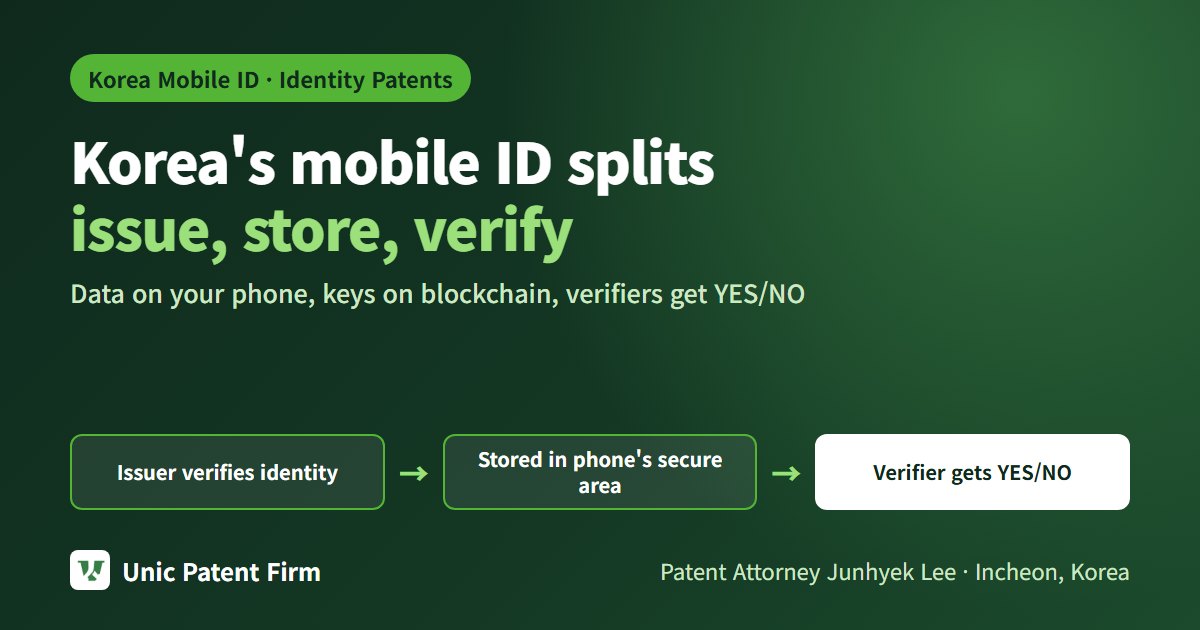
2.2. High security through separated issuance, storage and verification
The defining feature of the mobile ID is that issuance, storage and verification are separated. This is what fundamentally distinguishes it from earlier authentication patents.
| Stage | Content |
|---|---|
| Identity check | Visit to a community service center, check of the physical ID + registration of biometrics such as fingerprints |
| Issuance | Central issuing server of the Ministry of the Interior and Safety and Korea Minting and Security Printing Corporation (KOMSCO) |
| Storage | Encrypted identity information is stored only in the secure area of the user's smartphone; key information for verification is distributed across a blockchain; the central server does not store the original ID data |
So even if a data center is hacked, there is almost no risk of a mass data leak.
2.3. Safe even if the phone is lost
- The encryption key is disabled immediately upon a loss report
- It cannot be used without biometric authentication (fingerprint, face) or a six-digit app password
- The risk of misuse is far lower than with a physical ID
2.4. Only the necessary information is provided
The mobile ID uses a selective disclosure structure. Age verification, for example, works like this:
- The verifier app requests "confirm adult status."
- The smartphone requests verification using the date-of-birth information and the encryption key.
- The blockchain network determines validity by consensus.
- Only a YES / NO result is sent to the verifier app.
Personal information such as name and resident registration number is not left with the service using it.
3. The Overall Structure Seen Through Identity Authentication Patents
| Component | Role |
|---|---|
| Issuing server | Ministry of the Interior and Safety and KOMSCO — issue after verifying identity |
| User device | Stores the encrypted ID (secure area) |
| Blockchain network | Key verification, prevention of forgery |
| Verifier app or institution | Receives only the result (YES/NO) |
The key point is that the issuing server and authentication at the time of use (blockchain) are clearly separated. A related patent is KOMSCO's Korean Patent Publication No. 10-2022-0028870 (mobile ID authentication service method using blockchain-based decentralized identifiers (DID)). Its claims are analyzed in detail in our analysis of KOMSCO's DID and blockchain authentication patent.
4. Where the Mobile ID Is Used
| Field | Examples |
|---|---|
| Finance | Non-face-to-face identity verification at banks such as KB Kookmin Bank |
| Platforms | Naver authentication, public service login |
| Offline | Age verification at convenience stores, civil services at government offices |
It is likely to expand to AI service logins, unmanned stores and access control in smart factories.
5. Opportunities for SMEs and Startups
The mobile ID is not limited to government services. SMEs and startups can use it, or prepare related patents, in fields such as:
- Identity verification at unmanned stores and kiosks
- Real-name and age verification for AI service users
- Access control and permission management systems
- Identity authentication APIs for healthcare, education and fintech services
- Enterprise DID and VC-based authentication solutions
In short, "any digital service that requires trust" is a potential application.
Conclusion: The Core of Identity Authentication Patents Is a Separated Structure
The mobile ID achieves both security and privacy by separating issuance, storage and verification and passing on only the necessary result. If you are preparing an identity authentication service, look to this separated structure and selective disclosure approach to find the patentable points in your own technology.
If you are preparing patent applications for digital identity, DID or security technology, Patent Attorney Junhyek Lee of Unic Patent Firm in Cheongna, Incheon, will review them directly.
Does this apply to your business?
The answer depends on your product, filing schedule and contracts. Talk to a patent attorney directly.
This article is for general information only. Specific cases may be assessed differently depending on the facts. It is based on Korean law as of the publication date.