
Inventive Step, an Essential Requirement for Patents in Korea, Explained With Cases
Junhyek Lee, Patent Attorney, Unic Patent Firm · 2025.07.07
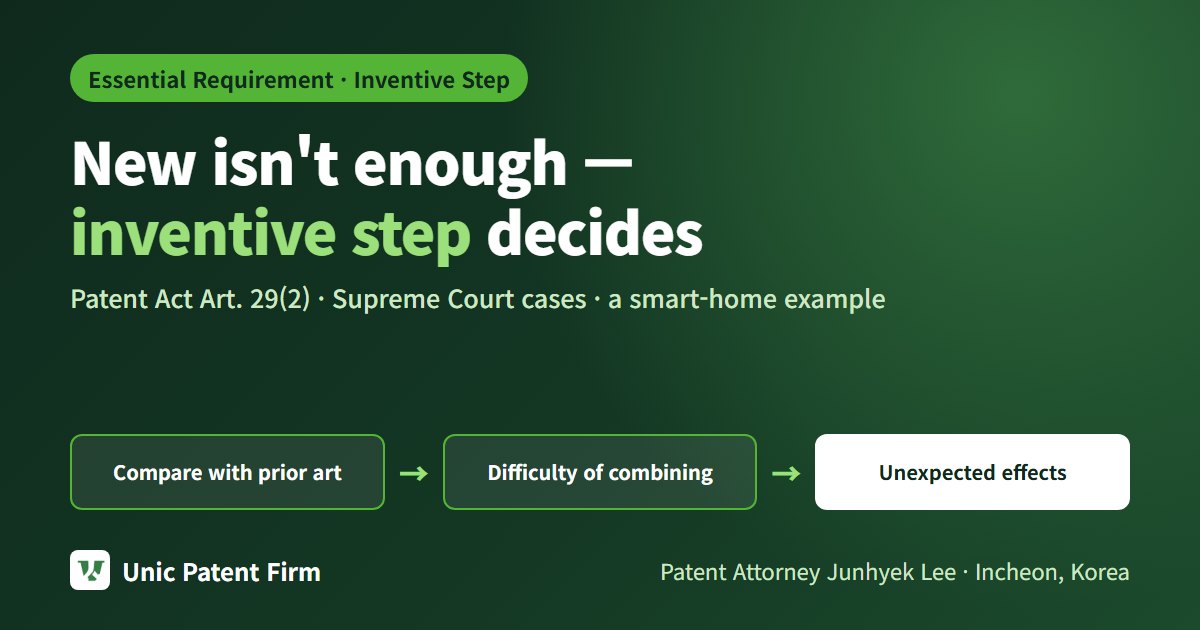
Many founders and developers ask: "I have a good idea — can it be patented?"
A patent is a strong right that can stop third parties from using what is registered, so the patent office grants registration only to inventions that pass examination. That is why being new (novelty) is not enough — you also need inventive step. In this article, Unic Patent Firm in Cheongna, Incheon, explains inventive step through case law and an example.
1. What Is Inventive Step?
1.1. The statute
Where, before a patent application is filed, a person with ordinary skill in the art to which the invention pertains could easily make the invention based on an invention falling under any subparagraph of paragraph (1), a patent shall not be granted for that invention notwithstanding paragraph (1). (Korean Patent Act, Article 29(2))
In other words, technology that anyone could think of, or easily think of, cannot be patented.
1.2. How is inventive step examined?
| Item | Standard |
|---|---|
| Point in time | The time of filing |
| Whose view | A person of ordinary skill in the field |
| Method | Compare with prior art (patents, papers, product manuals, etc.) and judge whether the invention could "easily be conceived" |
2. Standards From Case Law
2.1. Judge the invention as a whole and look at the difficulty of combination (Supreme Court Decision 2005Hu3284, September 6, 2007)
Where a claim consists of multiple elements, the subject of the inventive step assessment is the technical idea as a whole in which the elements are organically combined, not each element independently. Therefore, one must not break the claim into individual elements and merely ask whether each is known, but must examine the difficulty of the configuration as an organically combined whole based on its particular problem-solving principle, also considering the distinctive effect of the invention as a combined whole.
The Supreme Court also asks whether combining the prior art involves particular difficulty, and whether there is a new synergistic effect beyond what known prior art would predict (Supreme Court Decisions 97Hu1610, December 8, 1998, and 2001Hu2269, January 10, 2003, among others).
2.2. No hindsight (Supreme Court Decision 2006Hu138, August 24, 2007)
Inventive step must be judged by whether the invention could easily have been made from the prior art at the time of filing, and must not be judged in hindsight on the premise of already knowing the invention described in the specification. See Winning Inventive Step With the Prohibition of Hindsight for details.
2.3. What to prepare to establish inventive step
- Is there a particular problem-solving principle?
- Does the whole configuration, organically combined on that principle, produce a distinctive effect?
- If key technologies are scattered across several references, is combining them really easy?
- Is there a synergistic effect beyond what the prior art would predict?
3. An Example — Checking Home Conditions by Smartphone
| Item | Content |
|---|---|
| Invention | Technology to measure home temperature and humidity or detect whether someone is present using a smartphone — (1) a smart terminal, (2) temperature, humidity and infrared sensors + an MCU chip installed at home, (3) a program module (sensor data sent → received by the smartphone → displayed) |
| Premise | No device or technology yet measures home temperature from a smart terminal |
| Prior art 1 | Smartphones |
| Prior art 2 | An agricultural data collector that obtains temperature, humidity and soil data with sensors and sends it to an administrator's computer |
- Novelty: no identical technology exists in the prior art, so it is novel.
- Inventive step: if combining prior art 2's measurement technology with a smartphone is not difficult for a skilled person, it will be rejected.
- Factors in judging ease: whether the two are in the same field, whether they share a problem, whether combining them is technically difficult (if prior art 2 cannot be applied as is because it must work with a smartphone, inventive step is possible), and whether the effect is new (being able to check home data directly on a smartphone arguably differs in effect from the prior art).
In reality, most patent applications improve existing technology bit by bit, and examiners and judges decide inventive step based on how much was improved. It is also worth remembering that inventive step involves some subjectivity. So applicants do well to set out in the specification the configuration and effects showing how much they improved on existing technology.
Conclusion: A Small Edge Makes a Patent
Inventive step decides whether a patent is granted or rejected. A new idea alone is not enough; there must be technical progress compared with existing technology. Inventive step is recognized when a solution to a technical problem, an unexpected effect, or results achievable only under specific conditions are shown. How to respond to rejections is covered in Overcoming Inventive Step Rejections.
Drawing on inventive step cases across AI, health, IT and materials, Unic Patent Firm anticipates examiners' reasoning when drafting specifications. If you are struggling with an inventive step rejection, consult Patent Attorney Junhyek Lee of Unic Patent Firm in Cheongna, Incheon.
Does this apply to your business?
The answer depends on your product, filing schedule and contracts. Talk to a patent attorney directly.
This article is for general information only. Specific cases may be assessed differently depending on the facts. It is based on Korean law as of the publication date.