
Accelerated Examination, Provisional Filing and Priority Claims in Korea: Which to Use and When
Junhyek Lee, Patent Attorney, Unic Patent Firm · 2026.11.13
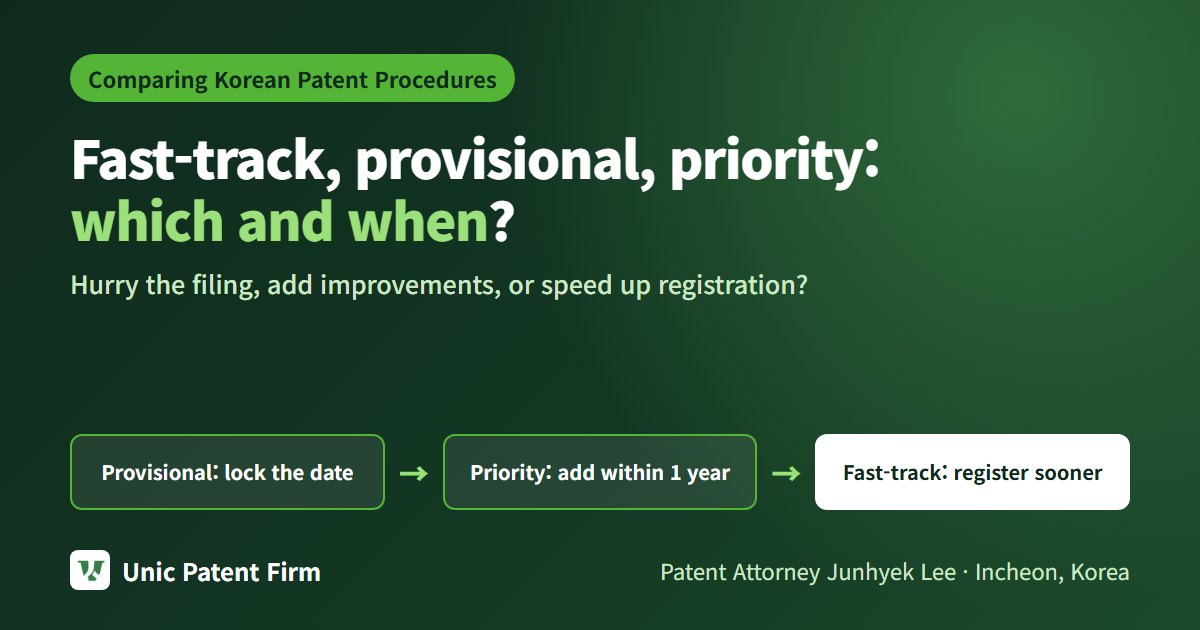
When preparing a patent in Korea, you often hear "accelerated examination," "provisional filing" and "priority claim application." The names sound alike, but the three systems differ completely in purpose and timing.
In this article, Unic Patent Firm in Cheongna, Incheon, uses three situations that come up often in consultations to explain the differences and how to use the systems together.
First, Filing and Registration Are Different
| Item | Patent application | Patent registration |
|---|---|---|
| Meaning | The stage of applying for a patent | The stage of securing the right after examination |
| Main effect | Secures the filing date; the application proceeds | The patent right arises |
| Enforcing the patent | Cannot be enforced on filing alone | Enforceable after registration |
A patent application means submitting documents describing the invention to apply for a patent; registration means receiving a decision to grant after examination and completing registration, including paying the patent fee. The difference is covered in detail in The Difference Between Filing and Registering a Patent.
1. "I Want My Patent Registered Quickly" → Accelerated Examination
This is when you need to secure the patent right quickly because of a product launch or investment.
1.1. Legal basis and purpose
Article 61 of the Korean Patent Act allows applications meeting certain requirements to be examined ahead of others, with details set by the Enforcement Decree and related notices. Examination normally follows the order of examination requests, but waiting too long delays rights when you are already selling a product or about to commercialize. Accelerated examination examines such applications first to support fast protection.
1.2. Main requirements
You cannot apply just because you "want it fast." An examination request must already have been filed (you can request examination and acceleration at the time of filing), and the application must fall within a category set by law. Typical categories include:
- Applications where the applicant is working, or preparing to work, the invention commercially
- Applications by qualifying venture companies and innovative SMEs
- Applications where, after publication, a third party is found to be working the invention commercially
- Applications directly related to export promotion and others specified by law
You also need a request explaining the grounds and supporting evidence. If you apply on the ground of preparing to work the invention, you must show the preparations concretely with prototypes, production equipment, contracts and the like.
1.3. What to keep in mind
Accelerated examination only moves your place in the queue; it does not guarantee registration or relax the requirements. You still need novelty, inventive step and the other requirements.
2. "Drafting Will Take Two Months, but I Want to File Now" → Provisional Filing
The basic structure of the invention is set, but you need time to add data, draft a formal specification and organize the claims — and an exhibition or product announcement is next week. Here you can consider what is commonly called a "provisional filing," an application with a provisional specification. (This refers to Korea's system, not the US provisional application.)
2.1. Legal basis and purpose
Article 42-2(1) of the Patent Act allows filing with a description of the invention but without claims, and Article 21 of the Enforcement Rules sets out how to submit a provisional specification instead of the prescribed format and the subsequent amendment procedure. The aim is to secure a filing date quickly by reducing the time needed to meet formal requirements. But a provisional filing is not a way to "reserve" an idea; it is a patent application containing a description of the invention.
2.2. What materials can be used
- Drawings: acceptable if the technical configuration can be understood from them
- Papers: must explain the technical configuration and operating principle to be protected
- Prototype photos: can be attached in the body, but if the internal structure or operating principle cannot be understood from photos alone, add explanatory text or drawings
- PowerPoint technology presentations: usable if the configuration and operation are concrete
2.3. Caution — later developments do not get the earlier date
If the first materials describe only an A+B structure, you cannot freely add C, developed two months later, to the existing application, because amendments are allowed only within the scope of the original specification and drawings. So distinguish whether "supplementing in two months" means tidying sentences and claims or adding new technology. To add new technology, consider a separate application or a domestic priority claim application.
- Claims must in principle be submitted within 1 year and 2 months of the filing date. If priority is claimed, check the reference date separately; if a third party requests examination, the deadline can come earlier. If not submitted in time, the application is deemed withdrawn.
- A provisional filing alone does not speed up examination. To be examined, you must complete the claims and request examination.
Accepted formats and practical strategy are covered in Securing a Filing Date First With a Provisional Specification.
3. "I Already Filed, but the Final Product Has a Better Structure" → Domestic Priority Claim Application
You first filed an A+B structure, but during development you added C or changed B, improving performance. If the changes are already sufficiently described in the original materials, you can consider amendment or a divisional application; if not, consider a separate application or a domestic priority claim application.
3.1. Legal basis and purpose
Article 55 of the Patent Act allows a later application claiming priority based on inventions described in the specification or drawings of an earlier application. Key limits include one year from the earlier filing date and whether the earlier application has been registered. The aim is to keep the benefit of the earlier date where appropriate while bringing improvements into a single application.
| When | Filing |
|---|---|
| March 1, 2026 | First application for the A+B structure |
| During product development | Improved structure adding C developed |
| November 10, 2026 | Domestic priority claim application covering the original and improved inventions |
3.2. Not everything goes back to March 1
- The same invention described in the first application: judged as of the first filing date
- Improvements first added in the later application: judged as of the later filing date
The exact scope must be reviewed invention by invention. If development is ongoing, it is best to decide on using domestic priority before fixing the registration schedule of the earlier application.
4. The Three Systems at a Glance
| Item | Accelerated examination | Provisional filing | Domestic priority claim |
|---|---|---|---|
| Main purpose | Speed up examination | Secure a filing date quickly | Combine the original invention and improvements in a later application |
| When to use | When fast protection is needed | When disclosure is imminent before formal documents are ready | When technical content is added or improved after filing |
| Legal basis | Patent Act Art. 61 etc. | Patent Act Art. 42-2, Enforcement Rules Art. 21 etc. | Patent Act Arts. 55 and 56 |
| Key condition | Examination request + eligible category | Concrete technical content in the first materials | In principle within 1 year of the earlier filing, before registration |
| Caution | Does not guarantee registration | New technology does not get the first filing date | Added inventions are judged as of the later date |
4.1. Using the three together
- If disclosure is imminent, file first with a provisional specification.
- Within one year, file a domestic priority claim application including the improvements.
- Complete the claims of the later application, request examination and, if eligible, request accelerated examination.
Note that the one-year domestic priority period and the 1 year and 2 months for submitting claims are different deadlines and must be managed separately.
Conclusion: First Ask Whether You Need to Hurry the Filing, the Improvement or the Registration
If you need a filing date fast, use a provisional filing; if you need to add improvements, a domestic priority claim application; if you need registration sooner, accelerated examination. Choose the system that fits and combine them where needed.
If your product structure changed after a decision to grant, or you are unsure whether a divisional or improvement application is needed, consult Patent Attorney Junhyek Lee of Unic Patent Firm in Cheongna, Incheon. What to check after a decision to grant is also covered in Compare Your Product and Claims Before Paying the Patent Fee.
Does this apply to your business?
The answer depends on your product, filing schedule and contracts. Talk to a patent attorney directly.
This article is for general information only. Specific cases may be assessed differently depending on the facts. It is based on Korean law as of the publication date.