
After a Decision to Grant in Korea: Compare Your Product and Claims Before Paying the Fee
Junhyek Lee, Patent Attorney, Unic Patent Firm · 2026.11.01
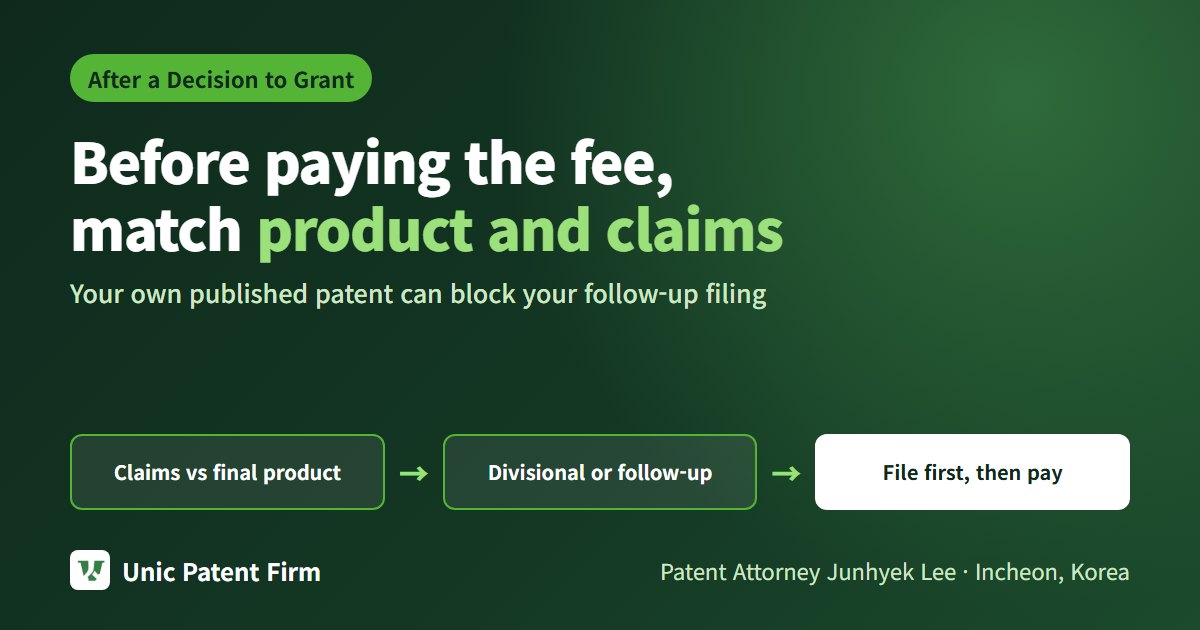
After filing a patent, products and services often change during development. You may change a configuration to improve performance or convenience, or remove parts to cut costs. There is one question you must then ask:
"Can the claims in the decision to grant protect the final product or service?"
Receiving a decision to grant does not by itself mean the product you will launch is fully protected. In this article, Unic Patent Firm in Cheongna, Incheon, explains what to check before paying the patent fee and the order in which to act.
1. You Received a Decision to Grant, but the Product Structure Changed
Suppose you filed on March 1, 2026, requested accelerated examination, and received a decision to grant on October 30 of the same year. The patent fee for the first three years is in principle paid within three months of receiving the decision, completing registration.
Meanwhile, ongoing improvements removed some parts and introduced a new operating method. You have not yet paid the fee. In this case, before paying, it is best to compare the granted claims with the final product and check whether an additional application is needed.
2. When Does the Patent Right Arise, and When Is the Technology Disclosed?
A patent right shall arise upon its establishment registration. (Korean Patent Act, Article 87(1))
Paragraph 3 of the same article requires certain matters to be published in the patent gazette after registration (registration publication). So the registration date, when the right arises, and the publication date, when the technology is disclosed, must be distinguished.
| Date (example) | Meaning |
|---|---|
| Registered November 25 | The patent right arises from this date |
| Published November 30 | Specification and drawings disclosed in the gazette → visible to third parties |
Disclosed technology can be used by third parties to research and file improvements, and can serve as prior art in examining later applications — including your own follow-up inventions.
3. Your Own Published Patent Can Be Grounds to Reject Your Follow-Up Application
What happens if you pay the fee without this review, the patent is published, and then you file an improvement?
| Date | Event |
|---|---|
| Mar. 1, 2026 | Original invention filed |
| Oct. 30, 2026 | Decision to grant |
| Nov. 30, 2026 | Original patent published |
| Dec. 10, 2026 | Follow-up application for the improvement |
The examiner can judge, based on the patent gazette published on November 30, whether the improvement filed on December 10 could easily have been derived (Patent Act Article 29(2), inventive step). If the improvement is a simple part change or routine design change, a rejection for lack of inventive step may be issued based on your earlier gazette alone or combined with other prior art.
- Such prior art is not excluded merely because the applicant is the same.
- Statutory application publication and registration publication are excluded from the grace period rules. Don't assume "I disclosed it myself, so filing later is fine."
Of course, an improvement with features and effects distinguishing it from the disclosed technology can still be registered if it has inventive step.
4. Check Whether the Granted Claims Protect the Final Product
The scope of protection of a patented invention shall be determined by the matters described in the claims. (Korean Patent Act, Article 97)
Protection is therefore judged by comparing the granted claims with the product's actual configuration:
- Are all the claimed elements present in the product?
- Are the relationships between elements the same?
- Have any parts been replaced with different configurations?
- Are any elements missing, or is there something substituting for them?
- Can the doctrine of equivalents apply to the changed parts?
A partial change does not necessarily take the product outside the scope. Conversely, if an essential claimed element was removed with nothing replacing it, it may be hard to stop copies of the final product with that claim. For service inventions, likewise compare the claimed processing steps with the actual service process.
5. How to Respond Depending on the Result
| Comparison result | Response |
|---|---|
| The final product falls within the existing claims | No need to refile; if a newly added structure or function is an important differentiator, consider a separate patent |
| The final structure is already described in the original specification or drawings | Consider a divisional application for separate rights (within three months of receiving the decision to grant, and before registration) |
| New improvements not in the original specification or drawings | Cannot be added to the existing application, so consider a new application or a qualifying domestic priority claim application |
Amendments after a decision to grant are not freely allowed; whether and how far amendment through a request for re-examination is possible must be reviewed separately. Divisional strategy is covered in detail in Why to Consider a Divisional Application Before Paying the Registration Fee.
6. If You Need Another Application: File First, Then Pay
If the existing application has not been published and a new application for the improvement is needed, consider this order:
- Adjust the fee payment schedule within the deadline — to secure time to prepare the follow-up application before publication. The goal is not simply to delay, but to balance the deadline against the need for early rights.
- Organize the improvements and file the follow-up application — set out what changed and what effects result, and draft claims covering not only the final product but also variations competitors might use.
- After filing the follow-up, pay the fee for the existing application — within the deadline.
Conclusion: Before Paying the Fee, Match the Claims Against the Product Once More
If you have received a decision to grant, check before paying the fee whether the final product or service falls within the claims. If more protection is needed, check whether the existing application and the product have been disclosed and choose a divisional or new application as appropriate — and since an earlier published patent can become prior art against your own follow-up, review the order of filing and payment together.
If you have received a decision to grant, Patent Attorney Junhyek Lee of Unic Patent Firm in Cheongna, Incheon, will directly compare your claims and product. The differences between accelerated examination, provisional filing and domestic priority are covered in Accelerated Examination, Provisional Filing and Priority Claims Compared.
Does this apply to your business?
The answer depends on your product, filing schedule and contracts. Talk to a patent attorney directly.
This article is for general information only. Specific cases may be assessed differently depending on the facts. It is based on Korean law as of the publication date.