
Is Selling Only Cartridges or Refills Patent Infringement? Indirect Infringement in Korea
Junhyek Lee, Patent Attorney, Unic Patent Firm · 2026.10.15
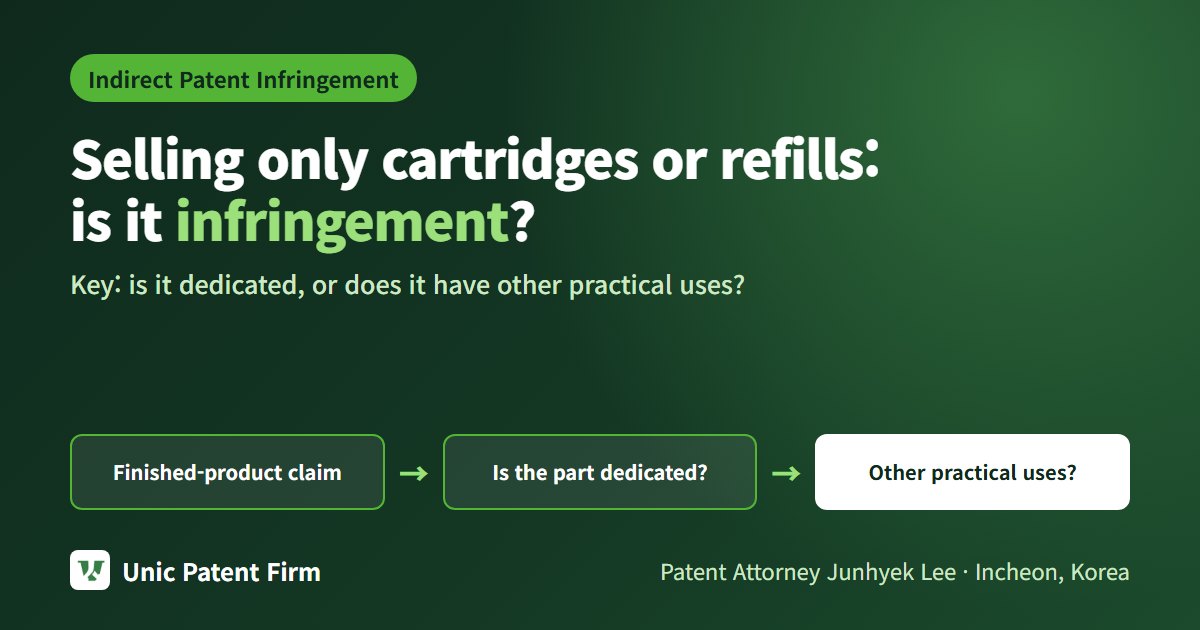
We were recently asked: "If I make and sell only ballpoint pen refills, do I infringe a patent on the whole pen?" The same question can arise with compatible printer cartridges or covers for curling irons.
In this article, Unic Patent Firm in Cheongna, Incheon, explains with case law whether making and selling only parts or consumables can infringe a patent on the finished product — that is, how indirect infringement is judged in Korea.
1. What Is Patent Infringement?
1.1. Literal infringement
Article 97 of the Korean Patent Act sets the scope of protection by what is written in the claims. Literal infringement asks whether the accused product has all the claimed elements and their relationships.
Example: "A ballpoint pen comprising a body, a push mechanism, a spring and a refill having a specific coupling structure"
A refill sold on its own lacks the body, push mechanism and spring, so it does not have all the claimed elements. Literal infringement of the finished-product claim is therefore hard to establish.
1.2. Indirect infringement
Article 127 of the Patent Act deems certain acts to be infringement:
- Product inventions: commercially producing, assigning, leasing, exporting or importing, or offering to assign or lease, an item used only to produce the patented product
- Process inventions: the same applies to an item used only to practice the patented process
So even without making the finished product, making and selling a dedicated part used only to produce the patented invention can be indirect infringement.
1.3. Leading case — laser printer photosensitive drum cartridges
In Supreme Court Decision 98Hu2580 (January 30, 2001), the cartridge at issue had the following features:
- It was an essential element of the patented invention
- It had no other use
- It was not a widely and easily available article
- Replacement was expected from the time the printer was bought
- The patentee made and sold the cartridges separately
The Court found the cartridge to be an item used only to produce the patented product.
2. How Indirect Infringement Is Judged
2.1. Is there a practical use other than producing the patented invention?
First, check whether the part is a dedicated item used only to produce the patented invention. A general-purpose refill or cover that works normally in many non-infringing products is hard to regard as dedicated.
But a claim that "it can be used in other products" needs support. The Supreme Court has held that the other use must be economic, commercial and practical; mere theoretical possibility or brief experimental use is not enough (Supreme Court Decision 2007Hu3356, September 10, 2009). A part that fits other products only after forced modification is assessed differently from one that can be mounted and used normally as is.
2.2. Does the part correspond to the elements of the finished-product claim?
Next, see whether combining or processing the part produces an article with the claimed elements. For example, if projection a on the part fits into groove A on the main body, the likelihood of indirect infringement rises.
- Groove on the body ↔ projection on the part
- Slit on the body ↔ insert piece on the part
- Catch on the body ↔ step on the part
- Fastening portions formed at specific positions and intervals
Whether the part has the specific features needed for the coupling disclosed in the body is evidence for judging whether it is dedicated.
3. Cases
| Case | Result | Reason |
|---|---|---|
| Printer photosensitive drum cartridge (Supreme Court 98Hu2580) | Indirect infringement found | Could not be used in printers not adopting the patented invention → replacement consumables can also be subject to indirect infringement |
| Laminating film for certificates (Supreme Court 2000Da27602, November 8, 2002) | Indirect infringement denied | Being a consumable needed by the device does not make it dedicated, and there was insufficient evidence it was used only to produce that device |
3.1. What about pen refills and curling iron covers? (hypothetical examples)
- Pen refills: a standard refill that works normally in many non-infringing pens is hard to regard as dedicated. But if it implements the patented pen's special coupling structure and has no other practical use, indirect infringement must be considered.
- Curling iron covers: if a patent protects "a curling iron in which a rapid-heating groove in the heating plate and a rapid-heating projection on the inside of the cover fit together," a cover with no projection on the inside that also works normally on ordinary curling irons gives grounds to regard indirect infringement as unlikely.
4. What to Check Before Launching Parts or Consumables
- Direct infringement (including infringement by equivalents)
- Indirect infringement
- Design infringement and so on
For replacement parts in particular, patent exhaustion and the distinction between repair and reconstruction may also be at issue, so don't reach a conclusion based solely on whether the item is dedicated.
Conclusion: Look at the Claims, the Combined Structure and Other Uses Together
If you plan to make and sell parts or consumables such as compatible cartridges, pen refills or curling iron covers, look together at the content of the claims, the structure produced after combination, and practical alternative uses.
If you need an infringement review before launching parts or consumables, or a response to indirect infringement, Patent Attorney Junhyek Lee of Unic Patent Firm in Cheongna, Incheon, will review it directly.
Does this apply to your business?
The answer depends on your product, filing schedule and contracts. Talk to a patent attorney directly.
This article is for general information only. Specific cases may be assessed differently depending on the facts. It is based on Korean law as of the publication date.