
Granted Quickly in Korea? Why to Consider a Divisional Application Before Paying the Registration Fee
Junhyek Lee, Patent Attorney, Unic Patent Firm · 2026.05.06
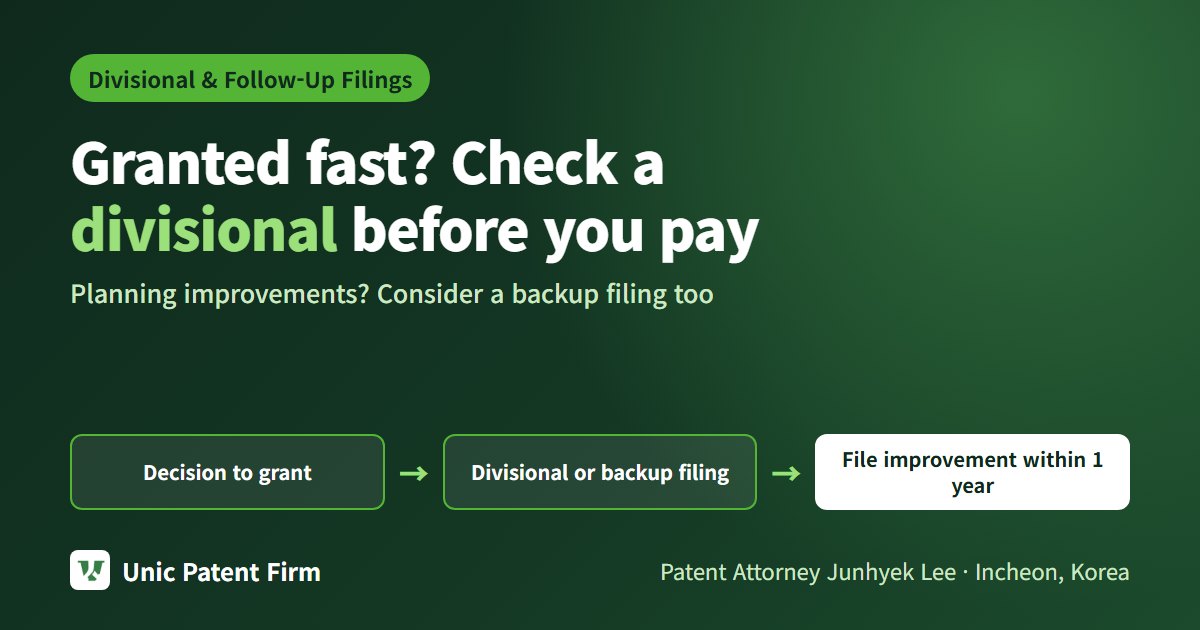
When you receive a decision to grant a patent, the usual step is to pay the registration fee right away. But pausing before paying to ask "Do we need a divisional application?" can pay off later.
Using two real cases from Unic Patent Firm in Cheongna, Incheon, this article explains the advantages and limits of divisional applications and how to use them in practice.
1. Two Cases Where a Divisional Application Was Considered
1.1. Case 1 — A university that checks before paying the fee
After receiving a decision to grant patent A, one university does not pay the registration fee immediately. It first asks the professor in charge whether a divisional application is needed, and only then proceeds with registration.
1.2. Case 2 — A quickly granted patent and a follow-up invention
The CEO of a small company whose patent B had just been granted through our firm (the fee not yet paid, so not yet published) came in to discuss a new patent, C.
C differed from B in structure and manufacturing method, so even after B was registered and published, B seemed unlikely to cause C to be rejected. In such a case, registering B first and filing C afterwards usually causes no major problem.
However, the CEO was preparing about two more patents through a government project within the next year, besides C, and those inventions might be partly related to B. In that situation, as in Case 1, it is worth considering whether a divisional application of the already-granted B is needed.
2. What Is a Divisional Application?
A divisional application is a system that lets you split multiple inventions contained in one patent application and file each as a separate patent. Beyond simply dividing inventions, in practice it is a very useful strategic tool for applicants.
2.1. Legal basis
Where a patent applicant has filed two or more inventions in one patent application, the applicant may divide part of it into one or more patent applications, within the scope of the matters described in the description or drawings originally attached to the application, during any of the following periods. (Korean Patent Act, Article 52(1))
In principle, a divisional application is deemed filed at the time of the original application (Article 52(2)).
2.2. Substantive requirement — almost any application qualifies
The provision says "two or more inventions," but under patent law each claim is one invention. So if you can draft claims different from the original application within the scope of the original description and drawings, a divisional application is possible. In practice, almost any application can be the basis of a divisional.
2.3. When you can file a divisional application
| Stage | Divisional filing window |
|---|---|
| During examination | Any period in which amendments can be made (e.g., the response period) |
| After a decision of rejection | Within 3 months from receipt of the decision |
| After a decision to grant | Within 3 months from receipt of the decision, but only before registration |
2.4. The biggest advantage — the original filing date
A divisional application is not a new filing; it keeps the original filing date. Even if technology was published after the original application, the divisional is examined as of the earlier date.
3. When a Divisional Application Helps
3.1. Securing several patents from one application
You can split the original into several applications, request examination for each and obtain separate registrations.
- When the original contains several embodiments, or covers methods, products, compositions and systems together
- When you register the original as a method and the divisional as an apparatus, securing two patents
3.2. As a response to grounds for rejection
During examination, some claims may be allowable while others are rejected. In that case you can use the following strategy:
| Claims | Handling |
|---|---|
| Allowable claims | Keep them in the original and register quickly |
| Rejected claims | Move them to a divisional application and continue examination |
You secure rights quickly for what is allowable while continuing to argue for the rejected claims separately. Rejected claims are often broader in scope, so if they are eventually granted they can be very valuable against infringers. It is also a way to avoid delaying or endangering the whole registration by arguing too hard against the rejection.
4. Strategy for Each Case
4.1. Case 1 — If claims worth fighting for remain
If any rejected or abandoned claims cover an invention worth fighting for, you can file a divisional application for that part and have it examined again. But if, after reviewing the examiner's reasons, the chance of overcoming them is low, there is no need to file one.
4.2. Case 2 — If you are preparing an improvement after a quick grant
Case 2 is very important in practice. The patent was granted quickly, about six months after filing, and the applicant now wants to file an improved invention C. If C is a partly modified form of B, C may later be rejected over the applicant's own patent B.
| Item | Option 1: Use a divisional application | Option 2: Use a backup (new) application |
|---|---|---|
| Method | File a divisional of B (B′) before registration, and file improvement C based on it | Before registration, file a separate application with the same content as B (BB), then file C claiming priority from BB |
| Deadline for C | Within 1 year from the original filing date | Within 1 year from the filing date of BB |
| Limits and advantages | If the original is registered 6–8 months after filing, only about 4–6 months remain to prepare the improvement | Extends the time to prepare C by at least six months compared with Option 1 |
After one year, new content cannot be added to the earlier application, so whichever option you choose, the deadline for filing C must be met.
Conclusion: If an Important Patent Was Granted Quickly, Consider a Backup Filing
Rather than paying the registration fee as soon as a patent is granted, make it a habit to check whether a divisional application is needed. In particular, if an important patent was granted quickly, for example through accelerated examination, we recommend filing one more application with the same content (a backup filing) before registration. That backup filing makes it easier to patent future improvements such as C.
If you are considering a divisional or follow-up filing strategy for a granted patent, Patent Attorney Junhyek Lee of Unic Patent Firm in Cheongna, Incheon, will review it directly.
Does this apply to your business?
The answer depends on your product, filing schedule and contracts. Talk to a patent attorney directly.
This article is for general information only. Specific cases may be assessed differently depending on the facts. It is based on Korean law as of the publication date.