
Overcoming Inventive Step Rejections in Korea: Answering "Easy to Combine" With Difficulty of Configuration
Junhyek Lee, Patent Attorney, Unic Patent Firm · 2025.11.25
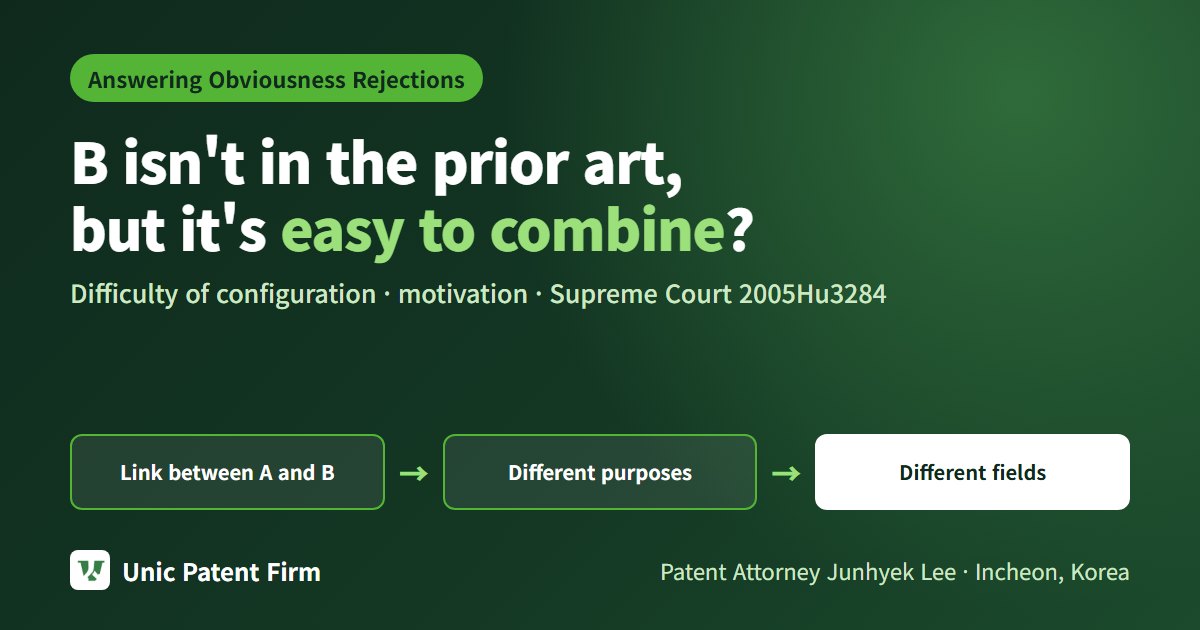
The most common objection in patent examination is a rejection for lack of inventive step (obviousness): "A person skilled in the art could easily make this by combining existing technologies, so it cannot be registered."
We recently handled such a case. The claimed invention was a system of A (an autonomous vehicle) + B (a component that suggests a driving route). The prior art showed only A, not B. Yet the examiner held that "a person skilled in autonomous driving would readily conceive of B and combine it with A for operation," denying inventive step.
In this article, Unic Patent Firm in Cheongna, Incheon, explains the arguments that can overcome such a rejection, focusing on Korean Supreme Court standards and practical strategy.
1. The Basic Concept of Inventive Step
Inventive step asks whether a person skilled in the art could easily have made the invention from the prior art at the time of filing. If it could be easily conceived by slightly modifying existing technology, it may be rejected.
In judging inventive step, one must not merely break the claimed configuration into individual elements and ask whether each is known; rather, one must examine the difficulty of the configuration as an organically combined whole based on its particular problem-solving principle, and also consider the distinctive effect of the invention as a combined whole. (Supreme Court Decisions 97Hu1610, December 8, 1998, and 2001Hu2269, January 10, 2003, among others)
2. Difficulty of Configuration — Was There a Suggestion or Motivation to Combine?
In judging inventive step by citing multiple prior art references, inventive step is denied if the references suggest or motivate combining the cited technologies to arrive at the invention, or, even if not, if it can be recognized that a person skilled in the art could easily arrive at such a combination in light of the technical level, common technical knowledge, basic problems of the field, development trends and industry demands at the time of filing. (Supreme Court Decision 2005Hu3284, September 6, 2007)
Turned around, the difficulty-of-configuration argument is that, at the technical level at the time of filing, a skilled person would have found it hard to adopt the configuration and hard to combine the elements, and could not easily have conceived the invention even with motivation from the prior art or ordinary creativity.
3. Three Questions for Arguing Difficulty of Configuration
3.1. Does the prior art contain anything related to B?
- Are A (autonomous driving) and B commonly used together?
- Does the prior art contain clues or technical needs that would call for B?
| Situation | Assessment |
|---|---|
| A (autonomous driving) and B (beacon-based indoor positioning) are inherently closely related | Easy to combine → inventive step requires something independently innovative in B itself |
| A and B are only weakly related, and nothing in the prior art calls for a function like B | No motivation to combine B with A → favorable for inventive step |
3.2. Do the prior art and the invention share the same purpose and problem?
If their purposes differ, combination is less likely. For example, if the invention (A+B) solves indoor environments where GPS is unavailable while prior art A is GPS-based autonomous driving, their fundamental purposes differ, so there is no motivation to derive B from A and difficulty of configuration can be recognized.
3.3. Is developing and applying B within the ordinary skill of someone in field A?
| Relationship of A and B | Assessment |
|---|---|
| A (autonomous driving) + B (sensors, electronic control) — same field | Easy to combine |
| A (autonomous driving) + B (chemical materials) — entirely different fields | Hard to combine → inventive step may be recognized |
In other words, ask how likely it is that a person skilled in field A would also know technology B.
Conclusion: Show Not That "B Is Missing" but That "Combining A and B Is Hard"
Inventive step is not recognized merely because B is absent from the prior art. What matters more is whether A and B were realistically combinable at the technical level at the time of filing. By examining the elements' relatedness, technical field, purpose and technical motivation, you can find grounds that "combining A and B is not easy" and overcome the rejection. The related principle of not judging with hindsight is covered in Winning Inventive Step With the Prohibition of Hindsight.
If you have received an inventive step rejection, Patent Attorney Junhyek Lee of Unic Patent Firm in Cheongna, Incheon, will build your response directly around difficulty of configuration.
Does this apply to your business?
The answer depends on your product, filing schedule and contracts. Talk to a patent attorney directly.
This article is for general information only. Specific cases may be assessed differently depending on the facts. It is based on Korean law as of the publication date.