
Rebutting "Anyone Could Have Thought of It": Winning Inventive Step With the Prohibition of Hindsight in Korea
Junhyek Lee, Patent Attorney, Unic Patent Firm · 2025.12.09
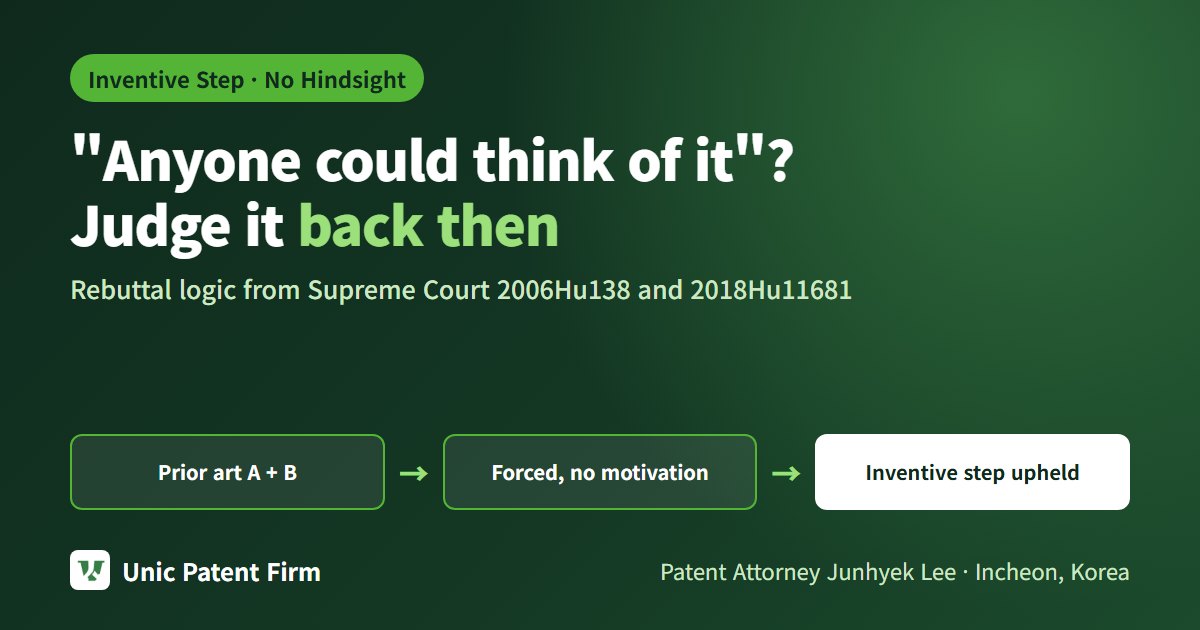
When you turn a new idea into a product and launch it, you always hear: "Haven't I seen this somewhere?" or "Couldn't anyone have thought of that?"
That happened with the paper coffee capsule I developed. With so many plastic and aluminum capsules, and paper cups and paper packaging everywhere, people said, "Isn't making a coffee capsule out of paper obvious?" Yet reaching that "obvious-looking result" took countless trials, errors and tests.
With a finished product in front of you, it is easy to say "Just make it like this." But finding the path from scratch, with no product and no proven performance, is a completely different level of difficulty. Patents are the same. In this article, Unic Patent Firm in Cheongna, Incheon, explains with case law how to use the prohibition of hindsight to establish inventive step.
1. A Common Problem in Patent Examination — Hindsight
When a patent application is filed, the examiner first reads a specification describing the finished invention. Searching for prior art after already knowing the invention's structure, principle and effects makes this kind of judgment easy:
"Anyone skilled in the art could easily have made this invention just by combining prior art A and B."
But this is judging backwards, after already knowing the invention, whether the invention was easy, and it departs from the real difficulty at the time of invention.
| The inventor | The examiner |
|---|---|
| Without knowing the invention at all, finds problems in existing products or processes and arrives at a solution (A+B) after many attempts | Sees the finished answer (the invention) first, then finds similar prior art and combines it "in hindsight" |
To narrow this gap, the Korean Supreme Court clearly emphasizes the prohibition of hindsight in assessing inventive step.
2. What Is the Prohibition of Hindsight?
Inventive step must be judged by whether a person skilled in the art could easily have made the invention from the prior art known at the time of filing. It must not be judged, in hindsight, on the premise that the technology disclosed in the specification is already known. (Supreme Court Decision 2006Hu138, August 24, 2007, among others)
In other words, you must ask whether someone who did not know the invention could easily have come up with its elements or idea by looking at prior art A, B and so on.
For example, suppose prior art A is a long-used autonomous driving technology, prior art B is a sensor technology, and the invention is a driving lane technology C that complements A. The question to ask is:
"At the time of filing, would a person skilled in A and B have thought of driving lane technology C and tried to combine it with A?"
3. Applying It — Supreme Court Decision 2018Hu11681
In an invalidation case (2018Hu11681), the Supreme Court held that the Intellectual Property Trial and Appeal Board's finding that the invention could be derived by combining prior inventions 3 and 4 violated the prohibition of hindsight. The gist of the ruling:
- Prior invention 4 does not show the difference between claim 1 and prior invention 3, namely "a catch formed by bending part of a slide piece with a grip upward at an angle, engaging a stopper on the inside of the upper cover."
- Prior invention 4's resilient catch is attached to the locking plate by screws, which differs from claim 1's catch formed by bending part of the slide piece.
- Combining the two would require replacing prior invention 3's button, stopper and slide piece and substantially changing the relative movement and arrangement of the parts.
- Absent any suggestion or motivation in the prior inventions, even a skilled person could not easily derive claim 1's configuration unless judging in hindsight on the premise of already knowing claim 1.
4. A Checklist for Office Action Responses and Invalidation Trials
This principle is a powerful tool for building counterarguments to rejections for lack of inventive step and in invalidation trials. When the examiner says "combining prior inventions 1 and 2 easily yields the invention," check the following:
- Is it a forced combination? — If, as in the case above, prior invention 1's basic structure must be changed substantially before prior invention 2 can be combined, it may be hindsight.
- Would combining them undermine prior invention 1's purpose or effect? — If prior invention 1 values safety, low cost or a simple structure, and applying prior invention 2 makes it more complex or costly or weakens its original effects (durability, waterproofing, etc.), the motivation to combine can be denied.
- Is there a need to connect the two? — Look at whether their main elements are similar or likely to be shared.
- Does the prior art suggest the invention? — If prior invention 1's specification contains no recognition of the problem, need or direction for introducing prior invention 2's element B, introducing B may be hindsight.
Conclusion: Judge by "Back Then," Not by "After Knowing the Invention"
The prohibition of hindsight comes down to one line: "Don't measure past difficulty from the viewpoint of someone who already knows the invention." Inventive step must be judged as of before filing, based on the prior art and common technical knowledge available to a skilled person in the field. If an examiner's rejection violates this principle, you can rebut it and obtain registration.
If you have received a rejection for lack of inventive step or are disputing inventive step in an invalidation trial, Patent Attorney Junhyek Lee of Unic Patent Firm in Cheongna, Incheon, will directly review the logic of the prior art combination.
Does this apply to your business?
The answer depends on your product, filing schedule and contracts. Talk to a patent attorney directly.
This article is for general information only. Specific cases may be assessed differently depending on the facts. It is based on Korean law as of the publication date.