
Importing a Foreign Brand and Hit With a Trademark Warning in Korea? Invalidating a Squatted Mark
Junhyek Lee, Patent Attorney, Unic Patent Firm · 2026.04.15
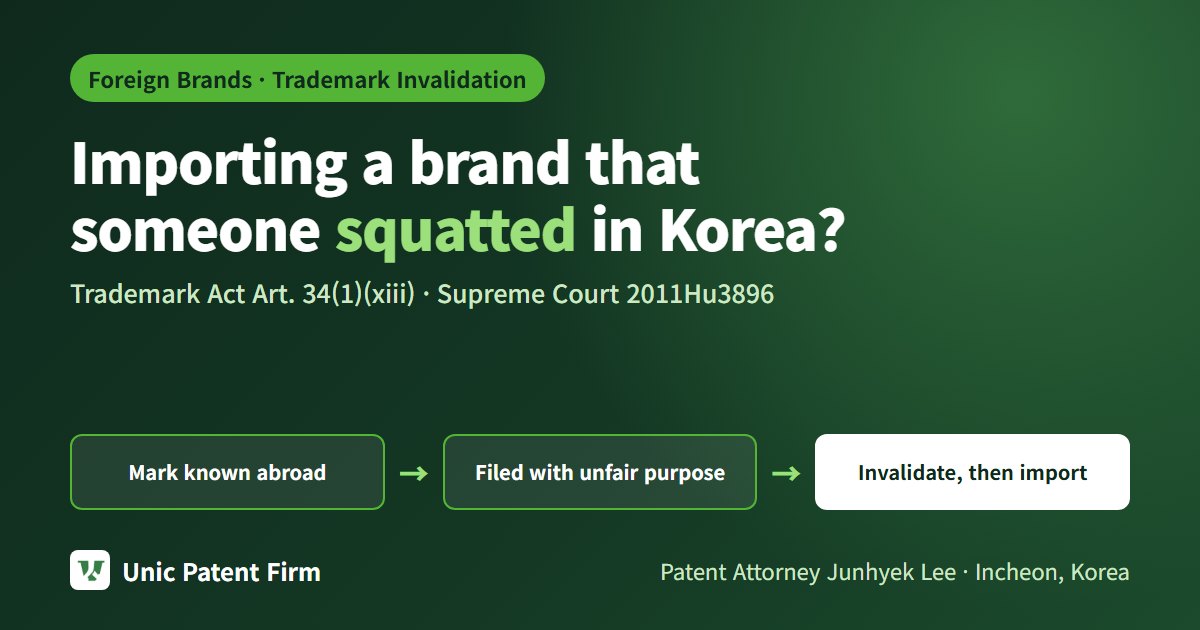
You signed a proper contract with an overseas company, imported its products and finished preparing your advertising. Then a third party that registered the same or a similar trademark in Korea first sends you a warning letter: "This infringes our trademark. Stop selling."
Genuine imported goods carry the foreign brand's trademark, and the packaging shows the trademark and manufacturer. Even so, problems can arise if someone else registered that mark in Korea first. This article explains how to invalidate the registered trademark of the party that sent the letter.
1. Legal Basis for an Invalidation Trial
1.1. Korean Trademark Act, Article 34(1)(xiii)
A trademark identical or similar to a trademark (excluding geographical indications) recognized by consumers in Korea or abroad as indicating the goods of a specific person, which is used for an unfair purpose, such as obtaining unjust profits or causing damage to that specific person
A trademark falling under this provision cannot be registered, and if already registered it can be challenged through an invalidation trial.
1.2. Why does this rule exist?
Sometimes a third party registers a brand already known abroad first (pre-emptive registration) in Korea, and then:
- Blocks genuine imports
- Cuts off distribution
- Demands payment for the mark
Subparagraph (xiii) exists to stop this kind of trademark squatting.
2. Two Requirements for Invalidation
| Requirement | Content |
|---|---|
| (1) Identical or similar to a recognized mark | The registered mark is the same as or similar to a mark recognized by consumers in Korea or abroad as indicating a specific person's goods |
| (2) Unfair purpose | The mark is used for an unfair purpose, such as obtaining unjust profits or causing damage to that specific person |
2.1. The Supreme Court's criteria
The Korean Supreme Court explains the purpose and criteria of this provision as follows (Supreme Court Decision 2011Hu3896, May 9, 2013, among others).
The purpose is to refuse registration of a trademark that a third party, taking advantage of the fact that a trademark recognized as indicating a specific person's goods (the "copied mark") is not registered in Korea, registers and uses by imitating it, in order to ride on the business goodwill embodied in the copied mark and obtain unjust profits, or to cause damage to the owner of the copied mark by impairing its value or obstructing its business in Korea.
The Court's method of assessment can be summarized as follows:
- Whether the mark is recognized as a specific person's: judged by the period, method, manner and scope of use, and whether it is objectively known to a considerable degree in light of trade practice or social norms.
- Whether there is an unfair purpose: judged comprehensively, considering the copied mark's reputation or creativity, the degree of similarity, whether and how the applicant and the original owner negotiated over the mark, their relationship, whether the applicant concretely prepared a business using the mark, the identity, similarity or economic connection of the goods, and trade practice.
- Reference time: these are assessed as of the filing date of the registered trademark.
3. Key Issues When Preparing an Invalidation Trial
3.1. Evidence that the foreign brand is a "recognized mark"
In line with the Court's criteria, prepare materials showing how well known the foreign prior mark is:
- Sales records
- Materials showing the period of use
- Advertising materials
- Other materials showing the degree of recognition
3.2. Similarity of the marks
Not only identical marks but also similar marks are covered. Similarity is assessed under the usual trademark similarity criteria.
3.3. Circumstances showing an unfair purpose
- The relationship between the foreign prior owner and the Korean registrant (for example, whether exclusive rights were ever granted)
- Whether the foreign owner has entered the Korean market
- Whether the registration aims to block imports of the foreign products into Korea
- The registrant's own sales and use record
- The circumstances of the trademark filing
Conclusion: A Genuine Import Is Not a Safe Harbor, but Invalidation Is an Option
Even if you import and sell foreign goods under a legitimate contract, if the brand was pre-emptively registered in Korea by a third party without the foreign company's consent, the fact that it is a "genuine import" alone does not free you from trademark infringement issues.
However, if the Korean registered mark imitates a mark already recognized abroad as a specific person's and was filed with an unfair purpose (free-riding, blocking market entry and the like), you can have it invalidated through a trademark invalidation trial under Article 34(1)(xiii) of the Trademark Act and then import and sell the products in Korea.
If you received a trademark warning letter while importing and selling a foreign brand, Patent Attorney Junhyek Lee of Unic Patent Firm in Cheongna, Incheon, will directly review how the registered mark was filed and whether it can be invalidated.
Does this apply to your business?
The answer depends on your product, filing schedule and contracts. Talk to a patent attorney directly.
This article is for general information only. Specific cases may be assessed differently depending on the facts. It is based on Korean law as of the publication date.