
The Hidden Advantage of Filing a Utility Model and a Design Together in Korea
Junhyek Lee, Patent Attorney, Unic Patent Firm · 2026.04.02
After developing a product, many people wonder: "Should we file a patent, a utility model or a design?" For products with a simple structure in particular, a utility model alone often seems enough. In practice, however, filing a utility model and a design together is sometimes the right strategy.
With a real case, Unic Patent Firm in Cheongna, Incheon, explains the hidden advantages of filing a utility model and a design at the same time.
1. Patent, Utility Model and Design at a Glance
| Item | Patent | Utility model | Design |
|---|---|---|---|
| Subject | Structures, methods, compositions | Mainly structures and devices | Product appearance (shape, pattern) |
| Scope | Broadest | Mainly devices and articles (systems possible) | Appearance |
| Standard | High inventive step | Relatively lower inventive step | Novelty and creativity |
| Term | 20 years from filing | 10 years from filing | 20 years from filing |
The terms are based on Article 88 of the Patent Act, Article 22 of the Utility Model Act and Article 91 of the Design Protection Act. A design right arises on registration and lasts until 20 years after the filing date of the design application.
2. When Should You Choose a Utility Model?
2.1. When a utility model fits
- Inventions (devices) relating to structures or apparatus
- When the difference from existing technology is not as large as for a patent — though there must still be structural or technical differences and advantageous effects resulting from them.
2.2. What to know about utility models
- Utility models are examined just like patents, and likewise grant rights over a technical idea.
- In practice, filing as a patent and converting to a utility model after seeing the examination result is also a good approach, though it adds time and cost before registration.
- Because inventive step can be applied subjectively, utility models are sometimes required to show almost the same inventive step and effects as patents these days.
3. When to Add a Design to a Utility Model
Filing a design alongside is advisable when:
- The structure forming the appearance is simple
- The outer shape is hard to change (for example, when a cylindrical part or a pipe is essential)
- The shape of the appearance itself is distinctive (for example, a particular curved structure, or a part of a particular shape attached to an existing device that improves its performance)
In other words, if the product or part is characterized by its structure (connections, functions, operating process and so on) but that structural feature is closely tied to its outer shape, registering that shape as a design can complement the utility model.
4. Key Advantages of Filing Both
4.1. Double protection makes design-arounds harder
| Right | What it protects |
|---|---|
| Utility model | Structure |
| Design | Appearance |
Protecting both structure and appearance makes it much harder for competitors to design around your rights.
4.2. Using the difference in terms
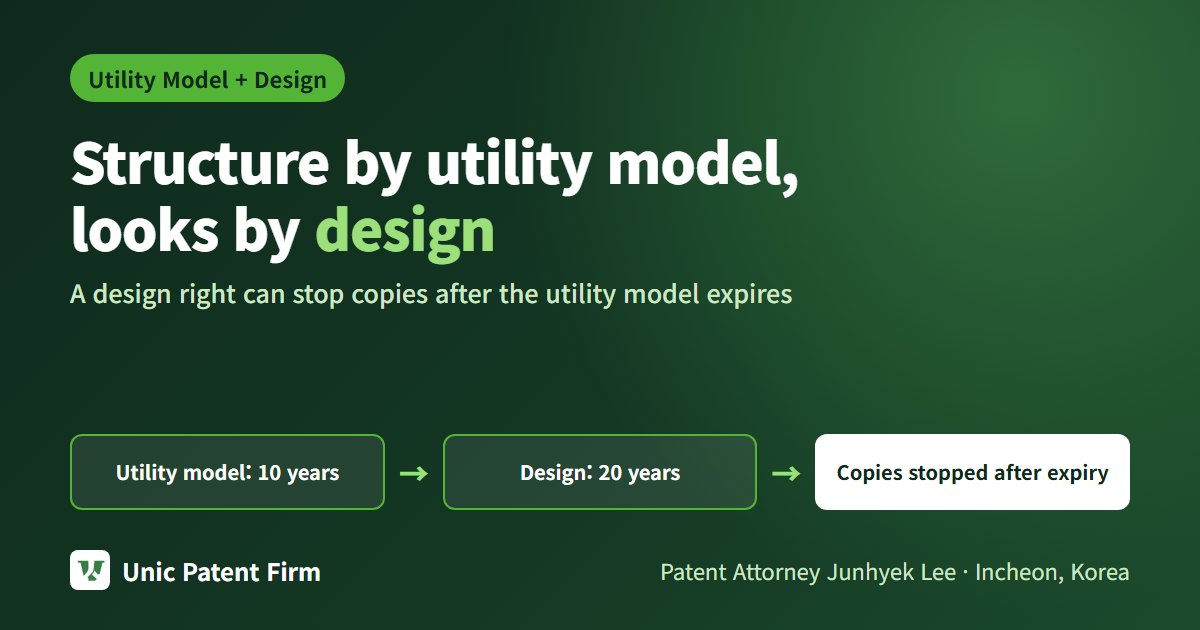
A utility model right ends 10 years after filing, while a design right lasts until 20 years after filing. So even after the utility model right expires, the design right can continue to stop third parties from copying similar products.
5. A Real Case — Stopping Copies With a Design Right After the Utility Model Expired
- A client developed a part for a particular device and obtained a utility model registration for its structure.
- Because of its structural features, the product also had a distinctive appearance.
- At first a utility model seemed sufficient, but we recommended an additional design application, and the client secured a design right as well.
- About ten years later, after the utility model right had expired, a third party began making and distributing products with the same shape.
- The utility model right could no longer be enforced, but the design right was still valid, and on that basis the client was able to stop the third party's sales and block its market entry.
Conclusion: Secure Both Early, Even at a Little Extra Cost
Many people file only a utility model and stop there, which can leave them unable to respond to copies ten years later. For products whose structure and appearance are closely linked, securing a utility model and a design together at the outset, even at a little extra cost, prepares you for the period after the utility model expires.
If you are wondering which combination of rights suits your product, Patent Attorney Junhyek Lee of Unic Patent Firm in Cheongna, Incheon, will review it directly.
Does this apply to your business?
The answer depends on your product, filing schedule and contracts. Talk to a patent attorney directly.
This article is for general information only. Specific cases may be assessed differently depending on the facts. It is based on Korean law as of the publication date.