
More Important Than Registration: Patent Claim Scope and Office Action Strategy in Korea
Junhyek Lee, Patent Attorney, Unic Patent Firm · 2026.03.31
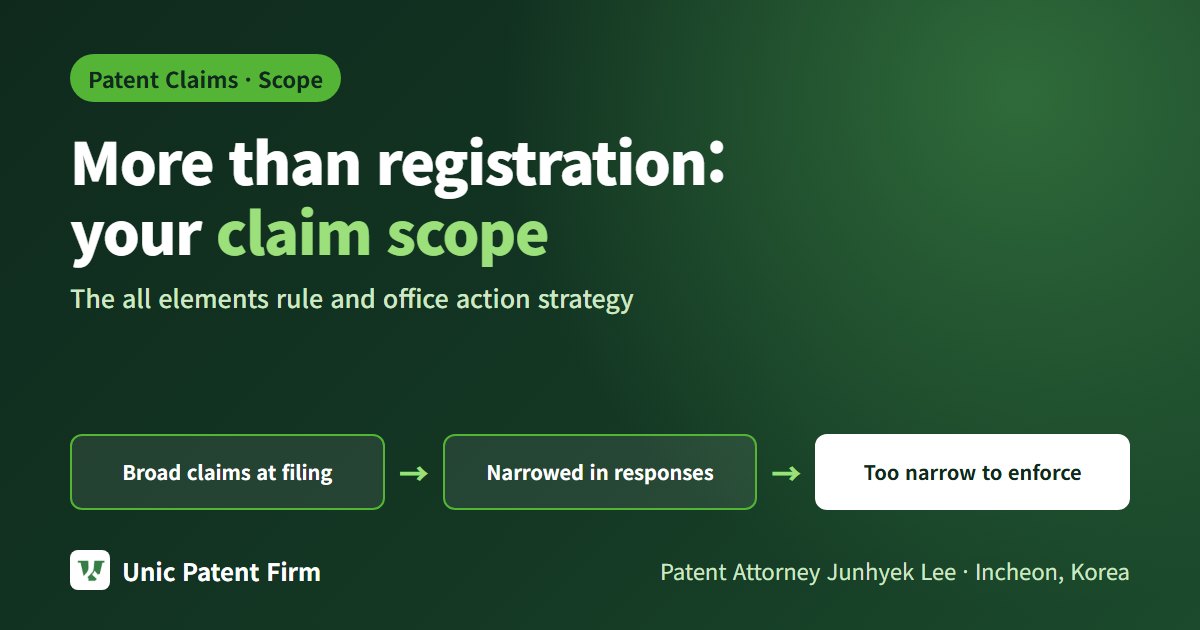
In business, a competitor's product often looks as if it infringes your patent. Many clients come to us saying "Isn't this obvious infringement?" and ask us to send a warning letter.
But quite often the claims were narrowed during examination before registration, and the patent as registered cannot support an infringement claim. In this article, Unic Patent Firm in Cheongna, Incheon, explains how patent infringement is judged and why you should be careful not to narrow your claims too much when responding to an office action.
1. How Infringement Is Judged — The All Elements Rule
Patent infringement is not judged by impressions or surface similarity. Korean patent law and case law apply the All Elements Rule.
Infringement is recognized only if the other party's product includes every element recited in a claim of the registered patent.
- If even one element is missing, there is no infringement.
- Even if the function is similar, there is no infringement if the elements differ.
This is why clients ask, "It looks the same, so why isn't it infringement?" Legally, the answer can be completely different.
2. The Basis for Comparison Is Always the Registered Patent
| Side | Basis for comparison |
|---|---|
| Your side | Always the claims of the registered patent |
| The other side | The product actually sold or used |
Published applications and the claims as originally filed are not the basis for comparison. In practice, claims are drafted broadly at filing but usually narrowed substantially during examination (office action responses). So a product may infringe the published specification but not the registered one.
3. How Claims Get Narrowed During Office Action Responses
3.1. What is a notice of grounds for rejection?
It is the procedure in which the examiner notifies the applicant of the examination result (grounds for rejection) and gives an opportunity to respond. Typically the examiner cites three to five similar prior patents, and the patent attorney files arguments and amendments to obtain registration.
3.2. Two strategies — registration-first vs protection-first
| Item | Registration-first | Protection-first |
|---|---|---|
| How to amend | Narrow the claims as the examiner requests, describing elements at length | Narrow only as far as needed to keep the difference from prior art, trying to keep the scope broader than the examiner would allow |
| Chance of registration | High | Lower |
| Time to registration | Shorter (one round of amendment and arguments) | Longer (if rejected, argue again through re-examination) |
| Cost | One response | Two responses plus the re-examination fee |
| Scope after registration | Narrower — enforcement may be difficult later | Kept as broad as possible — enforceable later |
To obtain the broadest possible rights, you effectively need to be prepared for one decision of rejection. In practice, however, many applicants prefer quick registration for government projects, certifications or investment.
4. Differences Between the Korean and US Examination Systems
As a technology latecomer, Korea has made fast examination, fast registration and shorter examination periods key policies. Unless the number of examiners increases substantially, maintaining fast examination makes it hard to give applicants many opportunities to amend and argue.
| Item | Korean IP Office (KIPO) | US Patent and Trademark Office (USPTO) |
|---|---|---|
| Opportunities to amend | Limited (about 1–2 rounds) | Relatively ample (Non-Final → Final OA, responses possible even after Final) |
| After rejection | Re-examination request needed (official fee + attorney fees) | RCE (Request for Continued Examination), relatively flexible |
| Claim amendment tendency | Conservative — claims narrowed substantially to register in one go | Active — scope maintained through repeated responses |
| Examination focus | Fast processing | Giving opportunities to secure rights |
Conclusion: What Matters Is Not Whether It Registers, but What Rights You Get
When planning a filing strategy, don't just ask "Will it register?" Decide in advance which way to go:
- Narrow the claims conservatively for quick registration, or
- Respond actively to secure the broadest possible scope, even if it takes longer
Keep in mind that a patent can be "registered" on paper yet fail to stop any third-party design-around, becoming nearly useless. We also believe the examination system should be improved to give applicants more flexible opportunities to amend so that patentees can secure adequate scope. This goes beyond applicants' interests; it raises the level of technology protection across industry and strengthens real innovation.
If you have received an office action and are unsure how to amend, or want to know whether your registered patent can support an infringement claim, Patent Attorney Junhyek Lee of Unic Patent Firm in Cheongna, Incheon, will review it directly.
Does this apply to your business?
The answer depends on your product, filing schedule and contracts. Talk to a patent attorney directly.
This article is for general information only. Specific cases may be assessed differently depending on the facts. It is based on Korean law as of the publication date.