
AI Patent Filing Guide for Korea: How Machine Learning and Generative AI Patents Differ
Junhyek Lee, Patent Attorney, Unic Patent Firm · 2026.01.22
More and more people want to file patents that use artificial intelligence (AI). In consultations we are often asked: "How should a generative AI patent be written differently from a machine learning patent?"
Using an invention that analyzes fine dust levels, stress indicators and accident data with two kinds of AI as an example, Unic Patent Firm in Cheongna, Incheon, compares how to file machine learning and generative AI patents and summarizes the points you must watch when drafting AI patents.
1. Machine Learning Patents — "Predict With Numbers and Learn Correlations"
The core of a machine learning patent is prediction based on quantitative data. The input (X) and the answer (y) must be clear.
1.1. Example input data (structured data)
Fine dust levels, stress indicators and accident data are the core inputs; the rest are supporting data.
| Category | Input items | Type | Description |
|---|---|---|---|
| Environmental data | PM2.5, PM10, ozone, NO₂ | Real numbers | Fine dust and air pollution levels |
| Weather data | Temperature, humidity, wind speed | Real numbers | Environmental confounders |
| Time information | Day of week, weekend or not | Categorical | Affects accident patterns |
| Stress indicators | Stress score (1–10), HRV | Numeric | Biometric and self-reported |
| Lifestyle patterns | Sleep hours, activity level | Numeric | Stress adjustment |
| Accident labels | Traffic accident type, number of accidents, casualties | Answer (y) | Prediction target |
1.2. What can be patented
With such data you can statistically analyze the correlation between fine dust levels and stress indicators and the traffic accident risk as stress increases. For example, if you can derive the following as a first- or second-order function, a patent application can be based on that relationship:
- An accident risk score according to fine dust levels
- The probability of an accident according to changes in stress indicators
Practical note: writing the specific coefficients or numerical ranges of the function directly into the claims can make the scope of protection too narrow. It is better to draft the claims around the relationship structure and how the variables are combined.
2. Generative AI Patents — "Explain the Situation and Suggest Actions"
| Stage | Content |
|---|---|
| Basic input | Fine dust levels, stress indicators, accident data and so on |
| Additional training | Existing statistics and studies on fine dust and traffic accidents, papers on stress and cognitive decline, traffic safety policies and public guidelines, past accident cases |
| Analysis | Use machine learning or statistical results as first-stage inputs, combined with additionally learned text, policy and case data |
| Output | Provide the analysis results, explain them in language people understand, suggest actions or prevention guides, and offer reasonable interpretations or alternatives even for inputs outside the statistical range, based on learned context |
2.1. Example generative AI input data
| Category | Input data | Type | Description |
|---|---|---|---|
| Analysis result | Accident risk 0.42 | Summary figure | Machine learning result |
| Environment summary | "Fine dust bad, rising for 3 days" | Text | Situation description |
| Personal condition | "5 hours of sleep, HRV down" | Text | Condition information |
| Additional training data | Literature on accidents, environment and psychology | Unstructured | Pre-training |
| Output conditions | Alert, consultation or report format | Template | UX |
As a result, generative AI produces explanation-centered output such as: "Today, fine dust and accumulated fatigue may raise your accident risk. Take extra care when driving at night."
3. What to Watch When Drafting AI Patents
3.1. "Using AI" alone does not make it patentable
Phrases like "analyzing with machine learning" or "explaining with generative AI" alone make it very hard to establish inventive step.
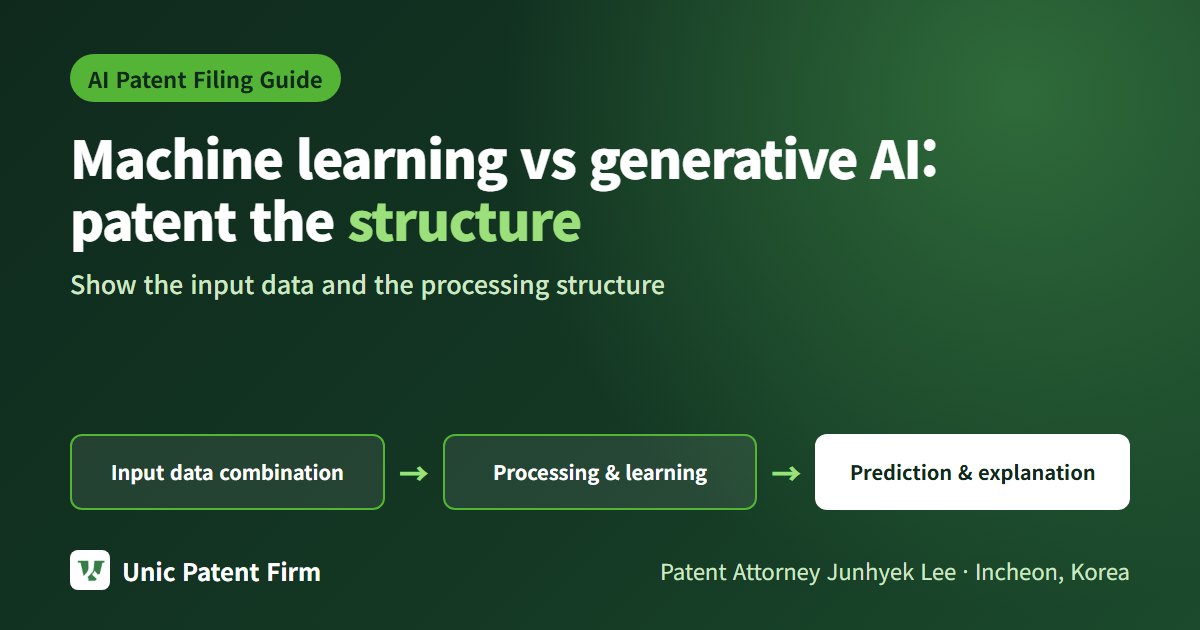
3.2. The core is "input data + processing structure"
A patent must clearly show:
- Which combination of input data is used
- Whether stress works as a mediating variable
- The model structure linking fine dust → stress → accidents, that is, "a learning model that predicts accident behavior by combining environmental and biometric data"
3.3. Additional points for generative AI patents
For generative AI patents, beyond the machine learning predictions, you need to clearly describe a system structure that generates personalized action guides or prevention messages by combining:
- The pre-training structure for data on fine dust, accidents and stress
- How policy data, accident cases and psychological state information are combined
- The specific preprocessing (data cleaning) steps, such as noise removal and normalization of stress indicators
Conclusion: Design What Goes In, How It Is Processed and What Comes Out From the Start
If you are preparing an AI-based service or research, the most important thing is to clearly design from the start what data goes in, how it is processed and what results come out. Even if your invention ends with machine learning predictions, it is worth also considering a patent that includes generative AI.
If you are preparing an AI patent application, Patent Attorney Junhyek Lee of Unic Patent Firm in Cheongna, Incheon, will directly review your data structure and claim design.
Does this apply to your business?
The answer depends on your product, filing schedule and contracts. Talk to a patent attorney directly.
This article is for general information only. Specific cases may be assessed differently depending on the facts. It is based on Korean law as of the publication date.