
Parameter Patents in Korea: How to Register Inventions That Structure Alone Cannot Define
Junhyek Lee, Patent Attorney, Unic Patent Firm · 2025.12.05
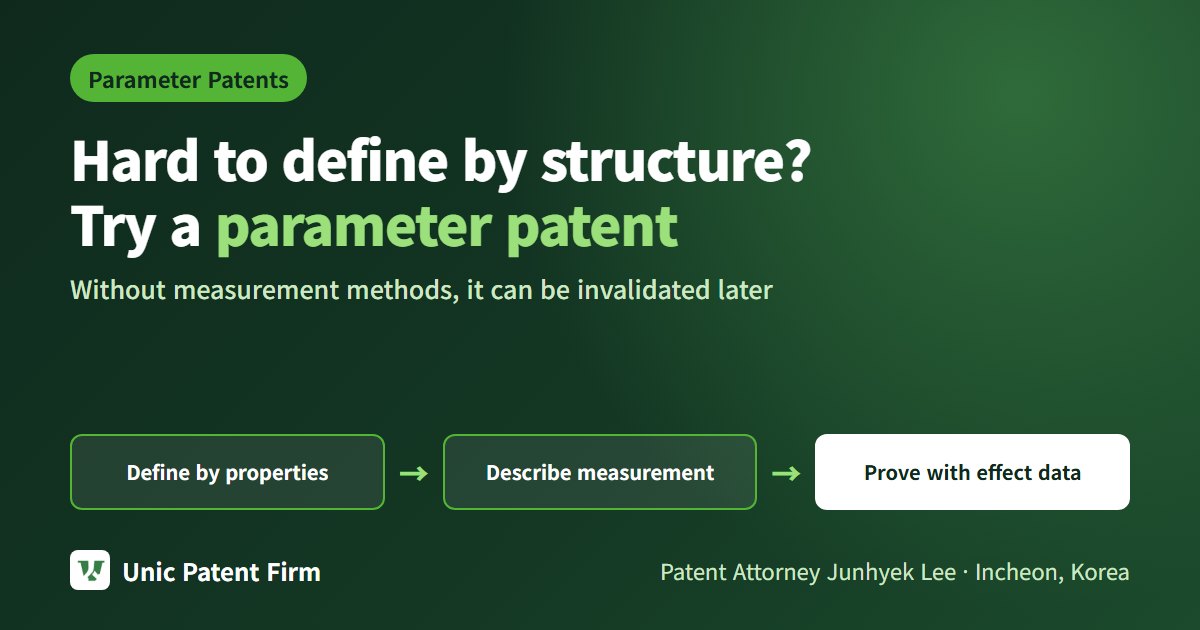
Sometimes you make a product or material with better performance by a different method, but the difference is hard to explain by structure alone, making patent protection difficult.
For example, the polymer used in a car tire may be the same as before, yet durability improves dramatically when certain physical properties such as density, glass transition temperature and elastic modulus are met at a given temperature. For inventions distinguished by performance and property values rather than structure (shape, composition), it is advantageous to seek a patent as a "parameter invention."
In this article, Unic Patent Firm in Cheongna, Incheon, explains the concept, requirements and pitfalls of parameter patents, with case law.
1. What Is a Parameter Invention?
It is an invention in which a newly created material or process is defined by physical, chemical or biological property values or by correlations among several variables. It is used when:
- It is hard to characterize the product itself by structure alone (chemical formula, molecular weight, functional groups, etc.)
- It is hard to define a process invention clearly by its steps alone
In such cases the invention is defined by property values, physical properties and correlations (functions, etc.).
Example: "A rubber composition with crystallinity of 40–55% and Tg of −15 to −5 °C" — if using this rubber in car tires improves wear resistance by 50% or more, the combination of crystallinity and Tg, rather than the rubber's composition or basic structure, is the core of the invention.
2. Conditions a Parameter Invention Must Meet
2.1. The parameters must support novelty and inventive step
The key is not the parameters themselves but whether the material or method they define has new effects compared with existing technology. For example, if a synthetic polymer is hard to specify by molecular weight or repeating-unit arrangement alone, you specify it by combining parameters such as viscosity, crystallinity, glass transition temperature (Tg) and density, and obtain registration by proving that the combination performs differently from known polymers.
2.2. The chance of registration tends to be high
Parameter inventions are usually defined by new combinations of variables or correlations, so the same combination rarely appears in the prior art, and it is hard for examiners or opponents to find known technology with the same combination. Well-chosen parameters therefore tend to give a relatively high chance of registration in terms of novelty and inventive step.
2.3. But public interest and description requirements are applied strictly
A parameter patent grants exclusive use of specific parameters and ranges, so whether that exclusivity runs against the public interest is also considered. Two points are especially important:
- Can the effect be achieved by known technology? — If the properties of the polymer defined by the parameters (e.g., tensile or torsional strength suitable for tires) can be equally achieved by known polymers outside the parameter range, or by known methods without the parameters, inventive step may be denied.
- Enablement (reproducibility) — the description requirement
If a person skilled in the art, in light of the technical level at the time of filing, cannot use the production method specified by parameters based on the description of the invention without undue experimentation or special knowledge, the description requirement under Article 42(3)(i) of the Patent Act is not met. (Supreme Court Decisions 2013Hu525, September 24, 2015, and 2017Hu1298, December 30, 2021, among others)
In other words, the measurement method, measurement conditions and technical meaning of each parameter value must be described in detail.
3. Case Study — A Polycrystalline Silicon Parameter Patent That Was Invalidated
Claim 1 of Korean Patent No. 10-1356688 is a method of producing polycrystalline silicon as follows:
- A reaction gas containing a silicon-containing component and hydrogen is introduced into a reactor through nozzles, and the reactor contains heated filament rods on which silicon is deposited
- As a function of the fill level (FL), the ratio of rod volume to the reactor's empty volume, the Archimedes number (Ar), representing the flow conditions in the reactor,
- lies between Ar = 2000 × FL−0.6 (lower limit) and Ar = 17000 × FL−0.9 (upper limit) when FL is 5% or less, and is 750 to 4000 when FL exceeds 5%
It is a typical parameter invention defining flow conditions by the correlation (formula) between fill level and Archimedes number. Yet this patent was finally invalidated after an invalidation trial and litigation. The gist of the reasoning:
- The invention is characterized by optimizing deposition by coordinating process variables so that the Archimedes number stays within a set range, so the values of the process variables carry important technical meaning.
- Yet the specification does not describe how to measure the rod volume (Vrod) that determines the fill level, or the reactor wall temperature (Twall) and volumetric flow rate (Q) that determine the Archimedes number.
- On the evidence submitted, it cannot be said that a skilled person could easily know how to measure these values at the priority date → insufficient description (not enabled).
Rod volume can be calculated geometrically, and wall temperature and flow rate can be measured with sensors and flowmeters, so one might ask, "Isn't that common knowledge?" But the Supreme Court's position is that as long as these values are essential elements defining the technical core (the flow conditions), their measurement methods and conditions must be stated clearly.
4. What a Parameter Patent Specification Must Include
| Item | Required content |
|---|---|
| Parameter definition | Formula, units, physical and chemical meaning |
| Measurement method | Equipment, sensors, sample preparation conditions, test standards, etc. |
| Where and when measured | At which process stage and location the measurement is taken |
| Reproducibility | A skilled person must be able to easily reproduce the same properties under the same conditions |
| Technical meaning | Explanation of the principle and effect of why performance improves in that range |
| Effect data | Comparative data on performance (strength, durability, efficiency, etc.) as the parameter changes |
Don't just state numerical ranges; describe the measurement methods and conditions concretely and prove with data the effects that appear only within that range.
5. Deciding Whether to Go With a Parameter Patent
Because a parameter patent limits the invention to specific variables and ranges, the scope of protection is also fixed to those parameters and ranges. Also consider:
- Whether the scope becomes too narrow
- Whether proving infringement becomes difficult because the other party's process or property values are hard to check directly
- Whether the invention truly cannot be specified with common properties such as tensile strength, hardness or viscosity
Where possible, we recommend first characterizing the invention with widely used property values and conditions rather than introducing new parameters, and adopting a parameter strategy as a supplement when those alone cannot explain the core of the invention.
Conclusion: Measurement Methods and Effects, Not Just Numbers, Protect Your Patent
A parameter patent is a good way to protect inventions that are hard to describe by structure, and it tends to register well, but without measurement methods and reproducibility it can be invalidated even after registration. The key is to include the parameter definitions, measurement methods and effect data in the specification without omission.
If you are preparing a materials, chemical or process invention as a parameter patent, Patent Attorney Junhyek Lee of Unic Patent Firm in Cheongna, Incheon, can help directly with specification design.
Does this apply to your business?
The answer depends on your product, filing schedule and contracts. Talk to a patent attorney directly.
This article is for general information only. Specific cases may be assessed differently depending on the facts. It is based on Korean law as of the publication date.