
How Are Patent Damages Calculated in Korea? A Ruling That Awarded Ten Times the Claim
Junhyek Lee, Patent Attorney, Unic Patent Firm · 2025.08.18
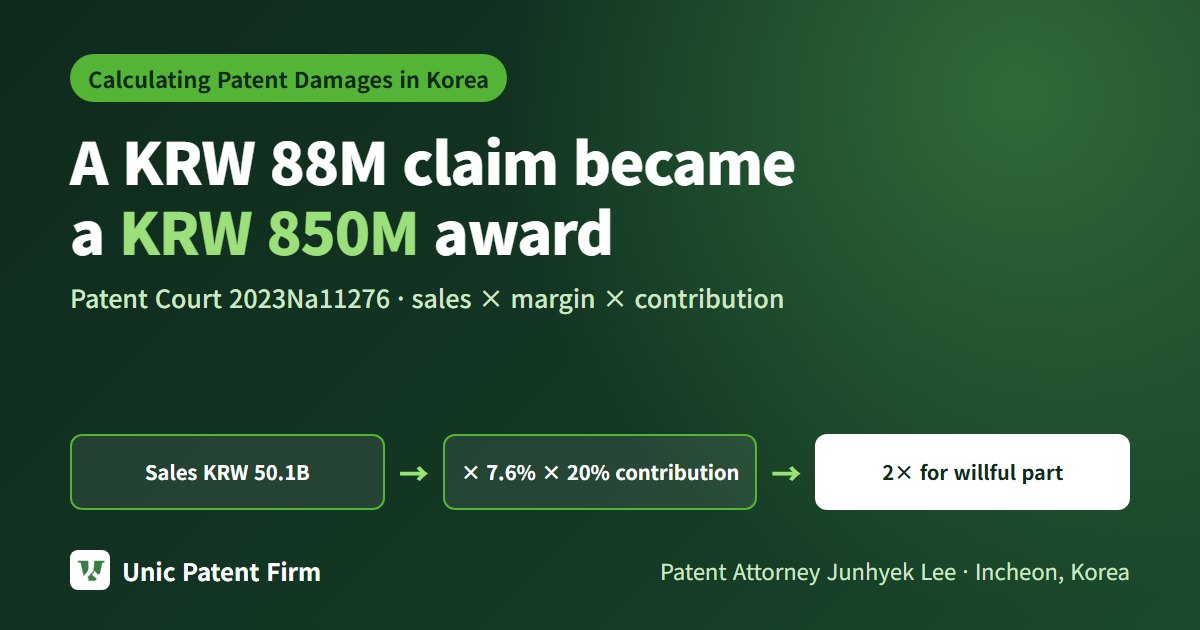
In patent, trademark and design infringement lawsuits in Korea, how are damages calculated? Recently there have been rulings in which damages rose sharply after willful infringement was found.
In this article, Unic Patent Firm in Cheongna, Incheon, summarizes how damages are calculated in Korea and walks step by step through a Patent Court ruling that awarded about ten times the amount originally claimed.
1. The Case — Patent Court 2023Na11276 (Decided October 31, 2024)
| Item | Content |
|---|---|
| Damages in the complaint | About KRW 87.93 million |
| Willful infringement | Found → enhanced damages of 2× applied |
| Final award | About KRW 850.66 million |
The court applied a marginal profit rate and a contribution rate to the infringer's total sales of about KRW 50.1 billion, calculating base damages of about KRW 760 million (a 20% contribution rate, reflecting only the patented feature's share of total sales). It then split the damages before and after the enhanced damages system took effect and applied the 2× multiplier for willful infringement only to the later portion.
KRW 670 million (before) + KRW 88 million (after) × 2 ≈ KRW 850.66 million
2. Korea's Three Methods for Base Damages
The Patent Act, Trademark Act and Design Protection Act provide three main ways to determine base damages (Patent Act, Article 128).
| Method | Description | Calculation | Features |
|---|---|---|---|
| (1) Patentee's lost profits | Quantity the patentee would have sold but for the infringement × profit per unit | Units of infringing goods sold × unit profit | Favorable when the patentee makes and sells the product |
| (2) Presumption from the infringer's profits | The infringer's profit from the product is presumed to be the patentee's loss | Sales of infringing goods − cost − expenses | Low infringer margins mean low damages |
| (3) Reasonable royalty | The fee the infringer would have paid for lawful use | Sales of infringing goods × royalty rate | Useful when sales are large but margins hard to compute |
The Patent Court case above applied method (2), the presumption from the infringer's profits.
3. How Method (2) Was Applied in the Ruling
- Total sales: total sales of products practicing the patented invention — about KRW 50.1 billion in this case
- Marginal profit rate: direct costs (materials, manufacturing, direct labor, etc.) are deducted from sales to obtain marginal profit; fixed (overhead) costs are generally not deducted. Here it was set at 7.6% based on the National Tax Service expense ratio.
- Contribution rate: the share of the product's overall functions attributable to the patent — about 20% here, meaning only 20% of sales was attributed to the invention.
- Base damages: KRW 50.1 billion × 0.076 × 0.2 ≈ KRW 760 million (KRW 670 million before + KRW 88 million after the system took effect)
- 2× for willfulness: the 2× multiplier (KRW 176 million) was applied only to the KRW 88 million of infringement after the system took effect, for a final award of about KRW 850 million.
4. Why the Court Found Willfulness
- The infringer could know of the patent — as an industry player, it was in a position to easily learn of it
- Infringement continued after warnings and notice — sales did not stop before or after the suit was filed
- The infringing product's structure and function were substantially the same as the patent — the design-around argument was rejected
5. For Enhanced Damages, When the Infringement Occurred Matters
As this ruling shows, enhanced damages apply only to infringement after the system took effect. When introduced in 2019, the cap for willful infringement was three times; after later amendments it is now up to five times. Two times was applied in this case, but if willfulness is proven for infringement after the amendment, awards could become much larger.
Conclusion: In the Era of Willful Infringement Damages, Plan Your Strategy Early
In Korea, damages of up to five times are now available for willful patent, trademark and design infringement. The amount depends heavily on which calculation method you choose, how you prove sales, margins and contribution rates, and how you show willfulness.
We compare US and Korean damages in Why Are US Patent Damages So Much Larger Than Korea's? If you need help responding to infringement or calculating damages, work out your strategy from the start with Patent Attorney Junhyek Lee of Unic Patent Firm in Cheongna, Incheon.
Does this apply to your business?
The answer depends on your product, filing schedule and contracts. Talk to a patent attorney directly.
This article is for general information only. Specific cases may be assessed differently depending on the facts. It is based on Korean law as of the publication date.