
RAG-Based LLM Patents in Korea: Who Is Filing and in Which Fields?
Junhyek Lee, Patent Attorney, Unic Patent Firm · 2025.07.28
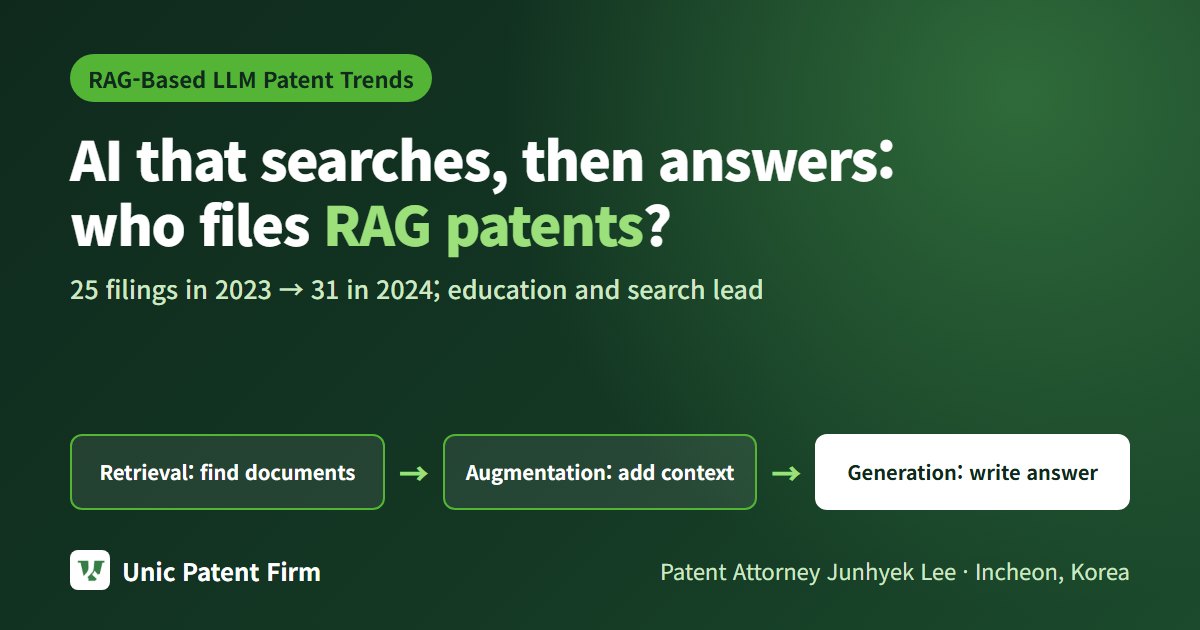
RAG-based LLMs are one of the foundational technologies of generative AI. How many patents are being filed in Korea, by whom, and in which fields?
In this article, Unic Patent Firm in Cheongna, Incheon, explains how RAG works in plain terms and summarizes RAG-based LLM patent filings in Korea (annual filings, main applicants, technology fields) and what they suggest.
1. What Is RAG-Based LLM Technology?
RAG (Retrieval-Augmented Generation) complements the limits of large language models (LLMs) by retrieving relevant information from external knowledge bases to improve the accuracy and reliability of answers.
| Stage | Description |
|---|---|
| Retrieval | For the user's query, fetches relevant text from external documents (FAQs, papers, internal data, etc.) by vector or keyword search |
| Augmentation | Feeds the retrieved text (context) into the LLM together with the query |
| Generation | The LLM generates an accurate, fact-based answer from the query and context |
Example: "When was ChatGPT released?" → RAG retrieves a document containing "ChatGPT release date: 2022.11.30" → the LLM generates "ChatGPT was released on November 30, 2022."
1.1. Main technical components
| Component | Description |
|---|---|
| Vector DB | Embedding-based database for search (e.g., FAISS, Pinecone) |
| Text embedding | Converts sentences into vectors (e.g., BERT, OpenAI Embedding) |
| Retriever | Module that searches similar documents (dense, BM25, etc.) |
| Generator | A large language model such as GPT |
| Chain | Combines retrieval and prompts (e.g., with LangChain) |
2. Analysis of RAG-Based LLM Patent Filings in Korea
2.1. Filings by year
About 25 applications were filed in 2023 and about 31 in 2024. This is the early filing stage for generative AI and RAG, with companies filing intensively to stake out the technology.
2.2. Top seven applicants
| Applicant | Other | Multilingual learning | Conversational response | Information retrieval | Total |
|---|---|---|---|---|---|
| YOL Co. (Seocho, Seoul) | 1 | – | 1 | – | 2 |
| URP Co. (Gangseo, Seoul) | – | – | – | 4 | 4 |
| Persona AI Co. (Gangnam, Seoul) | 3 | 1 | 2 | – | 6 |
| Naver Corporation (Bundang, Seongnam) | 1 | – | – | 1 | 2 |
| Rebellions Inc. (Bundang, Seongnam) | 1 | – | – | 2 | 3 |
| Cuver Co. (Bundang, Seongnam) | 1 | – | 2 | – | 3 |
| Chungnam National University Industry-Academic Cooperation Foundation (Yuseong, Daejeon) | 1 | – | 1 | – | 2 |
Most top applicants are small and mid-sized AI specialists or generative AI solution providers (e.g., URP — multi-question answer generation; YOL — generative AI based on logistics data; Persona AI — RAG for multilingual learning). Among large ICT companies, only Naver has filed two applications; filings by large companies have not yet taken off. That leaves an opening for companies that plan their strategy.
2.3. Filings by technology field
| Field | Filings | Content |
|---|---|---|
| Education | 19 | AI tutors, multilingual learning, personalized learning recommendations |
| Search | 12 | Semantic search, question-answering systems, FAQ recommendations |
| Conversational chatbots | 6 | Multi-turn QA, role-based chatbots, conversation simulation, situational responses |
| Advertising and marketing | 5 | Personalized content generation, automatic product descriptions |
| Medical | 4 | Automated diagnostic documents, medical information QA |
| Other | 12 | E-commerce, sentiment analysis, customs and trade, internal document summarization, psychological assessment |
3. What the Filing Data Tells Us
- Early in diffusion but highly concentrated: RAG-based LLM patents were filed intensively in 2024, signaling fierce competition to enter the market early, with further growth expected.
- Startups and SMEs lead: small and mid-sized AI companies are moving faster than large corporations to stake out the technology.
- Diversifying applications: beyond education, search and chatbots, filings extend to logistics, law, customs, psychological assessment and translation, with notable growth in generative AI patents combined with traditional industries.
- Policy and investment suggestions: stronger support for startup R&D and patent strategy, wider use of accelerated examination for generative AI patents, and field-specific (education, medical, search, etc.) roadmaps for combining LLMs and RAG.
Conclusion: Education and Search Lead; Industry-Fusion Patents Are Next
Patents in education are currently the most active, and search and chatbots are emerging as major applications. Advertising and medical fields also have large markets and can quickly become practical, and many "other" filings combine generative AI with existing industries, reflecting a technology convergence trend.
If you need patent filings or prior art searches for RAG or LLM-based services, Patent Attorney Junhyek Lee of Unic Patent Firm in Cheongna, Incheon, will review them directly.
Does this apply to your business?
The answer depends on your product, filing schedule and contracts. Talk to a patent attorney directly.
This article is for general information only. Specific cases may be assessed differently depending on the facts. It is based on Korean law as of the publication date.