
Generative AI Meets the Food Industry: Patent Strategy for AI That Designs Taste
Junhyek Lee, Patent Attorney, Unic Patent Firm · 2025.07.21
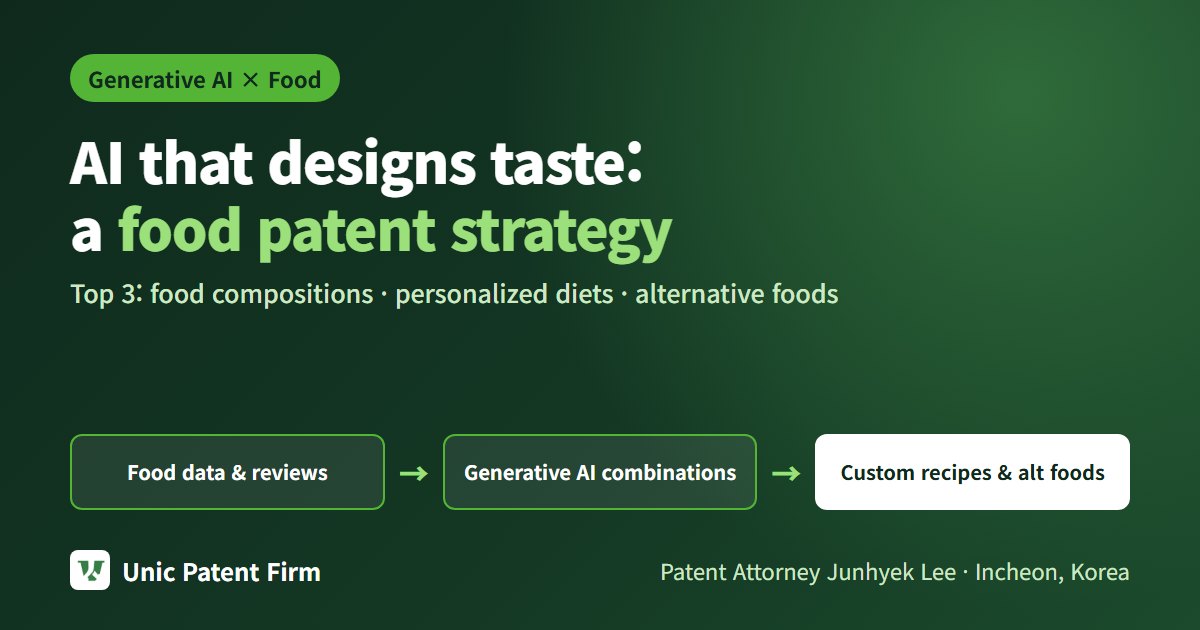
Generative AI is not just for writing text or making images. It has started being used to design taste, aroma and texture too.
In this article, Unic Patent Firm in Cheongna, Incheon, looks at how generative AI is used in the food industry, which areas benefit most, real-world examples, and the direction for patent strategy.
1. Generative AI Across the Food Industry
| Category | Generative AI applications | Impact | In use? |
|---|---|---|---|
| Food compositions (incl. sauces) | Proposing new seasoning combinations, designing flavor compositions from customer reviews, personalized compositions from health data | Very high (especially personalized sauces, functional compositions) | Yes (Givaudan, NotCo) |
| Processing and storage | Generating optimal processing conditions after analyzing raw materials, simulating storage scenarios | Medium (much structured data) | Partly (AI optimization exists, little generative use) |
| Packaging and containers | Packaging designs tailored to reviews and distribution, generating packaging copy and designs | Medium (effective for packaging marketing) | – |
| Processes and equipment | Simulating new line layouts, automatically generating process manuals and guide videos | Limited (focus on optimization rather than generation) | – |
| Distribution and logistics | Product description content based on preference trends, automated recommendation copy | Very high (content creation) | Yes (Korean e-commerce and delivery platforms trialing AI copy) |
| Consumer interface and diet analysis | Diet content from health data, AI chatbots for personalized diets and recipes | Very high | Yes (ZOE, MealGenie, Whisk) |
| Alternative and future foods | Alternative food combinations from existing food databases, protein blends considering environment and nutrition | Very high (unstructured combinations) | Yes (NotCo — NotMilk, NotBurger) |
| Sauces and seasonings | New seasoning combinations from flavor patterns, sauce recipes for specific customers | High | Yes (Givaudan — generative AI for flavors) |
2. Top Three Areas With the Greatest Impact
- Food compositions and sauces: new recipes, combinations and personalized design can drive product innovation, with recommendations based on consumer taste and health data.
- Consumer interface and personalized diets: AI trainers and diet content based on health information, easily integrated into healthcare apps.
- Alternative foods: very effective for designing alternative protein and fat combinations with environmental and nutritional efficiency in mind, and strong at designing new structures from existing data.
3. Food Companies Using Generative AI
| Company | Application |
|---|---|
| NotCo (Chile) | Generates plant-based meat and milk recipes with its generative AI "Giuseppe" (partnering with Coca-Cola and Kraft) |
| Givaudan (Switzerland) | Proposes new flavor and seasoning combinations with generative AI |
| Whisk (Samsung Next) | Generates personalized recipes from users' diet information |
| MealGenie | Automatically generates cooking content from simple ingredients |
| ZOE | Generates AI diet content from personal health data |
Conclusion: AI That Designs Taste — Patents Come From Data and Combination Structures
In the food industry, generative AI can design new flavors, support personal health and take the environment into account. Because it finds and organizes data and characteristics people tend to miss, it saves R&D time and labor, and the data it provides can spark new ideas and insights.
Unic Patent Firm has extensive experience filing and registering patents in AI, healthcare and food. If you need patents for food compositions or AI recipe and diet services, Patent Attorney Junhyek Lee of Unic Patent Firm in Cheongna, Incheon, handles everything personally, from consultation to drafting the specification.
Does this apply to your business?
The answer depends on your product, filing schedule and contracts. Talk to a patent attorney directly.
This article is for general information only. Specific cases may be assessed differently depending on the facts. It is based on Korean law as of the publication date.