
Generative AI Patent Filing Guide: Can AI-Made Fitness Training Content Be Patented?
Junhyek Lee, Patent Attorney, Unic Patent Firm · 2025.07.09
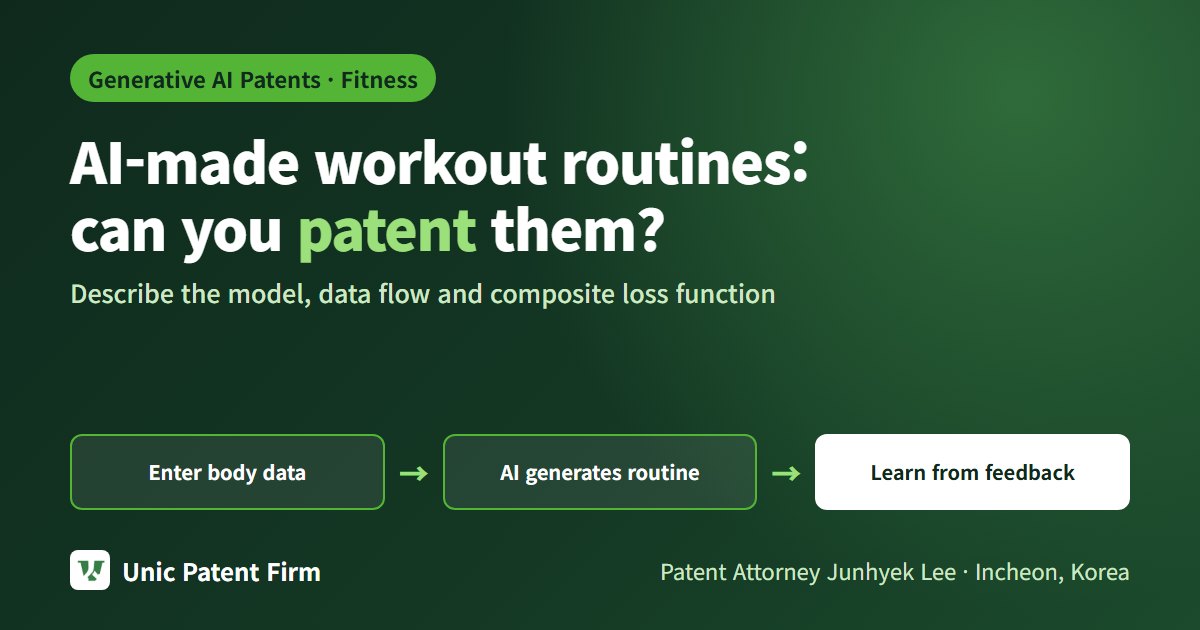
Have you seen "AI personalized workout routines" on YouTube or in apps? We are now in an era where AI does more than show exercises — it creates fitness content itself, tailored to the user's body and goals.
Such generative AI content can be protected by patents if it is technical. In this article, Unic Patent Firm in Cheongna, Incheon, uses generative AI-based fitness content as an example to explain a concrete patent filing strategy.
1. Filing, Registration and the Procedure
- Application: the technology has been submitted to the patent office. The filing date is secured, but registration is decided after examination.
- Registration: the right is finally granted after passing examination, and exclusive rights can be exercised from then on.
| Stage | Description |
|---|---|
| Filing | Submit the specification and other documents |
| Examination request | Request substantive examination (within 3 years of filing, or the application is deemed withdrawn) |
| Notice of rejection and response | Argue against the examiner's views or amend |
| Decision to grant | Pass examination, pay the fee → obtain the patent right |
2. Example — A Generative AI "AI Trainer"
- When the user enters height, weight, fitness goals and other physical information,
- the AI automatically generates a 30-minute daily routine based on learned data,
- and delivers it as video, audio and text through a smartphone app.
3. What This Technology Needs to Be Registered
| Requirement | Description |
|---|---|
| Novelty | Must differ from previously disclosed content generation methods |
| Inventive step | Must show technical improvement in AI model structure or processing over existing technology |
| Description requirement | The specification must describe the AI model structure, data flow and input–output relationships |
3.1. What to include in the specification (examples)
| Item | Example |
|---|---|
| Training data | Tens of thousands of training videos, user motion analysis data |
| Preprocessing | Pose extraction, speed classification, exercise intensity categories |
| Model structure | CNN+LSTM-based generative model (can be combined with image and text generation models) |
| Loss function | A composite loss based on routine accuracy + user response prediction accuracy |
| System flow | User input → user profiling → content request → AI routine generation → reflect user feedback → routine update |
| UI | Daily routine, exercise names, repetitions, reference video thumbnails |
3.2. Reference case — a soccer training content patent (10-2024-0071290)
An "image processing-based soccer training content generation system" has AI automatically compose training content from input images, poses and training goals. A fitness content AI can similarly be described as motion analysis + AI model + routine generation + feedback updates.
4. Raising the Odds of Registration — the Loss Function
A loss function expresses numerically the error between the model's prediction and the actual value; the model learns repeatedly to reduce it.
Data input → model computation → prediction → loss calculation → backpropagation → parameter update
| Loss type | Description | Example |
|---|---|---|
| Accuracy-based | Difference between the target and the AI output | Correct movement vs generated movement |
| Response-based | Difference between predicted and actual user responses (clicks, preferences, feedback) | User satisfaction prediction loss |
| GAN-based | How distinguishable real and generated content are | Fitness video generation |
| Multi-objective optimization | A composite loss considering the above together | The AI trainer example here |
A multi-objective loss means not simple routine generation but personalized content generation + content improvement reflecting feedback, showing both technical progress and commercial potential. Presenting the input–output flow, loss evaluation criteria and feedback structure with diagrams can raise the odds of registration.
Conclusion: Workout Content Can Be Patented
Even workout content is a technical creation if it is not mere video but generated by AI for each user and improved through repeated learning. Patenting it enables exclusive commercialization. Designing input data and processing structures for AI patents is also covered in AI Patent Filing Guide.
Unic Patent Firm has extensive experience filing patents in converging fields such as AI fitness content, digital healthcare and education. From filing strategy and drafting to Korean and overseas (PCT, US, Europe) patents, Patent Attorney Junhyek Lee of Unic Patent Firm in Cheongna, Incheon, helps directly.
Does this apply to your business?
The answer depends on your product, filing schedule and contracts. Talk to a patent attorney directly.
This article is for general information only. Specific cases may be assessed differently depending on the facts. It is based on Korean law as of the publication date.