
ChatGPT Said It Was Fine, So Why Trademark Infringement? Why You Need a KIPRIS Search
Junhyek Lee, Patent Attorney, Unic Patent Firm · 2025.06.06
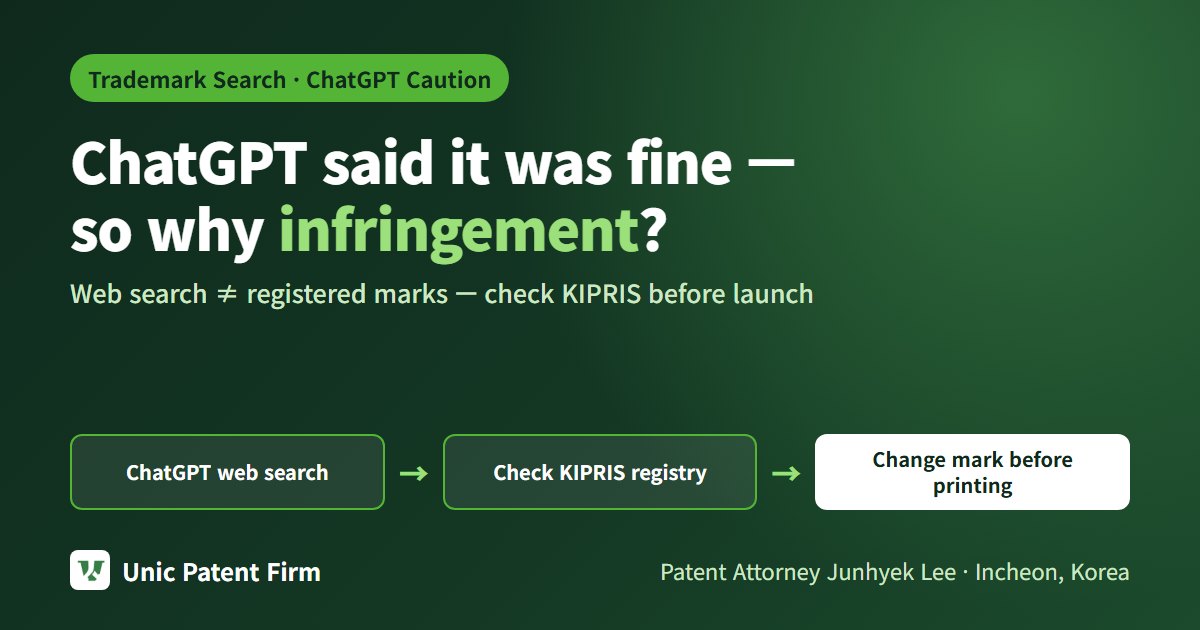
An SME in Incheon, Company A, ran into a serious problem just before launching a new brand. "We searched the mark and were told there was no problem!" It turned out the "search" had been a question to ChatGPT.
In this article, Unic Patent Firm in Cheongna, Incheon, uses Company A's real case to explain what to watch when using ChatGPT for trademark searches and what you must know before registering a mark.
1. The Case — An "a+b" Mark Where "b" Was Already Registered
The mark Company A asked us to review was made of two separable words, "a+b" (structured like "Samsung (a) Aqua (b)" or "Apple (a) Rider (b)").
For such marks, you must check each of a and b separately for similar marks and distinctiveness. Our review found no similar mark for a, but Company K had already registered a mark identical to b.
- Filing as is would likely be refused, and
- printing and launching the product as is could have led to a trademark infringement suit from Company K.
2. ChatGPT Is Not a Trademark Search Tool
| Item | ChatGPT | Patent office database (KIPRIS) |
|---|---|---|
| Checking registered marks | Not possible | Possible |
| Checking online sales | Possible (web search) | Not possible (needs a separate web search) |
ChatGPT can search the web but cannot access the Korean IP office's trademark registration database (as of this writing). It therefore cannot tell you which marks are registered.
3. How It Was Resolved
We told Company A it should not use the mark (and that registration would also be difficult). The staff member was flustered: "We've already finished the packaging design and are preparing to print — is there any way to keep using it?"
The only way to keep it would have been to invalidate or cancel Company K's mark, which, considering the circumstances, was not easy. So we advised again that since printing had not started, it was better to change the mark.
4. Why Did This Happen?
An hour or two later, Company A called back. While preparing the brand and design, they had searched on their own but not found Company K's mark; instead they had asked ChatGPT whether any "a+b" products were being sold online, and ChatGPT answered that none were currently on sale.
5. What to Watch When Checking Marks With ChatGPT
- If you ask about registrability, ChatGPT cannot access the patent office database, so instead of search results it advises you to consult a patent attorney — which is the right answer.
- ChatGPT can, however, find products sold online through web search. The problem is that web results and KIPRIS results can differ.
- Many marks registered with the patent office do not show up on the web: the owner may have registered without launching a product yet, or switched to another mark.
6. Luckily, Before Printing — Losses Minimized
Company A consulted us just before printing and decided to change the mark. They revised the mark and packaging design, printed, and filed the new mark. Had they launched unaware, it could have led to product recalls, damages and harm to the brand.
Conclusion: Check Your Mark During Development, Before Launch
ChatGPT is convenient but is not a tool for checking registered trademarks. Before launch, during development, it is safest to check registered marks on KIPRIS and review registrability and infringement risk. How to search trademarks on KIPRIS is covered in How to Search Trademarks on KIPRIS and Checking Prior Similar Marks by Similarity Group.
Unic Patent Firm is based in Cheongna, Incheon, and offers online and on-site consultations even if you are far away. If you need a trademark review before launching a new brand, contact Patent Attorney Junhyek Lee anytime.
Does this apply to your business?
The answer depends on your product, filing schedule and contracts. Talk to a patent attorney directly.
This article is for general information only. Specific cases may be assessed differently depending on the facts. It is based on Korean law as of the publication date.