
Security Patents After Nusantao IP v. Samsung: Encrypting Sensor Data Before It Hits the Bus
Junhyek Lee, Patent Attorney, Unic Patent Firm · 2025.12.11
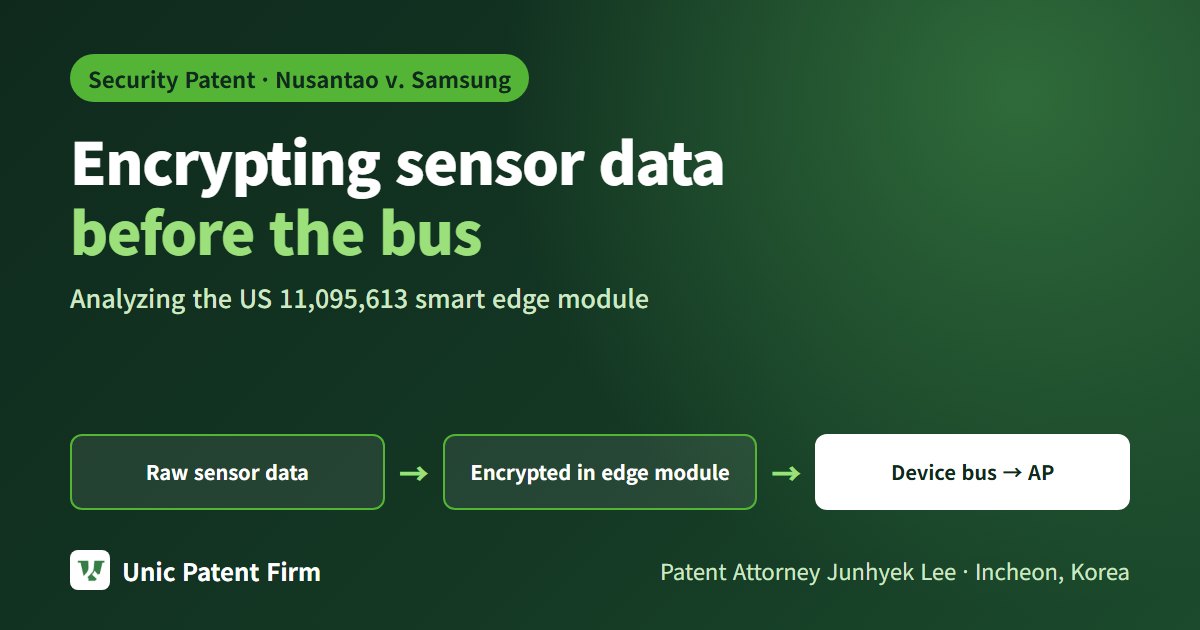
A notable lawsuit recently caught the IT industry's attention. According to a Bloomberg report on December 1, US patent assertion entity Nusantao IP LLC sued Samsung Electronics and its US subsidiary (SEA) for patent infringement.
The claim is that Samsung's Knox Vault security platform uses the company's patented technology without permission, and the accused products are wide-ranging: Galaxy smartphones, tablets, TVs, smartwatches and home appliances.
Rather than debating whether Samsung actually infringed, Unic Patent Firm in Cheongna, Incheon, analyzes the asserted patent itself and draws lessons for security patent strategy.
1. Patent Summary — US 11,095,613 B2
| Item | Content |
|---|---|
| Title | System of smart edge sensors |
| Filing date | March 27, 2019 |
| Grant | 2021 |
1.1. Claim 1
A smart edge module configured to be inserted between a communication bus of an electronic device and a sensor, the electronic device having a device processor running a device operating system, the smart edge module comprising: an interface adapter configured for receiving raw data from the sensor; a bus adapter configured for handling communications with the device bus; a module bus coupled to the interface adapter and bus adapter; a module processor configured for encrypting the raw data; a module memory storing a module operating system; and an encryption accelerator configured for acceleration encryption of the raw data.
In short, it is a smart edge module inserted between the communication bus and a sensor of an electronic device whose processor runs a device operating system, comprising:
| Element | Role |
|---|---|
| Interface adapter | Receives raw data from the sensor |
| Bus adapter | Communicates with the device bus |
| Module bus | Internal data transfer |
| Module processor | Encrypts the data |
| Module memory | Stores its own operating system |
| Encryption accelerator | Speeds up encryption |
The key is inserting a security module between the sensor and the device bus so that raw sensor data is encrypted before it travels on the bus.
Sensor → Smart Edge Module (encryption and preprocessing) → Device Bus → AP and memory
1.2. What is a device bus?
It is the data highway inside a smartphone connecting sensors, memory, modem, camera and so on to the CPU. Data from the camera, microphone or fingerprint sensor travels over the bus to the AP (CPU). This patent proposes a new security scheme in which data passes through a security module and is sent as encrypted raw data before it reaches the bus.
2. How It Differs From Conventional Smartphone Security
| Conventional (OS and network based) | This patent's structure |
|---|---|
| Plaintext data delivered to the AP → security handled at the AP | Encrypted at the sensor stage before delivery |
| If the AP is attacked, raw data is exposed | Raw data never reaches the AP in plaintext |
| Vulnerable for sensor-based AI and IoT | Strengthens security at the IoT edge |
In other words, it moves the starting point of security and encryption ahead of the AP.
3. Points Emphasized in the Specification
| Specification content | Where |
|---|---|
| Sensor data security matters in IoT and AI environments | Early part of the specification |
| Applied to smartphones, wearables and smart home devices | Fig. 4, 5 |
| One Smart Edge manages several sensors | Fig. 5 (540 ↔ 530/531/532) |
In the Fig. 5 embodiment, the module receives data from several sensors such as temperature and humidity, preprocesses and filters it (Pre-Proc), encrypts it and sends it to the modem or internal bus, and even includes access control for external AI models.
4. Issues That Look Important in This Case
| Issue | Significance |
|---|---|
| Does it access raw sensor data first? | The core of "raw data protection" technology |
| Does an edge security module manage multiple sensors? | Likely to be compared with the Knox Vault architecture |
| Is encryption done in hardware instead of the OS? | The strongest point of this patent's rights |
Conclusion: In the IoT and AI Era, Security Patents Are the Edge
This lawsuit shows how powerful security at the point where data is created (sensors and the edge) can be as a patent position. The competitiveness of IoT and AI products will increasingly lie in security technology, and patenting that technology around hardware structure and data flow will become more important.
If you are considering patent strategy for security, IoT or edge computing technology, Patent Attorney Junhyek Lee of Unic Patent Firm in Cheongna, Incheon, will review it directly.
Does this apply to your business?
The answer depends on your product, filing schedule and contracts. Talk to a patent attorney directly.
This article is for general information only. Specific cases may be assessed differently depending on the facts. It is based on Korean law as of the publication date.