
Better Performance, Similar Look? How to Patent an Improved Product in Korea
Junhyek Lee, Patent Attorney, Unic Patent Firm · 2025.11.28
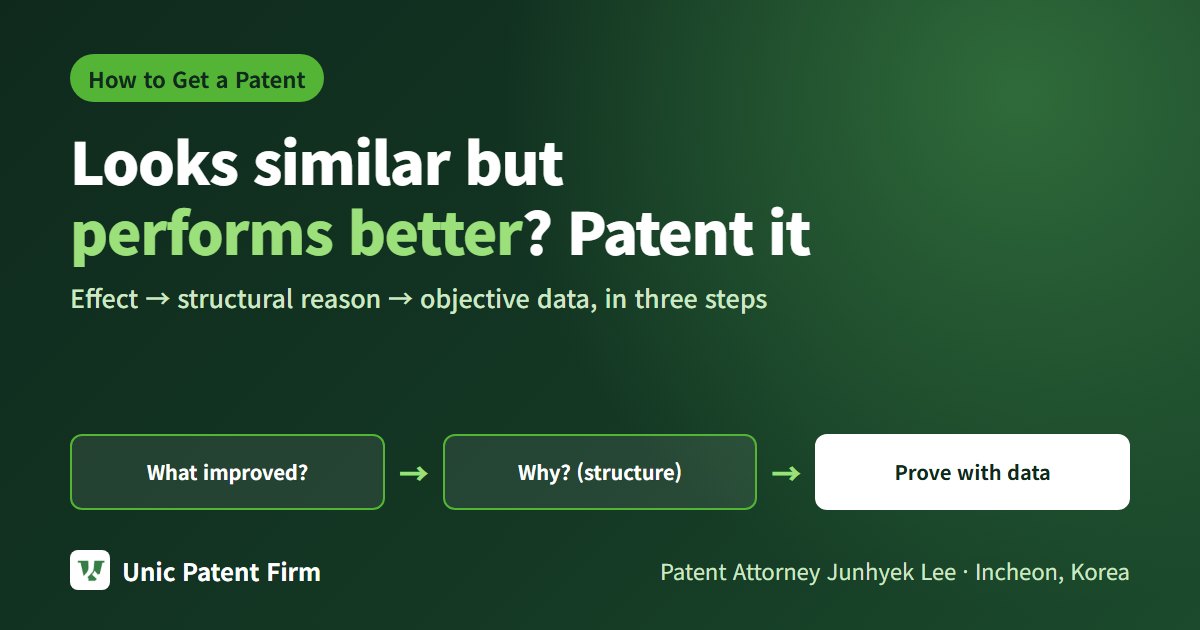
One concern we hear constantly in practice: "Our product clearly performs better, but its visible structure is almost the same as existing products. Can it be patented?"
This comes up especially often from manufacturers and companies developing machinery, measuring equipment, food and materials. In this article, Unic Patent Firm in Cheongna, Incheon, explains in three steps how to obtain a patent when an adapted product performs better.
1. First, Pin Down What Improved and by How Much
What "better performance" means differs by field.
| Field | Examples of better effects |
|---|---|
| Measuring equipment | Higher precision, better reproducibility, easier measurement, faster measurement |
| Machinery and tools | Greater ease of use, simpler structure (fewer parts), safer operation |
| Food and food production equipment | Better taste (richer coffee, more even flavor), health functions (sweet taste with less sugar), easier production |
The first step is to set out what improved and how.
2. Find the Specific Reason the Performance Improved
A patent is easier to obtain when it explains why the effect is better. Rather than "it got better," show why, in terms of a change in structure or process.
| Case | Previous problem | Structural change | Result |
|---|---|---|---|
| Precision of measuring equipment | Samples stuck to the inner walls, reducing precision | Reduced the inner surface area and changed to a structure that leaves no residue | Smaller equipment, yet precision up by more than 50% |
| Ease of use | A horizontally mounted bar tilted down easily under concentrated load | Changed to an upward incline of 20° | Wider usable range and better load stability → much easier to use |
3. Prepare Objective Data Proving the Improvement
Words alone are not enough. Use data, tests, experiments and drawings wherever possible.
| Field | Supporting evidence |
|---|---|
| Measuring equipment | Precision and reproducibility test data |
| Machinery and tools | Drawing comparisons, explanations of structural differences |
| Food, pharmaceuticals, materials | Antibacterial test reports, coffee concentration measurements, taste test results, tensile strength, wear resistance and elasticity tests |
Objective figures and graphs make the case much more persuasive and improve your chances.
4. The Supreme Court Also Looks at the Distinctive Effect of Small Differences
A completely new structure can often be registered with a detailed explanation and drawings alone. But if the product adapts an existing one with little visible difference, the following strategy is essential:
- Clearly present the difference in performance and effect
- Explain why the effect improved through differences in structure or process
- Submit test data or other objective evidence
An invention must be judged by the difficulty of its overall configuration, and the distinctive effect produced by the combination must also be considered. (Gist of Supreme Court Decisions 97Hu1610 and 2001Hu2269)
So even a small structural change favors registration if it produces a distinctive effect. How to use this principle to overcome rejections for lack of inventive step is covered in Overcoming Inventive Step Rejections: Difficulty of Configuration.
Conclusion: Don't Give Up Because "the Structure Looks Similar"
If a small structural difference produces a much better effect than existing products, you can — and should — get a patent. In recent practice, effect-centered and data-centered patents are becoming more important. If you quantify the performance gain and explain it through differences in structure or process, registration is entirely possible.
If you need help organizing performance data, explaining effects or planning your specification, Patent Attorney Junhyek Lee of Unic Patent Firm in Cheongna, Incheon, can help directly.
Does this apply to your business?
The answer depends on your product, filing schedule and contracts. Talk to a patent attorney directly.
This article is for general information only. Specific cases may be assessed differently depending on the facts. It is based on Korean law as of the publication date.