
Inventive Step for Functional Compositions, Chemical and Pharmaceutical Inventions: Proving Unexpected Effects
Junhyek Lee, Patent Attorney, Unic Patent Firm · 2025.11.12
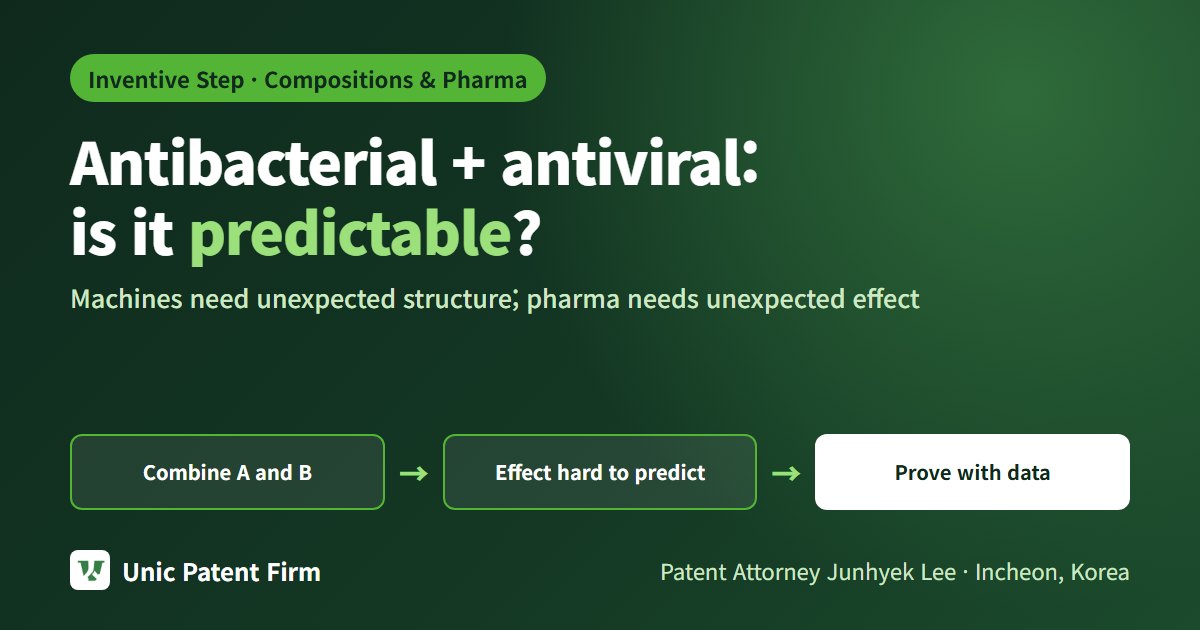
One of the most common terms in patent examination is inventive step. But how it is judged differs considerably by technical field.
In this article, Unic Patent Firm in Cheongna, Incheon, uses examples to show how inventive step is judged differently for antiviral compositions and functional substances than for mechanical and IT inventions.
1. The Basics — "Could a Skilled Person Easily Make It?"
Inventive step asks whether a person skilled in the art could easily have made the invention from the prior art at the time of filing. If it could be easily conceived by slightly modifying existing technology, it may be rejected.
Inventive step must be judged not element by element but by the overall technical idea in which the elements are organically combined, also considering the distinctive effect obtained from the whole configuration. (Gist of Supreme Court case law, including 2005Hu3284)
2. Inventive Step in Mechanical, Electronic and IT Fields
Consider an invention for "a drone that delivers information despite jamming using multi-hop communication of a mesh network module." If mesh networking and routing technologies are already known, the examiner may find it "a combination a skilled person could easily apply."
In mechanical and IT fields, then, simply combining known technologies or offering only predictable effects makes inventive step hard to establish. Technical differences and effects that are hard to predict must be clear.
3. Functional and Antiviral Compositions Are Different
In chemistry, biotechnology and pharmaceuticals, unpredictability is far more important in judging inventive step. Take antiviral compositions as an example.
- Prior paper 1: "Ingredient A has antibacterial activity."
- Prior paper 2: "Ingredient B has antiviral activity."
Given these two papers, could one predict that the combination A+B is effective against a specific virus (e.g., a coronavirus)?
3.1. Not every antibacterial substance works against viruses
- A review in Current Opinion in Colloid & Interface Science (Falk et al., 2019) explains that "not all surfactants always show antibacterial effects, and not all microorganisms are equally sensitive to surfactants."
- Studies in Antiviral Research (Romanowski et al., 2013) and the Journal of Hygiene (Wood & Payne, 1975) found that quaternary ammonium compounds (QACs) were effective against enveloped viruses (herpes, influenza, etc.) but had almost no effect on non-enveloped viruses (polio, adenovirus, etc.), and that inactivation efficiency varied greatly by virus type even for the same QAC.
So "antibacterial" and "antiviral" are different concepts, and a substance's effect on herpes does not guarantee an effect on non-enveloped viruses.
4. Mechanical and IT Inventions vs Functional Compositions and Pharmaceuticals
| Item | Mechanical and IT inventions | Functional compositions and pharmaceuticals |
|---|---|---|
| Technical structure | Physical configurations, circuits, algorithms | Chemical compositions, molecular structures |
| Predictability of effects | High (results easy to predict) | Low (unexpected interactions possible) |
| Key to inventive step | Difficulty of combining known technologies, difference in effects | Experimental data, proof of synergy |
| Core evidence | Technical differences, improvements | Biological data, statistical significance |
Mechanical results are relatively predictable, but antiviral composition results are harder to predict, so proving the effect can itself be the core basis for inventive step.
Conclusion: Machines Need Unexpected Configurations; Pharma and Chemistry Need Unexpected Effects
Inventive step is judged differently by field. In mechanical and IT fields, an unexpected configuration matters; in pharmaceutical and chemical fields, an unexpected effect matters. So for antiviral composition patents, combining ingredients is not enough — you must prove the effect objectively with experimental data. Unpredictable effects are the real strength of a patent.
If you need help filing or defending inventive step for functional composition, chemical or pharmaceutical inventions, Patent Attorney Junhyek Lee of Unic Patent Firm in Cheongna, Incheon, can help directly.
Does this apply to your business?
The answer depends on your product, filing schedule and contracts. Talk to a patent attorney directly.
This article is for general information only. Specific cases may be assessed differently depending on the facts. It is based on Korean law as of the publication date.