
Security Technology Through AI and Encryption Patents: Four Pillars That Stop Hacks
Junhyek Lee, Patent Attorney, Unic Patent Firm · 2025.10.30
Security incidents keep coming, from card company hacks to breaches of government agencies. In a recent government case, hackers stole certificates held by individuals and used them to break into government networks; in the card company case, WAS (web application server) vulnerabilities and attacks disguised as normal traffic were the problem.
In this article, Unic Patent Firm in Cheongna, Incheon, uses actual patent filings to look at how security patent technology against such attacks has evolved — in other words, how AI, encryption and web security technologies are combined.
1. Four Technology Pillars of Security Patents
| Category | Core technology | Keywords |
|---|---|---|
| (1) Web application security | Blocking SQL injection, code integrity verification, virtual patching | WAF, web security |
| (2) AI-based traffic detection | Machine learning anomaly detection, proxy and tunneling analysis | AI, ML, detection |
| (3) Authentication and real-time response | Multi-factor authentication, session protection, behavioral authentication | Authentication, session security |
| (4) Financial data protection | Tokenization, encryption, distributed data storage | Encryption, data protection |
2. Web Application Security — Directly Addressing WAS Vulnerabilities
| Title | Application No. | Applicant | Main content |
|---|---|---|---|
| Web application security system and security method using the same | 10-2009-0069345 | CodeOne → Korea Technology Finance Corporation | Security module that detects and blocks web attacks such as SQLi and XSS in real time |
| System and method for detecting and blocking web attacks | 10-2018-0063747 | F1 Security | Machine learning-based web attack detection and automatic blocking |
| Internet remote web application security system | 10-2005-0037853 | Monitorapp | WAS security gateway analyzing web traffic patterns |
These patents are core technologies that directly address WAS vulnerabilities (attacks on web application servers). Because virtual patching can block attacks even when security patches are late, they are seen as a technical answer to incidents caused by unapplied patches.
3. AI-Based Anomalous Traffic Detection — Countering Attacks Disguised as Normal Traffic
| Title | Application No. | Applicant | Main content |
|---|---|---|---|
| Security device based on web application server transaction information and session ID | 10-2016-0040328 | Lee Seok-woo | Analyzes session-based transaction anomalies, detects abnormal traffic |
| Security device using web application transaction information | 10-2016-0040323 | Elevisor | AI analysis to detect disguised attacks via proxies and tunneling |
| Cloud-based application security verification service | 10-2015-7005358 | Intel Corporation | Integrated AI verification of code and traffic in the cloud |
AI-based security technology catches hacking disguised as normal traffic. Its hallmark is using machine learning to distinguish attacks such as proxy, VPN and tunneling attacks that are hard for conventional signature-based equipment to detect, making it the most effective response to "intrusions disguised as normal traffic."
4. Authentication and Real-Time Blocking — Defending Against Account Theft and Session Hijacking
| Title | Application No. | Applicant | Main content |
|---|---|---|---|
| Authentication method and system | 10-2012-0073635 | Douzone Bizon | Multiplies user authentication steps to prevent internal account takeover |
| Smart card browser-based access security system | 10-2011-7023435 | Gemalto SA | Protects session security and authentication procedures, optimized for finance |
It overcomes the limits of older structures in which action was taken only after a person approved what the AI detected, implementing real-time detection → authentication check → automatic blocking. This is key to defending against account theft and session hijacking in the financial sector.
5. Financial Data Protection — "Unrecoverable Even If Leaked"
| Title | Application No. | Applicant | Main content |
|---|---|---|---|
| Terminal based on a secure web browser via a virtual web server | 10-2011-0135280 | Minigate | Encrypted channels and data tokenization |
| Secure access control for embedded devices | 10-2018-7017175 | Robert Bosch GmbH | Data access control based on tokenization and multiple encryption |
This "tokenization + encryption" structure makes the original data unrecoverable even if it leaks. Payment information such as card numbers and CVCs is stored in split form, and a one-time encryption key is used during transactions. Since leaked data cannot be restored, damage is minimized.
6. Technology Trends at a Glance
| Category | Representative application | Core technology | What it counters |
|---|---|---|---|
| Web application security | 10-2009-0069345 | SQLi blocking, code integrity | WAS vulnerabilities |
| AI-based detection | 10-2016-0040328 | Traffic pattern analysis | Attacks disguised as normal traffic |
| Real-time authentication | 10-2012-0073635 | Multi-step authentication | Session hijacking |
| Financial encryption | 10-2011-0135280 | Tokenization, encryption | Neutralizing data leaks |
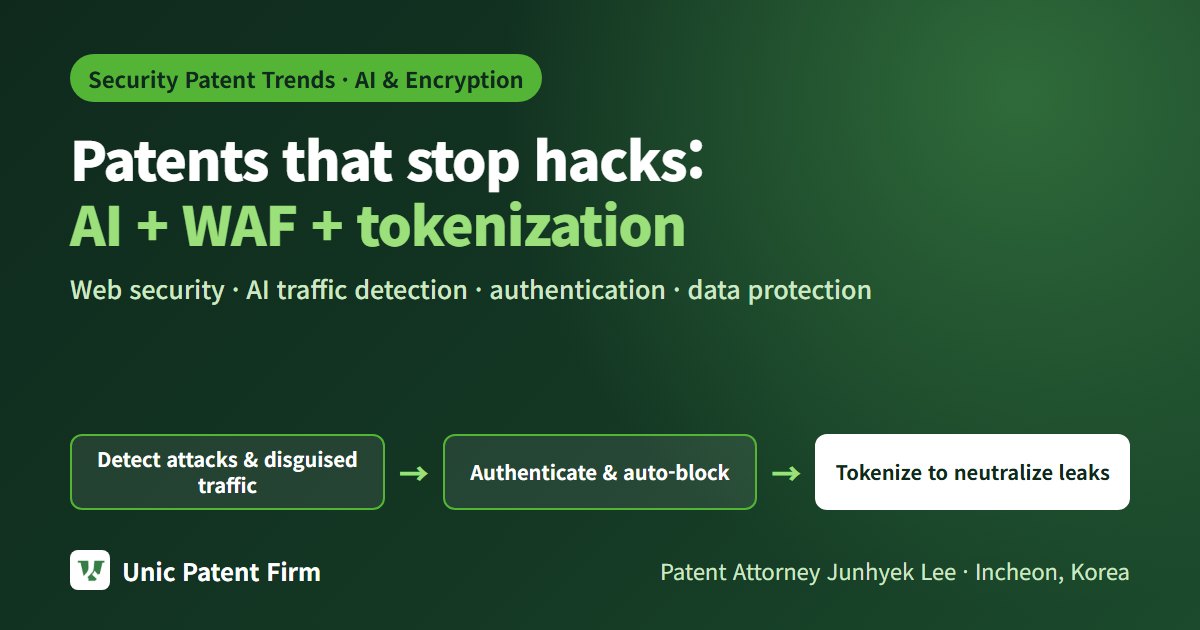
The common trend in 2024–2025 patent data is a converged "AI + WAF + tokenization" structure, meaning a full-cycle defense from hack detection → authentication → data protection.
Conclusion: Complex Attacks Need Combined Defenses — and Patents to Match
Recent hacks are complex attacks combining "delayed patches + traffic disguised as normal + data leakage." Defending against them requires AI-based traffic anomaly detection, web application security with virtual patching, and tokenization and encryption together, and patents are in fact being filed around these technologies.
If you need patent filings or prior art searches for security, authentication or encryption technology, Patent Attorney Junhyek Lee of Unic Patent Firm in Cheongna, Incheon, will review them directly.
Does this apply to your business?
The answer depends on your product, filing schedule and contracts. Talk to a patent attorney directly.
This article is for general information only. Specific cases may be assessed differently depending on the facts. It is based on Korean law as of the publication date.