
Chatbots vs AI vs Generative AI: What Each Is and What Patents Can Protect
Junhyek Lee, Patent Attorney, Unic Patent Firm · 2025.09.10
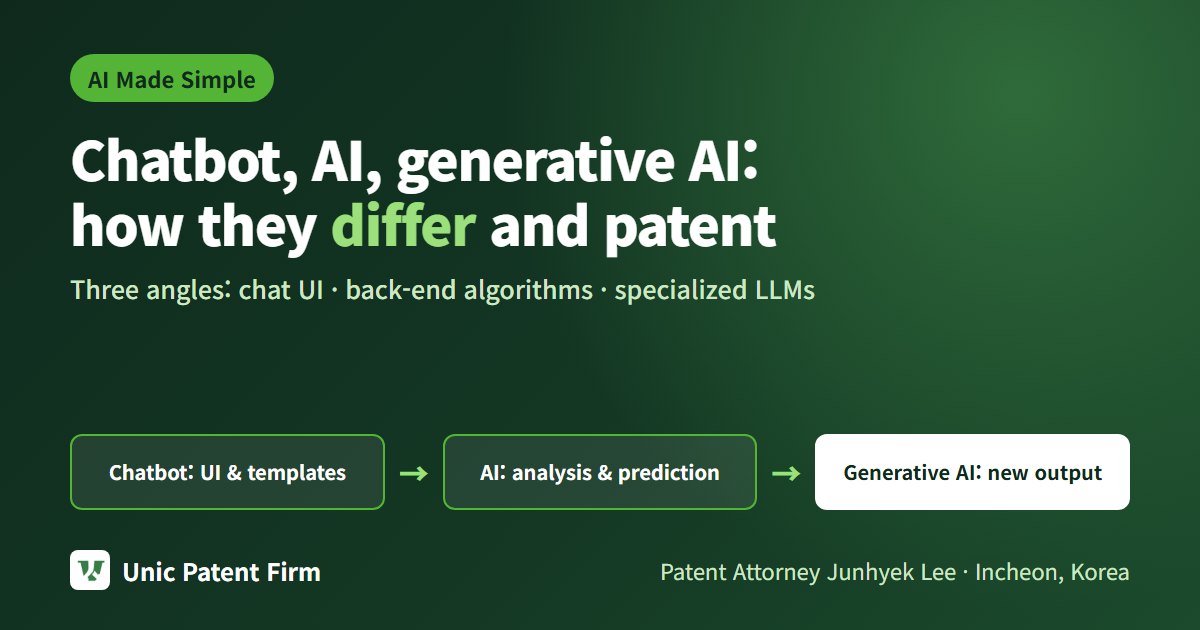
These days we constantly hear "AI," "chatbot" and "generative AI." But it is easy to get confused about how the three differ and where they overlap.
In this article, Unic Patent Firm in Cheongna, Incheon, explains the differences between chatbots, artificial intelligence (AI) and generative AI in plain terms, and how each can be protected by patents.
1. Chatbots — The Customer Service Agent
1.1. Conventional chatbots
A chatbot is a program that automatically answers user questions by text or voice. It need not be AI; it can work with nothing more than prewritten scenarios (FAQ answers).
- Banking app chatbot: "Tell me my balance" → gives a fixed answer
- Hospital booking chatbot: "When can I book?" → outputs results from a database
User → enters a question → [chatbot UI] → outputs a pre-registered answer
1.2. Recent chatbots with natural language processing
| Older chatbots | Latest chatbots |
|---|---|
| Keyword matching → always the same answer to the same question | Natural language processing (NLP) + machine learning → understands questions with similar meaning and phrases answers to fit the context |
- More varied answer templates: instead of one sentence, several templates are chosen randomly or by condition (e.g., "Hello, how can I help you?" / "Welcome, what do you need help with?").
- Combined with generative AI: recent corporate chatbots connect generative AI such as GPT on the back end to give richer, context-aware answers, which vary somewhat with prompt conditions and conversation history.
1.3. How do chatbots and generative AI differ?
| Chatbot | Generative AI |
|---|---|
| Basically "chat UI + templates" → answers are standardized, though NLP and ML allow varied expression | Generates new sentences every time → can give entirely different contextual answers to the same question |
Recent chatbots have more varied answers, but that variety stays within a set frame and context. Creating new sentences and outputs is the domain of generative AI.
2. Artificial Intelligence (AI)
AI refers broadly to "technology that imitates human intelligence." The goal is to let machines perceive → understand → judge → learn → predict and decide.
| Main technology | Content | Example |
|---|---|---|
| Machine learning (ML) | Learns rules from data to classify and predict | Spam detection |
| Deep learning | Neural network analysis of images, speech and language | Face and speech recognition |
| Expert systems | Rule-based decision-making | Medical diagnosis support |
| Recommender systems | Learn user preferences | Movie recommendations |
AI focuses on analysis, judgment, classification and prediction. Its output is not a new creation but a data-based "inference of the right answer."
3. Generative AI
A subfield of AI that learns from existing data and then "generates" new content. Its core is creativity: going beyond classification and judgment to create new text, images, music and code.
| Main technology | Examples |
|---|---|
| Large language models (LLMs) | ChatGPT, Claude → text generation |
| Image generation models | Midjourney, Stable Diffusion → images and designs |
| Voice and video generation | TTS (text-to-speech), AI avatars → synthesized voice and video |
| Multimodal AI | Integrated output combining text, images and sound |
- Generates a different answer to each question (very high variability).
- Takes a prompt as input and produces results in real time.
- Output is not a mere copy of existing data but a new combination or creation.
4. Comparing the Three, and What Patents Can Protect
| Item | Chatbot | AI | Generative AI |
|---|---|---|---|
| Core concept | Chat interface | Technology imitating human intelligence | AI that generates new content |
| Scope | Rule-based or simple AI | Includes machine and deep learning | Based on large language models |
| Conversation | Required | Optional | Includes conversation and content generation |
| Examples | Customer service chatbots | Spam filtering, autonomous driving | ChatGPT, Midjourney |
| Starting point | Automating conversation | Data-driven intelligence | Creative output |
| What patents protect | UI and conversation features, plus added NLP capabilities | Systems and algorithms (back-end technology) | LLM training specialized for a field, and conversation, analysis and output generation using it |
Conclusion: Broad Rights From Three Angles, Technology in Stages
Looking at your technology from three angles — chatbot (UI and conversation), AI (back-end algorithms) and generative AI (specialized LLMs and output generation) — lets you secure broad rights. You might start with a scenario-based chatbot or AI that provides analysis and evaluation in early development, then expand to generative AI that proposes scenarios and outputs on its own.
If you are considering patent strategy for an AI or chatbot service, Patent Attorney Junhyek Lee of Unic Patent Firm in Cheongna, Incheon, will review it directly.
Does this apply to your business?
The answer depends on your product, filing schedule and contracts. Talk to a patent attorney directly.
This article is for general information only. Specific cases may be assessed differently depending on the facts. It is based on Korean law as of the publication date.