
Can You Protect an Unregistered Brand in Korea? A Prior Use Right Case Analyzed
Junhyek Lee, Patent Attorney, Unic Patent Firm · 2025.06.25
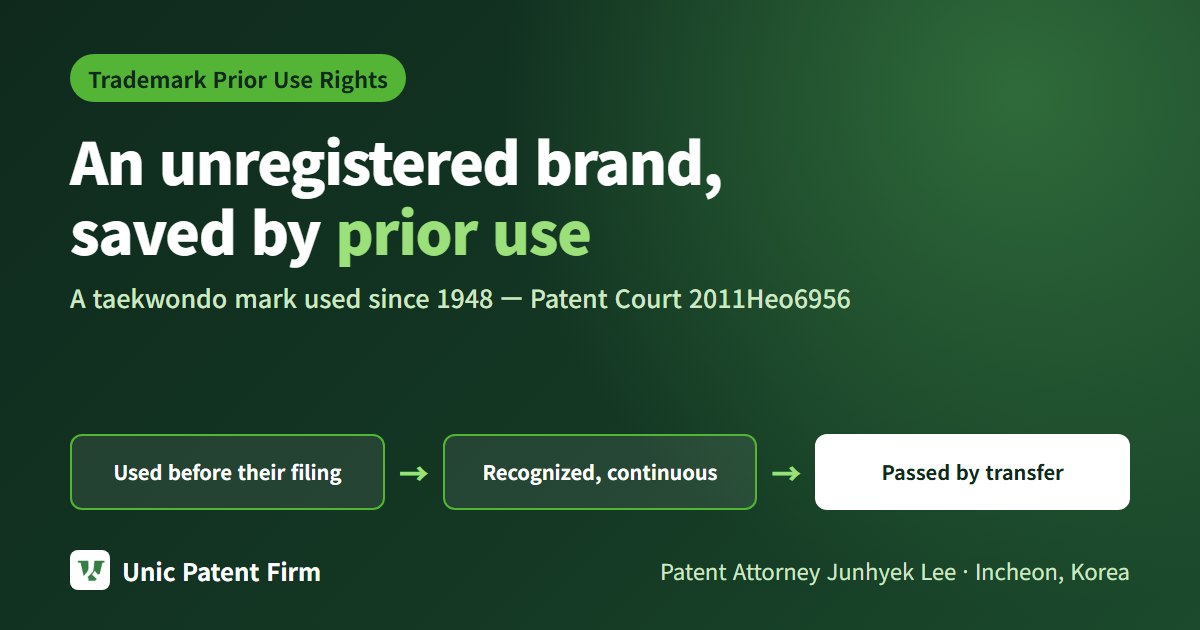
As a rule, a trademark is protected only once registered. Is there no way, then, to protect a brand you have used for years without registering it?
In this article, Unic Patent Firm in Cheongna, Incheon, explains the meaning and requirements of prior use rights and examines a real case (Patent Court 2011Heo6956) recognizing prior use rights in a taekwondo equipment mark used since 1948.
1. What Is a Prior Use Right?
If you had been using a mark in Korea continuously before someone else filed it, and the mark was already recognized by consumers as indicating a particular person's goods, you may continue using it even after the other person registers it.
It adds an element of use-based protection as an exception to the basic registration-based principle of trademark law, protecting those who genuinely used a mark without an unfair competitive purpose and preventing the harm of copycat marks being registered later.
2. Requirements
Where the other party has registered the mark and you are using it without registration, all of the following must be met:
| Requirement | Content |
|---|---|
| Use before the other's filing | You were using the mark in Korea before the other party filed |
| No unfair competitive purpose | You used it without intending unfair competition |
| Continuous use | You used it continuously in Korea |
| Consumer recognition | At the other party's filing date, Korean consumers recognized the mark as indicating a particular person's goods |
| Identical or similar goods | You use it on goods identical or similar to those of the registered mark |
| Succession | The user's position can pass through a business transfer, and the mark's recognition passes to the new owner |
3. The Case — Patent Court 2011Heo6956
The issue was whether the defendant's challenged mark fell within the scope of the plaintiff's (successor intervenor's) registered mark; the defendant claimed a prior use right. The basic requirements and succession were the key points.
3.1. Timeline
| When | Events |
|---|---|
| 1948 | The trade name "Solpyo Sangmusa" began to be used on taekwondo uniforms and equipment |
| 1989 | An acquirer established Solpyo Sangmusa Co. and continued using the challenged mark for taekwondo equipment |
| 2000 | Solpyo Sangmusa Co. went bankrupt → "Sangmusa" acquired the business and continued using the mark |
| Mar. 10, 2006 | The plaintiff filed the mark, registered on Oct. 27 the same year (exploiting the gap after others' marks had lapsed) |
| Oct. 2009 | The defendant, Pinetree Sangmusa Co., acquired Sangmusa's business and continued using the mark |
| 2010 onward | The plaintiff filed a criminal complaint and a scope confirmation trial, all dismissed → then brought this suit |
3.2. The court's judgment — prior use right recognized
The court found that the defendant held a prior use right under former Trademark Act Article 57-3 (now Article 99).
- Long continuous use: used continuously from 1948 through successive business transfers to the defendant; on the plaintiff's filing date (Mar. 10, 2006), Sangmusa was still using it.
- No effect from others' intervening marks: the plaintiff argued that use while another person's marks were registered (registered 1983 and 1985) was unlawful, but since use began much earlier, in 1948, those registrations did not interrupt or negate the prior use right.
- Continuity regardless of dissolution: even though Solpyo Sangmusa Co. was deemed dissolved, Sangmusa acquired the business after the bankruptcy and kept using the mark, so use continued.
- Valid business transfer: considering the transfer documents, the business was validly transferred to the defendant company, not to an individual.
3.3. Evidence of consumer recognition
- Taekwondo equipment exported to the US and featured in catalogs
- Catalogs produced for overseas buyers and distributed domestically
- Counterfeits imitating the mark made and sold in China
- Korean consumers mistaking the plaintiff's uniforms for the defendant's and inquiring
- Domestic shipments of about KRW 90 million in 2008–2009; exports of over KRW 10 billion in 2000–2006
- Official agreements with World Taekwondo to supply equipment
4. Points to Watch When Claiming a Prior Use Right
- You need evidence of use (invoices, advertising, signage, packaging, etc.).
- In a dispute, the area or range of goods you may use can be limited.
- Prior use rights are not automatic; you must assert and prove them, for example in infringement litigation.
Conclusion: Prior Use Is a Last-Resort Shield — Registration Comes First
This case shows that even without registration, if you have used a mark steadily for a long time and the market recognizes it as a particular brand, your right to keep using it can be protected even if someone later registers an identical or similar mark. It also matters that the prior use right can pass on through changes in corporate form or business transfers as long as actual use continues.
Still, a prior use right is a defense you must prove after a dispute arises. To remove the risk of disputes, filing and registering the mark is far more reliable. Prior use and other non-infringement exceptions in responding to warning letters are covered in Trademark Warning Letters (Part 1). If you want to protect a brand you have long used, consult Patent Attorney Junhyek Lee of Unic Patent Firm in Cheongna, Incheon.
Does this apply to your business?
The answer depends on your product, filing schedule and contracts. Talk to a patent attorney directly.
This article is for general information only. Specific cases may be assessed differently depending on the facts. It is based on Korean law as of the publication date.