
Deepfakes and AI Security Patents: What 98 Korean Patents Reveal
Junhyek Lee, Patent Attorney, Unic Patent Firm · 2025.06.18
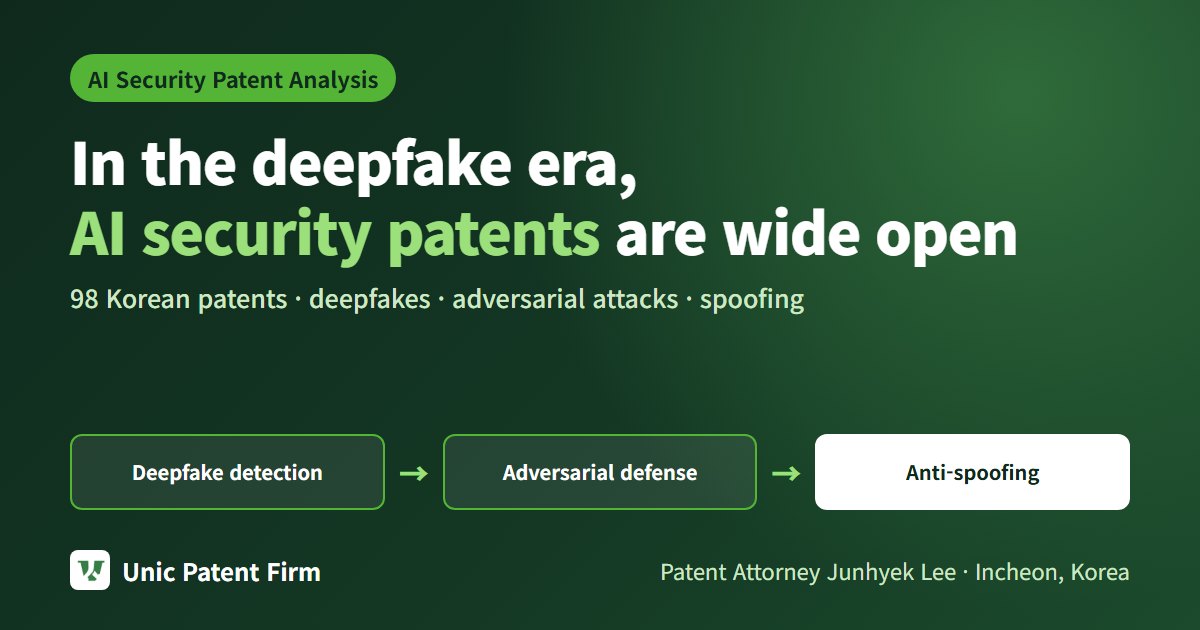
Face-swapped videos (deepfakes) made with generative AI are being used in crimes impersonating politicians, celebrities and ordinary people. With telecom hacks and large-scale personal data leaks occurring at home and abroad, AI security has become essential.
In this article, Unic Patent Firm in Cheongna, Incheon, explains what AI security is and its core technologies (deepfake detection, adversarial attack defense and anti-spoofing), and shares the results of analyzing 98 Korean AI security patents and what they suggest.
1. What Is AI Security?
AI security has rapidly gained attention technically, legally and industrially, and is closely tied to the development of generative AI. It divides into two branches.
| Item | Security using AI | Security of AI itself |
|---|---|---|
| Meaning | Using AI for security purposes (intrusion detection, face recognition, etc.) | Protecting AI when it is itself the target of attack |
| Examples | Face recognition access systems, AI anomaly detection | Defending against adversarial attacks, preventing model theft |
| What is protected | People and systems | AI algorithms, training data, model outputs |
2. Three Core Technologies of AI Security
2.1. Deepfake detection
- Background: as GAN (generative adversarial network)-based deepfakes advance, video manipulation has become so precise that real and fake are hard to tell apart.
- Technology: deep learning detects video, audio and images in which faces, voices or behavior have been manipulated.
- Examples: Meta's (formerly Facebook) Deepfake Detection Challenge (DFDC) released a dataset of more than one million deepfake and real videos, with systems to block content and warn users when deepfakes are found. Microsoft's Video Authenticator scores the probability of a deepfake for each frame, judging by facial boundaries, distortion and afterimages.
2.2. Defending against adversarial attacks
- These attacks make tiny manipulations to a deep learning model's input so the AI makes a wrong judgment — for example, an image that looks the same to people but makes the AI see a cat as a turtle.
- They can induce malfunctions in autonomous vehicles, surveillance and authentication systems and financial models, posing security threats.
- Example: IBM's patent US10204457B1 identifies nodes in a CNN model that are vulnerable to attack in advance, adds a security layer that detects and filters adversarial inputs, and automates the defense by integrating it into training.
2.3. Anti-spoofing
Technology that detects and blocks attempts to fool biometric or AI-based authentication systems with forged biometric data or devices, using sensor-based methods, AI behavioral analysis and multimodal techniques.
3. How Korean AI Security Patents Have Evolved
| Period | Main content | Main applicants |
|---|---|---|
| Before 2020 | Traditional encryption, network and file protection patents | Somansa, ETRI, Hancom, etc. |
| Taking off from 2019 | AI-based security detection and defense (AI hacking detection, intrusion prevention, stronger authentication) | E2ON, LG, Comtrue Technologies, KETI, etc. |
Until AI emerged, security centered on traditional encryption and network and file protection. As AI was commercialized, problems such as deepfakes and spoofing arose, and AI security patents to address them have been filed in large numbers since the late 2010s.
Method: Korean patents were searched with AB=[(artificial intelligence+ai)*(security+spoofing+adversarial+deepfake)], and 98 patents directly related to AI security were selected
4. Results From 98 Korean AI Security Patents
4.1. Filings by year — surging since 2021
Filings have risen sharply in recent years, especially since 2021, reflecting intensifying competition in technology development and patenting as AI and security grow in importance. At the time of the survey, most filings from 2023 onward were not yet published, so the real increase is likely even larger.
4.2. Main applicants — SMEs, mid-sized companies and universities lead
- Specialist companies: led by the top filer IGLOO Corporation (a mid-sized security management company), with SoftFreak (security solutions) and KEPCO KDN (an energy ICT public company) among those specializing in particular fields.
- Large companies: Samsung, LG and others filed only two patents, showing little activity in this field so far — possibly because they focus on fundamental security of their own AI platforms or adopt outside solutions.
- Universities: industry-academic foundations at Sangmyung, Soongsil, Hallym, KAIST and others rank high, indicating that foundational and next-generation research is led by academia.
In short, Korea's AI security ecosystem has SMEs and mid-sized companies leading commercial technology while universities conduct forward-looking research on future threats.
4.3. By technology field
| Category | Patents | Share |
|---|---|---|
| Security systems | 68 | 80.9% |
| Adversarial attacks | 10 | 11.9% |
| Deepfakes | 4 | 4.8% |
| Spoofing | 2 | 2.4% |
"Security systems" means traditional security technology such as encryption. Filings on adversarial attack defense have grown since 2020, but development against new AI security threats such as deepfakes and spoofing is not yet active.
5. What Korean AI Security Patents Tell Us
5.1. A wide gap with global companies on new threats
- Korea: in the data analyzed, all adversarial attack and deepfake patents were filed by universities and research institutes (KAIST, Hallym, Soongsil, etc.), with none from companies — they have not yet turned into commercial patent portfolios.
- Global: big tech companies such as Microsoft, Google and Intel have filed adversarial defense patents that strengthen AI models themselves for years, building technology barriers.
- Korean security companies lag global players such as CrowdStrike and Palo Alto in solution coverage, technology and overseas sales, so building AI security patent competitiveness is the challenge.
5.2. The market is early, so opportunities remain
- More R&D: research in AI security areas such as adversarial attacks and deepfakes needs to expand.
- Startup opportunities: companies licensing universities' foundational technology, or researchers founding startups directly, are promising models, and such deep-tech startups are attractive to investors.
- Niche markets suited to Korea: B2B deepfake detection for stronger non-face-to-face identity checks in finance, fake news detection for media and copyright protection for content platforms is set to grow quickly. The deepfake detection market was worth several billion dollars as of 2023, with annual growth of 30–40% expected. Adversarial defense specialized for AI in manufacturing, healthcare and smart cities, where Korea is strong (e.g., preventing interference with smart-factory vision inspection AI or attacks inducing misdiagnosis by medical AI), is another differentiated niche.
- A global patent strategy: don't stay in the domestic market; file in major countries such as the US and Europe from the early stages of development.
Conclusion: In the Deepfake Era, AI Security Patents Still Have Plenty of Open Space
Korean AI security patents have grown quickly since 2021, but most cover traditional security systems, and company patents on new threats such as deepfakes, spoofing and adversarial attacks are still rare. That is an opportunity for companies that secure patents in this field first.
If you need patent filings or an overseas filing strategy for AI security, deepfake detection or biometric authentication, Patent Attorney Junhyek Lee of Unic Patent Firm in Cheongna, Incheon, will review them directly.
Does this apply to your business?
The answer depends on your product, filing schedule and contracts. Talk to a patent attorney directly.
This article is for general information only. Specific cases may be assessed differently depending on the facts. It is based on Korean law as of the publication date.