
Filing a Business Emblem in Korea: Can a Non-Profit Group Be the Applicant?
Junhyek Lee, Patent Attorney, Unic Patent Firm · 2025.10.25
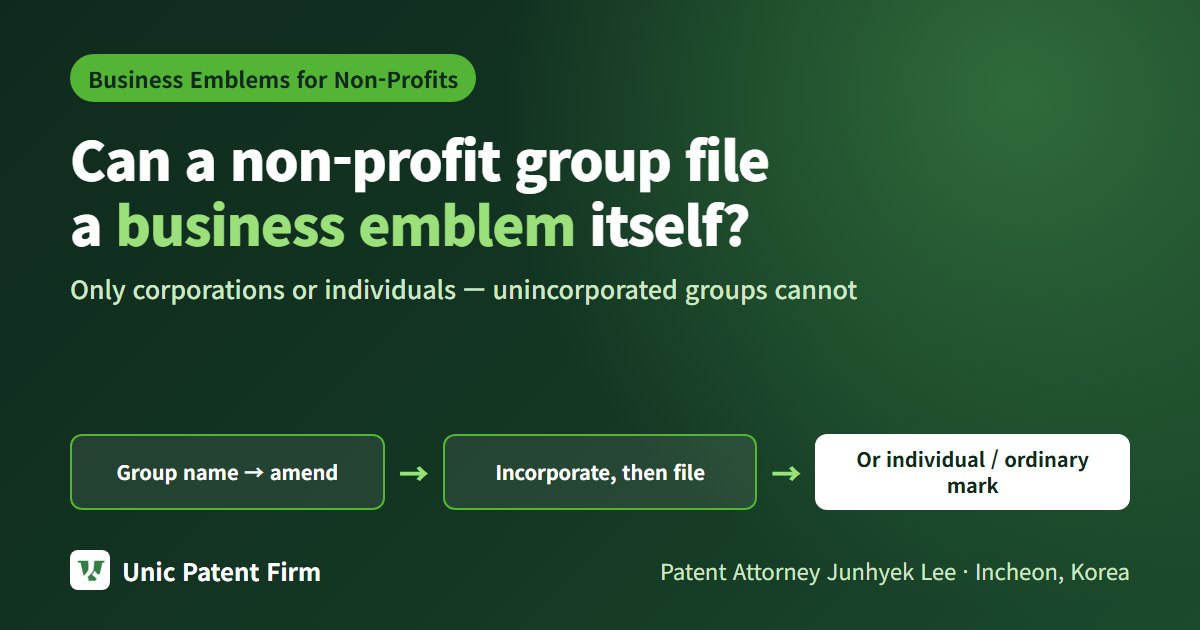
We are getting more inquiries from non-profit civic groups holding a tax identification number who want to "file a business emblem in the group's name."
Under the Korean IP office's examination guidelines (70101), however, a business emblem — a mark for non-profit activities — can be filed only by a corporation or an individual (natural person); groups without legal personality cannot file. In this article, Unic Patent Firm in Cheongna, Incheon, explains applicant eligibility, the business emblem system and how to respond, with a real case.
1. A Real Case — A Non-Profit With Only a Tax ID Number
A volunteer group held the following documents:
- A non-profit civic organization registration certificate from the Ministry of the Interior and Safety
- A unique (tax) identification number certificate from the National Tax Service
The group filed a business emblem in its own name, but it was an organization without legal personality. In such cases, the office issues a request for amendment or a refusal and asks that the applicant be changed to an individual or a corporation.
2. Why Business Emblems Matter
- Legally protecting the mark symbolizing the group's credibility
- Preventing unauthorized use of similar names by third parties
- Avoiding confusion of names in sponsorship, donations and public-interest projects
- Stronger public-interest protection than ordinary trademarks
Name protection is especially important for public projects, welfare programs and educational institutions.
3. Definition and Legal Basis
| Item | Content |
|---|---|
| Legal basis | Korean Trademark Act, Article 2(1)(ix) and Article 3(6) |
| Definition | A mark used by a person engaged in non-profit business to indicate that business |
| Applicant | A corporation or an individual (natural person) |
| Designated business | Non-profit "business" such as welfare, education or volunteering, not goods |
| Purpose | Protecting credible marks of non-profit groups and institutions and preventing unauthorized use |
Ordinary trademarks protect the source of goods and services, while business emblems protect marks for non-profit activities based on public interest and credibility. That is why applicants are limited to corporations and individuals, and unincorporated groups are not eligible.
4. Applicant Eligibility in Practice
| Applicant | Eligible? |
|---|---|
| Corporation | Yes — school foundations, incorporated foundations, social welfare corporations, etc. |
| Individual | Yes — the founder can file in their own name (but examination is careful) |
| Unincorporated group | No — subject to a request for amendment or refusal |
4.1. Summary of the guidelines
- The provision that "only a person engaged in non-profit business in Korea may obtain registration of a business emblem" is interpreted strictly; filing in a group's name alone is not allowed. For filings in a group's name, the office sends a request to change the applicant to an individual (the representative) or a corporation.
- If filing as an individual, you must prove that you yourself carry out the non-profit business related to the designated business, using materials issued or recognized by credible bodies such as government agencies or local governments. This also applies when a representative or member submits materials showing that their group or corporation carries out non-profit business.
5. How to Resolve the Case
| Option | Description | Feasibility |
|---|---|---|
| Keep the group as applicant | Not possible for groups without legal personality | ❌ Refused |
| Amend to an individual | Amend to the representative's own name | △ Possible but strictly examined |
| Incorporate, then file | Establish a non-profit corporation and file in its name | ✔ Most stable |
| File an ordinary trademark | File an ordinary mark in an individual's name instead | ⚠ Possible but less credible |
In practice, refiling after obtaining legal personality or filing an ordinary trademark is realistic. Note, however, that a business emblem application cannot be converted into an ordinary trademark application, so you must file anew.
Conclusion: The Surest Route Is "Incorporate, Then File a Business Emblem"
- Obtain legal personality → file a business emblem: establish an incorporated foundation or association and file in its name — the strongest protection for the group's mark.
- File an ordinary trademark: in the founder's or representative's name — less credible than a business emblem, but you secure trademark rights.
- Business emblem in an individual's name: possible, but requires supporting documents and very strict examination.
If you are considering how to protect a non-profit's name or logo, Patent Attorney Junhyek Lee of Unic Patent Firm in Cheongna, Incheon, will review the right applicant and approach directly.
Does this apply to your business?
The answer depends on your product, filing schedule and contracts. Talk to a patent attorney directly.
This article is for general information only. Specific cases may be assessed differently depending on the facts. It is based on Korean law as of the publication date.