
A Lipstick Case vs a Ballpoint Pen: When Are Articles Identical or Similar in Design Law?
Junhyek Lee, Patent Attorney, Unic Patent Firm · 2025.08.27
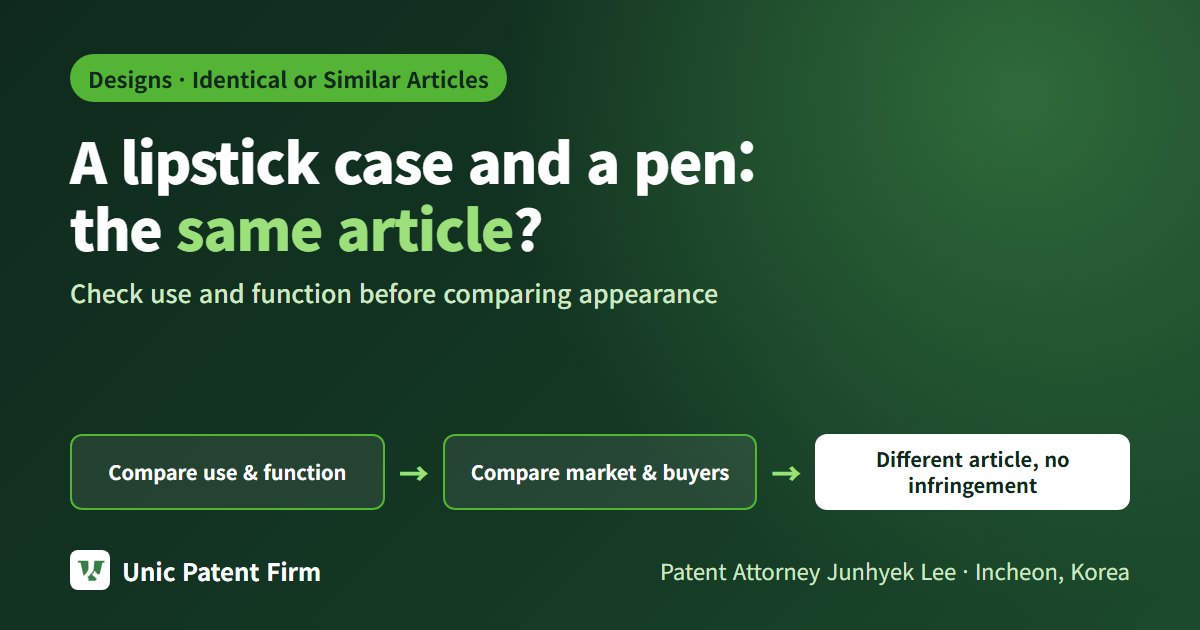
A client recently asked: "The front of the ballpoint pen we plan to produce looks very much like another company's lipstick case. Could that be a problem?"
Can a design infringe when it resembles a different kind of article? In this article, Unic Patent Firm in Cheongna, Incheon, explains how the identity or similarity of articles is judged and applies it to this case.
1. Designs Are Compared Only Between Identical or Similar Articles
1.1. Korea
Whether designs are identical or similar is judged only between designs for identical or similar articles (Korean IP office design examination guidelines). So if the articles differ, in principle there is no infringement no matter how alike they look.
1.2. Elsewhere
| Region | Test | Lipstick vs pen |
|---|---|---|
| United States | Ordinary Observer Test — an ordinary observer must be likely to be confused within the same product category | Different product categories, so not compared |
| EU | Informed User Test — the overall impression on an informed user | Different contexts (cosmetics vs writing instruments) → different market areas → no infringement |
2. Identity and Similarity of Articles — Korean Examination Guidelines
- Design similarity is judged only between identical or similar articles.
- Identical articles: identical shape, pattern and color → identical design; similar → similar design
- Similar articles: similar shape, pattern and color → similar design; otherwise dissimilar
- Dissimilar articles: dissimilar designs regardless of shape, pattern or color
Here, identical articles share the same use and function, and similar articles share a use but differ in function. Even dissimilar articles may be treated as similar if they can be used interchangeably.
| Category | Definition | Examples |
|---|---|---|
| Identical articles | Same use and function | Ballpoint pen vs disposable ballpoint pen |
| Similar articles | Same use, different function | Ballpoint pen vs fountain pen (writing; different ink supply) / desk clock vs wristwatch (telling time; different form and wearing) / desk lamp vs light fixture (lighting; different installation) |
| Interchangeable dissimilar articles → similar | Different use and function, but interchangeable in use | Cutlery holder vs pencil case (both used as "containers") / phone case vs wallet (both hold cards and cash) |
| Dissimilar articles | Different use and function | Flowerpot vs umbrella |
3. Applying It — Lipstick Case vs Ballpoint Pen
| Factor | Lipstick case | Ballpoint pen |
|---|---|---|
| Appearance | Similar cylindrical shape and removable cap → similar if you look at appearance alone | |
| Use and function | Cosmetics | Writing instrument |
| Sales channels | Beauty stores | Stationery stores |
| Consumers | Cosmetics buyers | General consumers, office workers |
Because use, function, market and consumers all differ, the articles are not identical or similar, and design infringement is unlikely.
Conclusion: Check the Article Before Comparing Appearance
Design infringement analysis first asks whether the articles are identical or similar, before comparing appearance. Even if they look alike, different articles mean no infringement. As here, a lipstick case and a ballpoint pen are not identical or similar articles despite their resemblance, because their use, function, market and consumers differ. How appearance is compared between the same articles is covered in the food storage container design case.
Unic Patent Firm supports pre-launch similarity reviews, prior design searches and comparisons of foreign design systems. If you are worried about design infringement before launch, consult Patent Attorney Junhyek Lee of Unic Patent Firm in Cheongna, Incheon.
Does this apply to your business?
The answer depends on your product, filing schedule and contracts. Talk to a patent attorney directly.
This article is for general information only. Specific cases may be assessed differently depending on the facts. It is based on Korean law as of the publication date.