
Understanding Madrid International Trademark Filings: Registering in Many Countries With One Application
Junhyek Lee, Patent Attorney, Unic Patent Firm · 2025.06.04
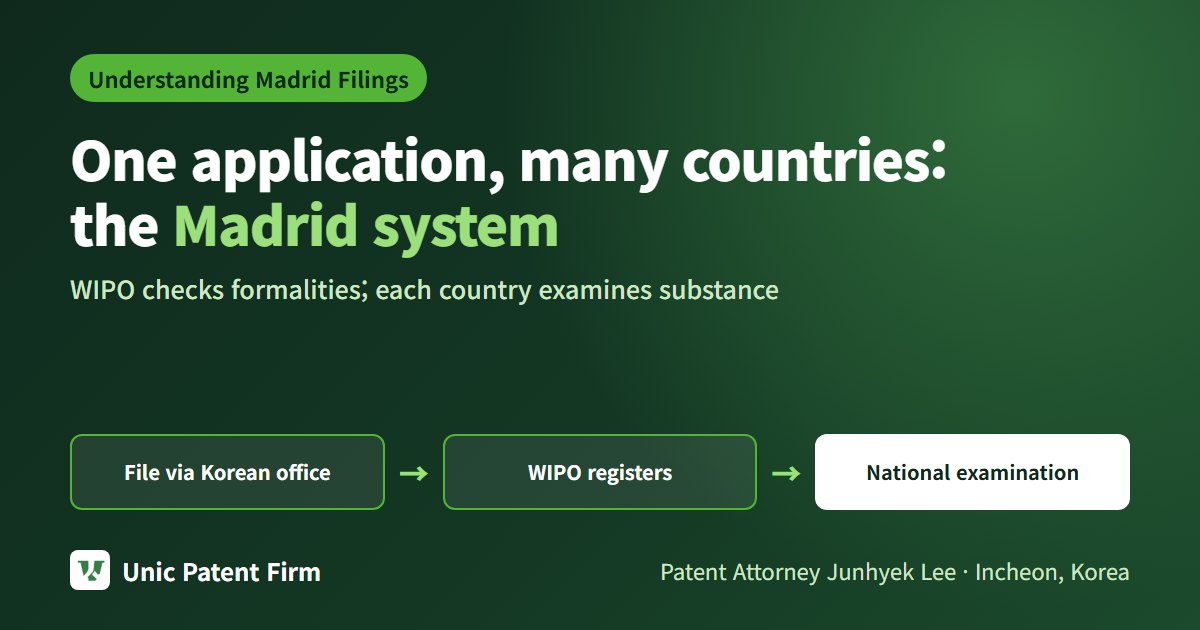
"Can't we register our trademark in several countries with a single application?" asked the CEO of a medical startup. Companies preparing to expand abroad want to register in the US, Japan, Europe, China and elsewhere, but filing country by country takes a lot of time and money.
The system that lets you secure trademark rights in many countries with one application is the Madrid international trademark system. In this article, Unic Patent Firm in Cheongna, Incheon, explains what it is and how to use it to secure foreign rights efficiently.
1. What Is a Madrid International Application?
It is an international trademark system run by WIPO (the World Intellectual Property Organization) that lets you file a mark in more than 100 countries, including Korea, at once. Its advantages are a simple procedure and savings in cost and time compared with filing separately in each country.
2. Requirements and Procedure
2.1. Requirements
- You must have a basic mark in Korea (a basic application or registration).
- You can designate more than 100 countries, including the US, the EU, Japan and China.
- Fees are added for each designated country.
2.2. Procedure
| Step | Action | Notes |
|---|---|---|
| (1) | File the international application with the Korean IP office | Requires a Korean basic application or registration |
| (2) | Formality check by the Korean IP office | Basic formal review |
| (3) | Transmission to WIPO's International Bureau | The Bureau assigns a number |
| (4) | International registration and publication by WIPO | Sent to designated countries after registration |
| (5) | Examination and registration in each designated country | Each country decides on registration |
You can file online through the Korean IP office's e-filing system (patent.go.kr), or on paper in person or by mail.
3. Who Examines the Mark?
3.1. WIPO checks formalities only
- It reviews only whether the application meets formal requirements (basic application data, designated countries, fee payment, etc.).
- It records the mark in the International Register (assigning the international registration date) and sends the information to the designated countries.
- It does not decide whether the mark should actually be protected.
3.2. Each designated country examines substance
After international registration, each designated country examines registrability independently under its own laws.
| Item | What is examined | Example |
|---|---|---|
| Conflicts with prior marks | Whether the mark conflicts with identical or similar earlier marks | Refusal in Japan over a prior registered mark |
| Clarity of goods | Vague or overly broad descriptions of goods can be refused | China often requires amendments for lack of clarity |
| Public-interest grounds | Contrary to public order, causing confusion, generic names, etc. | The US refuses vague or deceptive names |
| Use requirements | The US emphasizes use of the mark | Designating the US via Madrid requires a declaration of intent to use, and a declaration of use must be filed within a set period after registration |
If problems arise, an office action (provisional refusal) requests amendments or arguments; if not, registration proceeds country by country.
4. Average Examination Periods by Country
| Country | Examination period | Notes |
|---|---|---|
| United States | 6–12 months | Use-based; declaration of intent and evidence required |
| China | 6–9 months | Frequent requests for clarity amendments |
| Japan | 6–12 months | Focus on similar existing marks |
| EU | 4–6 months | Relative grounds raised through third-party oppositions |
| United Kingdom | 4–6 months | Similar to the EU but a separate system |
Designated countries must issue any refusal within 12 or 18 months of the international registration date; otherwise protection is granted. So examination can be shorter than with separate national filings.
Conclusion: International Registration Is Not the Finish Line
- Don't relax once the international registration is done — check each country's examination results.
- If you receive a refusal, respond with amendments or arguments through a local agent in that country.
- Search prior marks in each country before filing to avoid unnecessary refusals and wasted costs.
Madrid filing costs are covered next in Madrid International Trademark Filing Costs. If you are preparing to file trademarks abroad, Patent Attorney Junhyek Lee of Unic Patent Firm in Cheongna, Incheon, can help directly.
Does this apply to your business?
The answer depends on your product, filing schedule and contracts. Talk to a patent attorney directly.
This article is for general information only. Specific cases may be assessed differently depending on the facts. It is based on Korean law as of the publication date.